
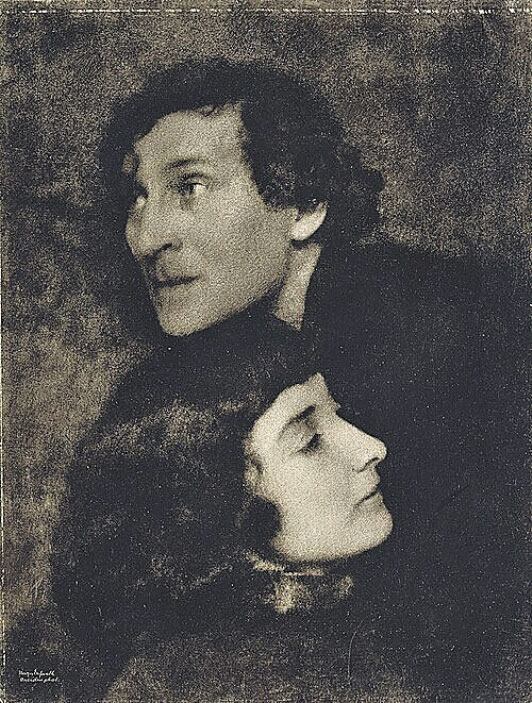
“Her silence and her eyes belong to me. It was as though she could see my childhood, present, and future all at once.” As Marc Chagall (1887–1985), the artist known as the “master of color,” revealed in his autobiography, there was a person who served as his inspiration, the subject of his admiration, and the one who completed his life and work. She was his wife, Bella Rosenfeld (1895–1944). To fully grasp Chagall, one must first meet Bella. This article follows the path of Bella, who significantly contributed to elevating Chagall to the status of a 20th-century master.
◇Love That Transcended Walls
In the fall of 1909, Chagall and Bella felt an immediate connection the moment they met. In his autobiography *My Life*, Chagall remembers that when he saw Bella, he instinctively knew, “This is my wife.” Bella also described Chagall’s eyes in her memoir as a “mysterious green-gray similar to the sky and water,” stating, “I felt as if I were drowning in his eyes, drifting on a river.”
Although their love was intense, reality remained an obstacle. Bella came from a wealthy Jewish jewelry family in Vitebsk (now in Belarus) and had studied history and literature at Moscow University, making her a highly educated and sophisticated woman for her era. Chagall, on the other hand, was the oldest of nine children, born into a Hasidic Jewish family near Vitebsk, where his father worked in a fish shop and his mother sold vegetables. He was a young, unknown painter with deep passion but no recognition. Bella’s parents strongly opposed the relationship, warning, “You will starve if you marry him.” Nevertheless, Bella visited Chagall’s studio almost every day, helping him with meals and even bringing him art supplies.
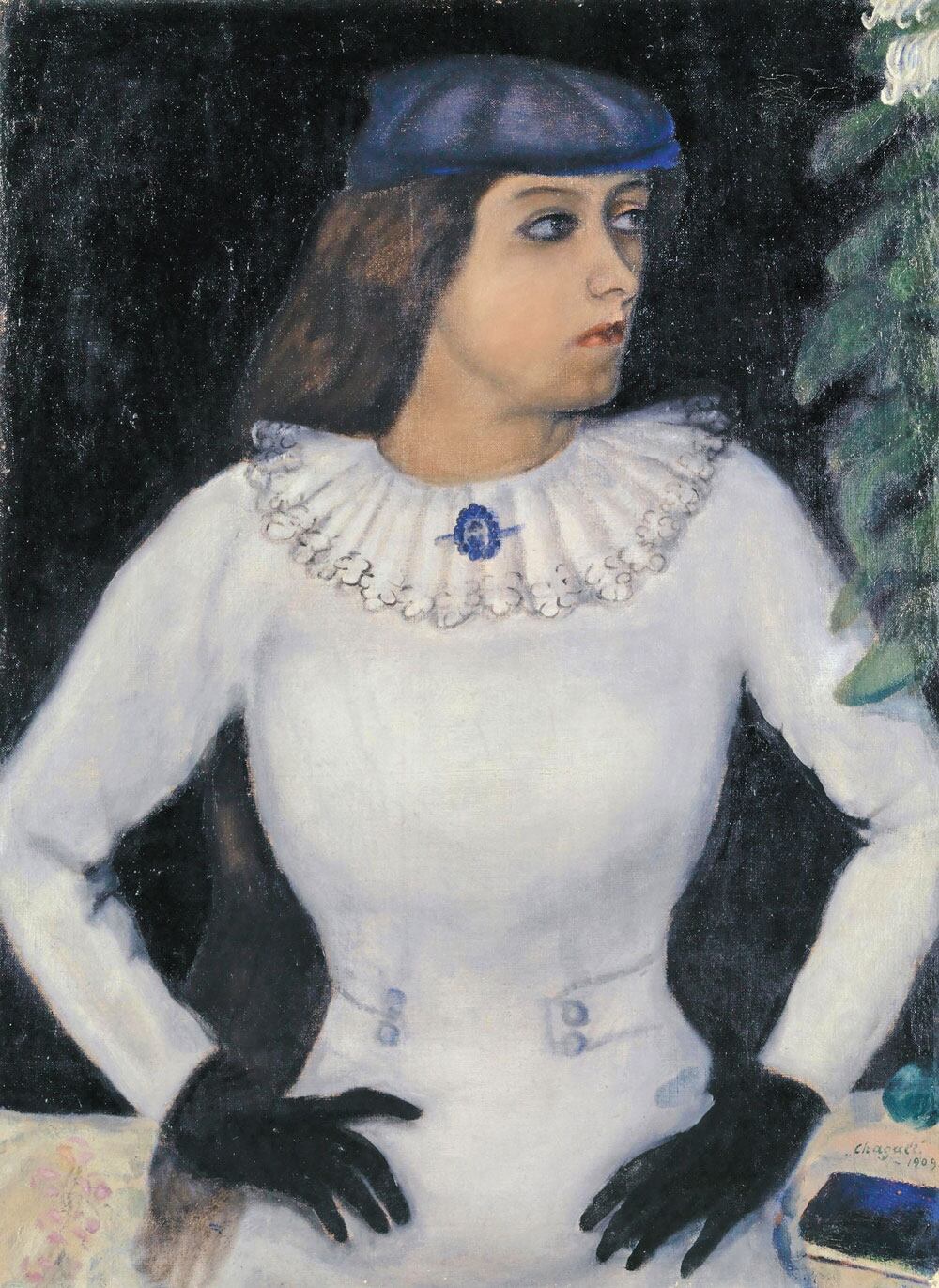
Despite facing resistance from their families, the couple eventually got engaged. A piece created during this time of lasting love was *My Fiancée with Black Gloves*. This early depiction of Bella by Chagall provides a look at the artist’s style prior to being called the “magician of color.” The strong contrast between the white dress and dark background emphasizes Bella’s grace and enigmatic presence. The black gloves, in particular, emphasize her poise and Chagall’s admiration for her. Although their different backgrounds occasionally made Chagall feel inadequate, Bella consistently acted as an intellectual guide, helping to shape his sensitivity and thoughts into more profound and expansive directions.
◇Iconic Works Arising from Bittersweet Goodbyes
Following their engagement, Chagall began exploring the broader art scene. In 1910, he was awarded a scholarship by patron Maxim Vinaver and traveled to Paris, the center of the art world during that period, where innovative movements such as Cubism and Fauvism were gaining momentum. Chagall lived at La Ruche, a gathering place for struggling artists, and interacted with avant-garde personalities like Guillaume Apollinaire and Robert Delaunay, embracing the latest trends in modern art. However, his soul always longed for his hometown, Vitebsk, and Bella.
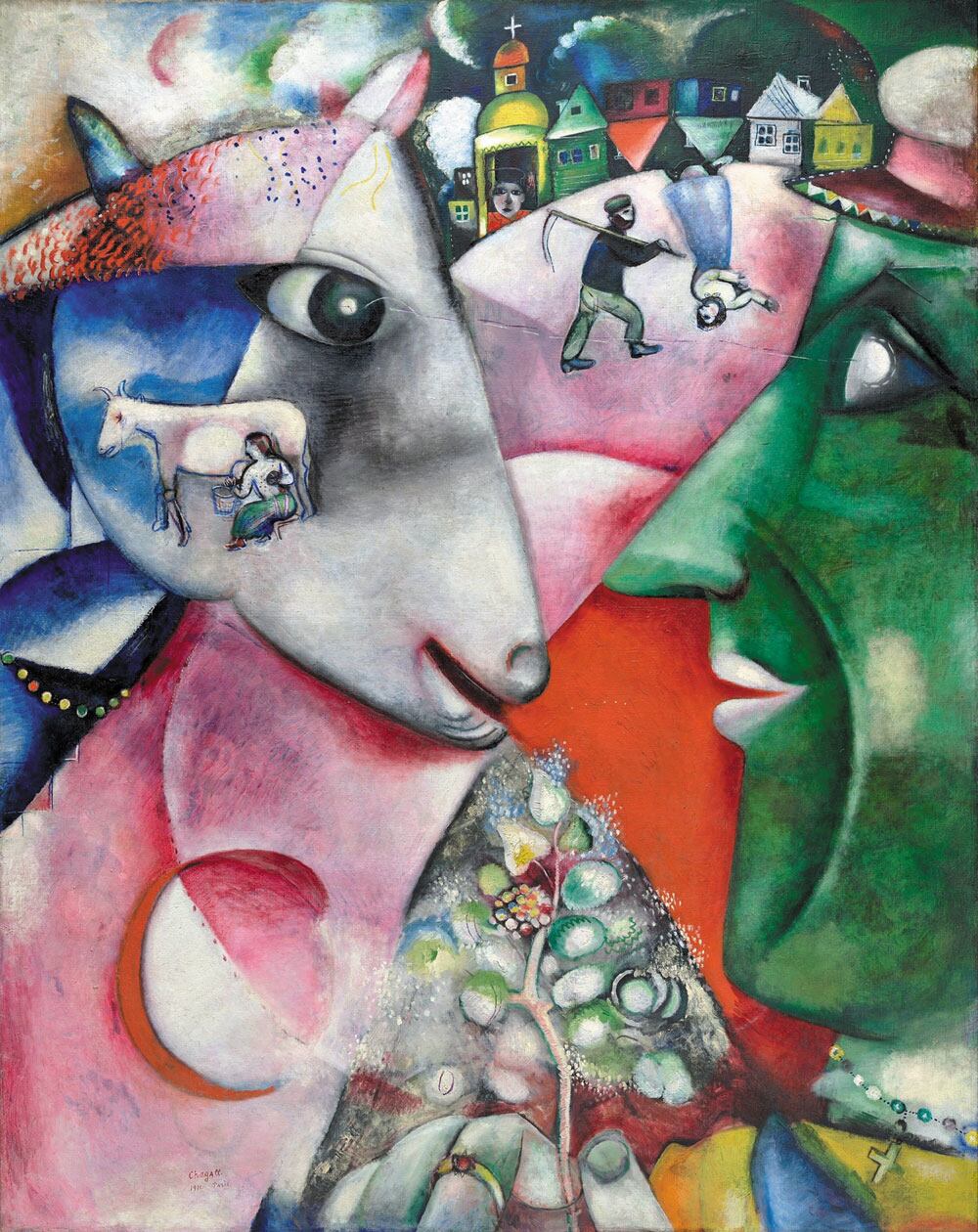
The four-year break was a time of personal development, during which Chagall adopted new artistic movements while exploring his inner being through Bella, his guiding light. This experience led to the creation of *I and the Village*, the artwork that earned Chagall international recognition. Featuring a green-skinned Chagall and a white goat looking at each other peacefully, the piece seamlessly combines Cubist methods acquired in Paris with sentimental recollections of Vitebsk, expressed through a whimsical imagination. It marks a significant point in Chagall’s journey toward becoming a master, transforming his Jewish heritage and Russian feelings into a distinctive style.
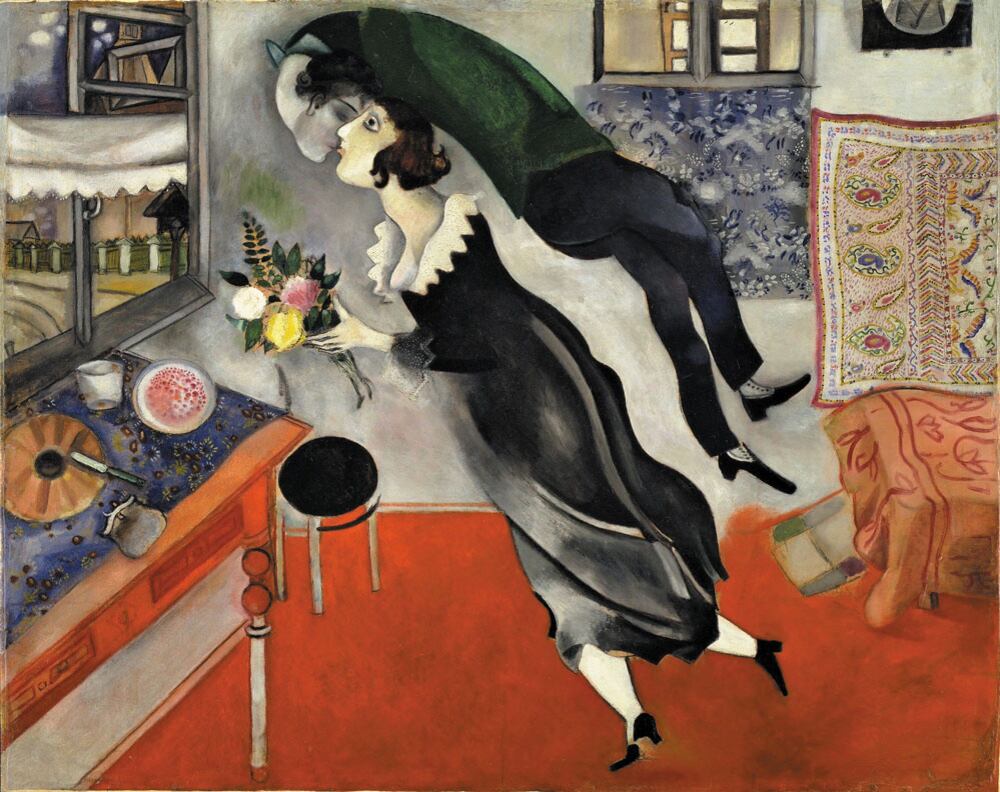
In 1914, Chagall eventually went back home and was allowed to marry Bella the next year. *The Birthday* powerfully depicts the happiness of this much-anticipated marriage. On July 7, the day before their wedding, Chagall, a struggling artist, was so absorbed in his work in his tiny room that he even forgot his own birthday. Suddenly, Bella arrived with a bouquet and a carefully made meal. In her memoir *First Encounter*, Bella poetically recounted the moment: “You stood on one leg, reaching toward the ceiling as if the small room could no longer hold you. You bent down and kissed me, and we soared over blooming fields and rooftops.” The impossible acrobatic position, which defied gravity, and the transformation of a regular space into a magical world show how his love for Bella became a source of creativity.
◇Artistic Compass, the Wife
Following their marriage, Bella took on the roles of Chagall’s advisor, critic, translator, and partner, acting as a guiding figure. The fact that Chagall relied on her “yes” and “no” as the ultimate standards for finishing his pieces highlights her essential role in his artistic process. She also served as a guide for survival, helping Chagall navigate through difficult times as an artist.
During the Russian Revolution, while Chagall headed the Vitebsk People’s Art School, he had conflicts with radical artists such as Kazimir Malevich regarding the future of art. Bella warned that aligning art with political trends might result in negative consequences, encouraging him to maintain his independent artistic principles. Aware of the danger to artistic freedom under the communist government, Bella was instrumental in persuading Chagall to leave Russia and find refuge in the West. Her proficiency in French proved especially helpful in facilitating Chagall’s entry into the Parisian art world after they moved there in 1922. When Chagall created illustrations for Gogol’s *Dead Souls* at the request of renowned art dealer Ambroise Vollard, Bella read the original text aloud next to him, linking his brushstrokes to the literary story.
In 1931, Chagall’s autobiography *My Life*, released in Paris, was a remarkable joint effort. Bella, who had studied literature at Moscow University, transformed Chagall’s unpolished, disjointed Russian text into a unified narrative. She also translated the book into French, helping Chagall establish himself as an international artistic figure.
◇One Soul, Two Expressions
Bella’s literary accomplishments were impressive. Beginning in 1935, as Nazism cast a dark cloud over Europe, she started writing in Yiddish, bringing back the rituals, holidays, and settings of Jewish homes and Vitebsk through elegant writing. The memories of the Jewish community she revived were expressed in Chagall’s paintings as feelings of memory, love, and sorrow. *Fiery Light* (1946) and *First Encounter* (1947), released after her death, are unique collaborative pieces combining Bella’s words with Chagall’s art. Critics compare their work to “two expressions from one soul.”
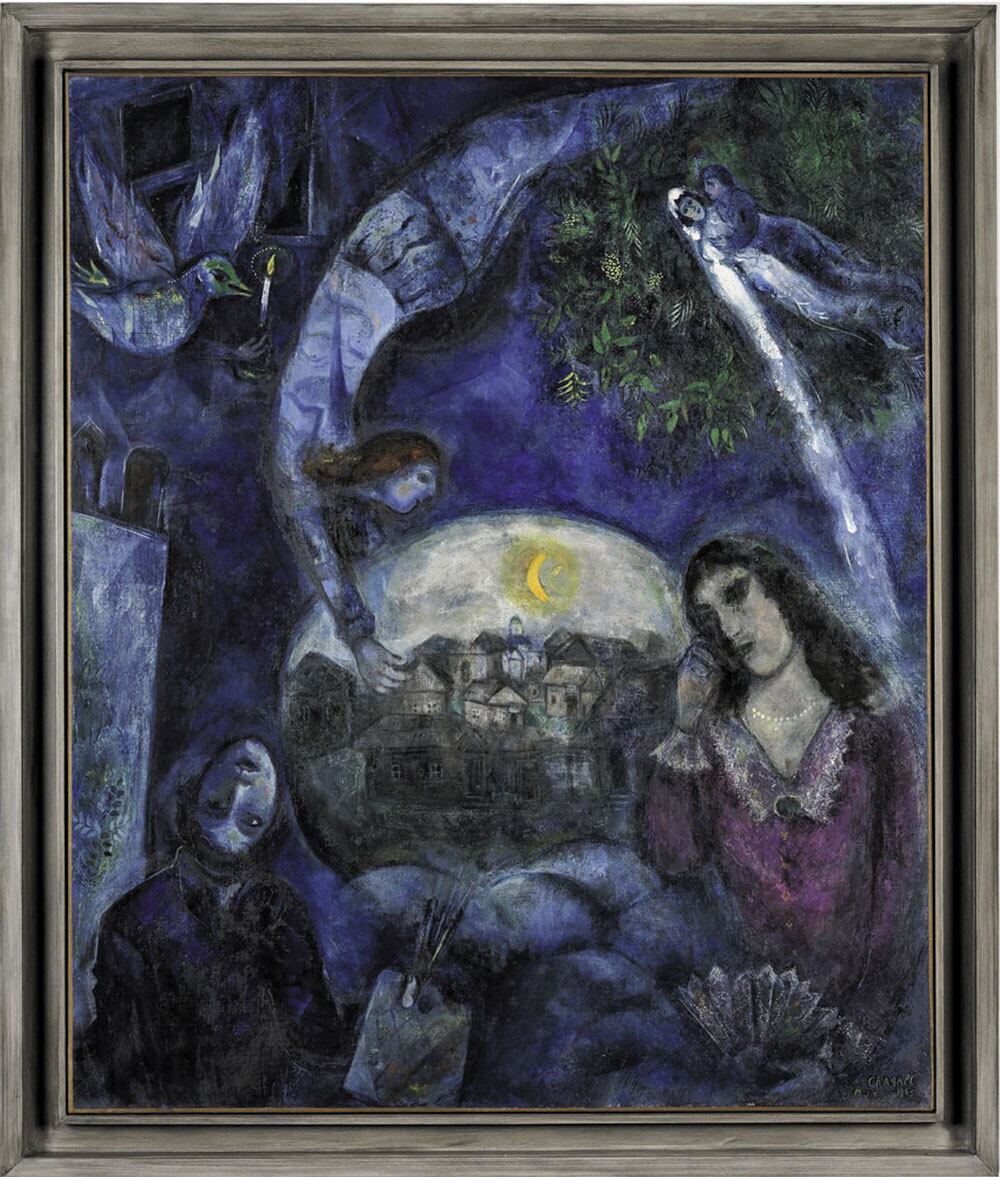
In 1944, Chagall experienced the most profound sorrow of his life when Bella passed away suddenly due to a viral illness while in exile in the United States. Overwhelmed by her loss, Chagall covered all his paintings and refrained from using a brush for nine months. The first piece created during this period of silence was *Around Her* (1945). The vibrant colors that once celebrated love were replaced with blue shades reflecting sadness and hopelessness, as the canvas was filled with yearning and grief. In the circular space, the landscape of Vitebsk is visible, and their daughter Ida soars through the sky, holding onto memories of home. Below, a young Bella wearing a pink dress holds a fan, while Chagall, with his head turned back, looks into the distance.
Throughout her lifetime, Bella was a source of love and flight; following her passing, she transformed into a representation of yearning and timelessness. She was the native land within Chagall’s heart and the unseen force that guided him into a world of fantasy. The influence of Bella remained in his creations until his death at the age of 98.




 jasdooit
Leave a comment