
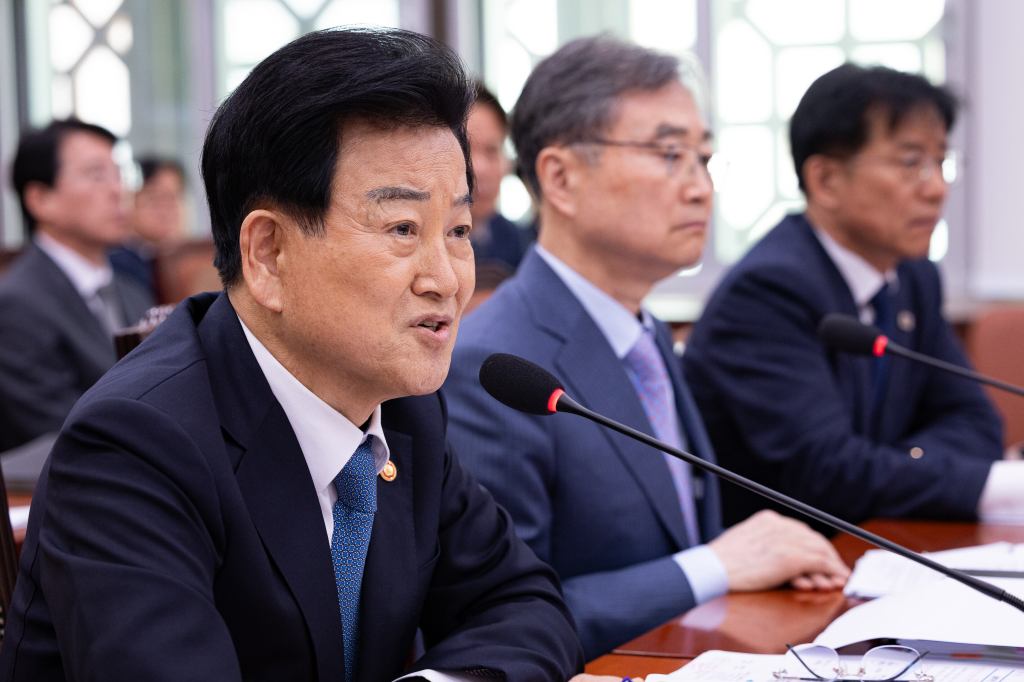
It has been verified that the U.S. side inquired with the South Korean government regarding the context of Unification Minister Chung Dong-young’s comments made last month during a National Assembly session. In his remarks, he stated that North Korea’s uranium enrichment facilities are not only located in the previously identified sites of Yeongbyeon in North Pyongan Province and Kangson in South Pyongan Province, but also in Gusan, North Pyongan Province. Minister Chung referenced a report by Rafael Grossi, the Director General of the International Atomic Energy Agency (IAEA), although it was later clarified that Grossi had only mentioned Yeongbyeon and Kangson as uranium enrichment sites and did not refer to Gusan.
South Korea and the U.S. have not officially verified Gusan as a location for a uranium enrichment plant. If Minister Chung shared information provided by the U.S. in confidence—whether on purpose or accidentally—it would be a significant problem. On the 17th, the Ministry of Unification addressed reports stating, “The U.S. objected to Minister Chung’s comments and discussed plans to limit information exchange,” by saying, “There was an inquiry from the U.S., and we explained the context behind the minister’s remarks,” but also mentioned, “We are not aware of any protest or restrictions on information sharing.” However, the U.S. seeking clarification on the background of Minister Chung’s comments can be considered a form of protest. Considering that the U.S. has previously limited information sharing with countries involved in similar situations, such actions cannot be excluded this time.
Since assuming his position, Minister Chung has consistently created tension within the alliance by pushing for changes to South Korea-U.S. joint military exercises. Last year, he stated that North Korea had 2,000 kilograms of highly enriched uranium, first referencing an intelligence agency’s estimate before later rephrasing it as “expert opinion” due to controversy. He openly disagreed with the UN Command, arguing that South Korea should have authority over DMZ entry approvals and effectively “boycotted” routine policy discussions between South Korean and U.S. officials. Domestically, he publicly opposed the UN resolution on North Korea’s human rights, which the government eventually supported, and frequently promoted the idea of a “two-state” solution for North Korea, causing embarrassment to relevant agencies. Minister Chung’s eagerness to enhance inter-Korean relations has led to a lack of trust within the alliance and internal conflicts among government departments.
His continuous focus on North Korea’s growing nuclear capabilities probably seeks to address the matter through discussions between North and South Korea, as well as between North Korea and the United States, before it becomes too late. Nevertheless, the North Korean nuclear issue has been ongoing for more than three decades. North Korea already behaves as though it has achieved the status of a nuclear-armed nation. Proceeding independently, as Minister Chung has done, will only make things worse.

 jasdooit
Leave a comment