
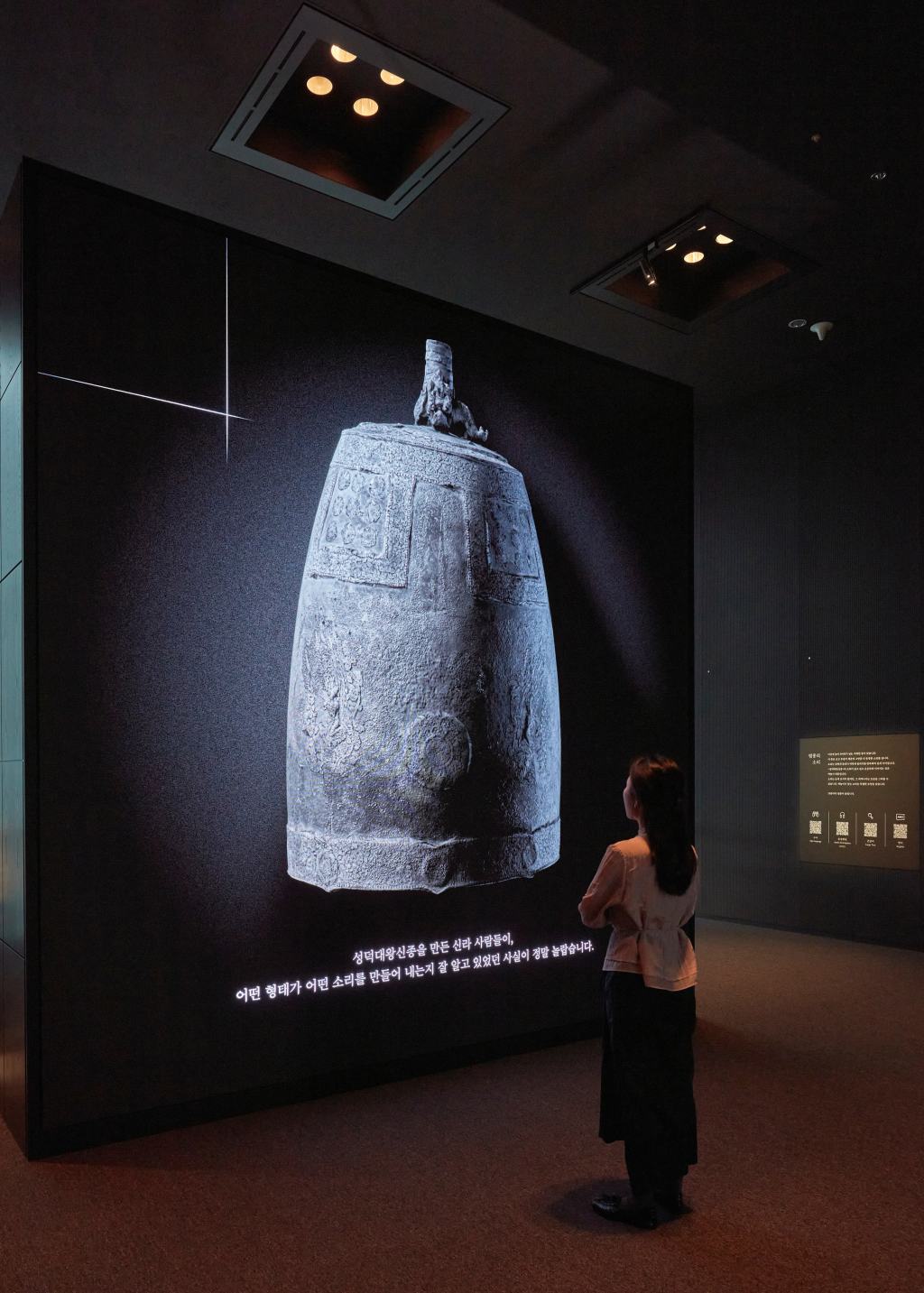
Recently, I frequently meet international tourists in the National Museum of Korea’s *Space_Between*, where the Sacred Bell of Great King Seongdeok can be heard. I believe this is a result of the impact from BTS’s new album, which features the bell’s sound in a track titled “No. 29.” Today, I heard a foreign visitor leaving the area say to their friend, “It’s truly amazing.” My generation has grown up learning about other cultures to develop empathy, so the worldwide interest in Korean traditional culture is both unexpected and impressive.
Opened in March of last year, *Space_Between* is an immersive space that was developed by repurposing a 30-pyeong rest area located between the Metal Craft Room and the Celadon Room on the third floor of the permanent exhibition hall. The name “Between” was chosen due to its location between exhibition halls, with an additional significance of connecting individuals. Although people have different physical conditions—such as vision and hearing—this space provides experiences that go beyond the visual aspect of traditional museum displays, enabling shared interactions through sound and touch. During the preparation phase, staff casually expressed the hope that people with diverse tastes and cultural backgrounds could enjoy the space together. Unforeseen at the time, the space has demonstrated the value in its name: here, National Museum of Korea Director General You Hong-june and HYBE Chairman Bang Si-hyuk listened to the bell’s sound together, bridging traditional and pop culture.
Next to *Space_Between*, the Metal Craft Room showcases a range of large and small bells. The exhibit highlights the Sacred Bell of Great King Seongdeok, an iconic Korean bell. This particular bell is one of the notable pieces in the Gyeongju National Museum’s collection. Between 2020 and 2022, the museum carried out a percussion study on the bell, and the recordings and associated materials from this project were utilized to develop the content of *Space_Between*. Particular emphasis was placed on visually illustrating the beat frequency effect, which plays a vital role in how the bell’s sound travels.
Visitors can compare the Sacred Bell of Great King Seongdeok featured in *Space_Between* with the bells on display in the Metal Craft Room. A notable characteristic of Korean bells is the cylindrical sound tube, typically located at the top. Adjacent to the sound tube is the dragon-shaped loop (yongnyu), with the dragon’s head orientation changing depending on the period. The surface designs and the structure of the sections containing inscriptions also vary across different eras. Some bells flare out in the middle like a jar and taper toward the bottom, while others gradually widen downward.






Leave a Reply