
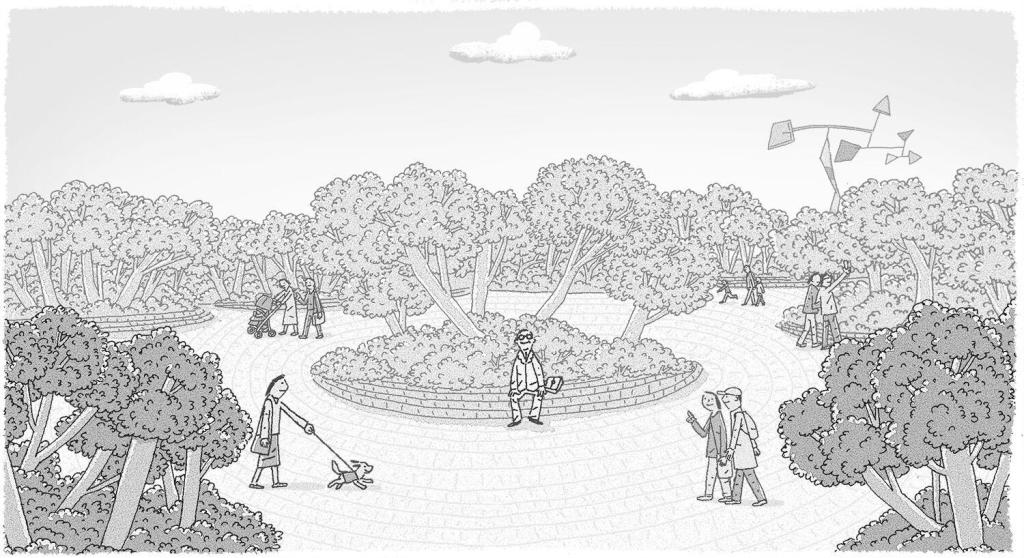
The Leeum Museum of Art in Itaewon, Seoul, is situated on a gentle slope that faces Namsan Mountain to the rear and overlooks the low-lying Han River to the front. The approximately 500-pyeong outdoor space in front of the museum serves as the museum’s front yard but also functions as the roof of the parking lot beneath it. As a result, the entire museum, including the outdoor space, resembles a large ship [ship] heading toward the ocean, with the outdoor area appearing like the ship’s bow (船首). This resemblance is even more apparent when viewed from the main road in Itaewon.
Up until this point, this open area has served as an outdoor sculpture garden, featuring large artworks by famous sculptors such as Alexander Calder, Louise Bourgeois, and Anish Kapoor, which were placed one after another, enabling guests to experience sculptures while moving between the museum and the nearby natural setting. There, visitors looked up at the massive sculptures. Individuals not familiar with sculpture might have observed the pieces with a feeling of admiration and possibly felt a bit overwhelmed.
Currently, the area has been transformed into a public garden that blends landscape, architecture, and natural beauty, offering a welcoming environment for locals. Even though it is not officially recognized as a public garden because it was not established by the government or a public organization, it can still be regarded as one since the general public is able to enter and utilize it freely. It has developed beyond just being a venue for art exhibitions into a recreational and creative space where visitors can stroll, relax, and reflect, making it a place where visitors play the central role.
The individual overseeing this project is the Mexican artist Gabriel Orozco. He studies the environment and context of the specific location where his artworks are situated to discover inspiration within them. Moreover, he does not limit himself to particular media or materials, instead using those available in the surrounding areas. Instead of magnifying objects or creating large-scale sculptures, he focuses on subtle works that rely on what already exists. Recently, through landscape projects like the ‘Orozco Park at South London Gallery’ and the ‘Environmental and Cultural Master Plan for Chapultepec Park in Mexico City,’ he has aimed to merge natural environments and public spaces into one cohesive system. This project at the Leeum Museum of Art, called the ‘Gabriel Orozco Garden,’ follows this same approach. The fundamental idea was inspired by ‘Saehan Samu (The Three Friends of Winter),’ a theme from traditional East Asian painting, taking into account the characteristics of Seoul as a location. This is because of his extended stay in Tokyo, which gave him a deep understanding of Eastern aesthetics.
Saehan Samu denotes the trio of friends who stay together during the cold winter, representing pine trees, bamboo, and plum trees that maintain their greenery or bloom despite the winter chill. These symbols embody integrity, steadfastness, humility, strength, perseverance, and hope. They also reflect the noble character of humans that remains unaltered even in difficult times. The garden features 17 pine trees, 11 plum trees, and roughly 1,500 bamboo plants, reflecting the core concept, along with other flora centered around white flowers such as white beeches, snow yews, wild roses, Yunnan asters, and water plums, forming a landscape evoking the simplicity of winter. The ground is covered with Boryeong stone sourced from Boryeong City in South Chungcheong Province. All plants and stones are indigenous to South Korea. Moreover, the garden is divided into 10 circular areas of different sizes known as ‘Plaza 1–10,’ each having unique plant arrangements, designs, and bench placements to create distinct moods. The floor covered with Boryeong stone showcases continuous geometric patterns that align with the circular layouts.






Leave a Reply