

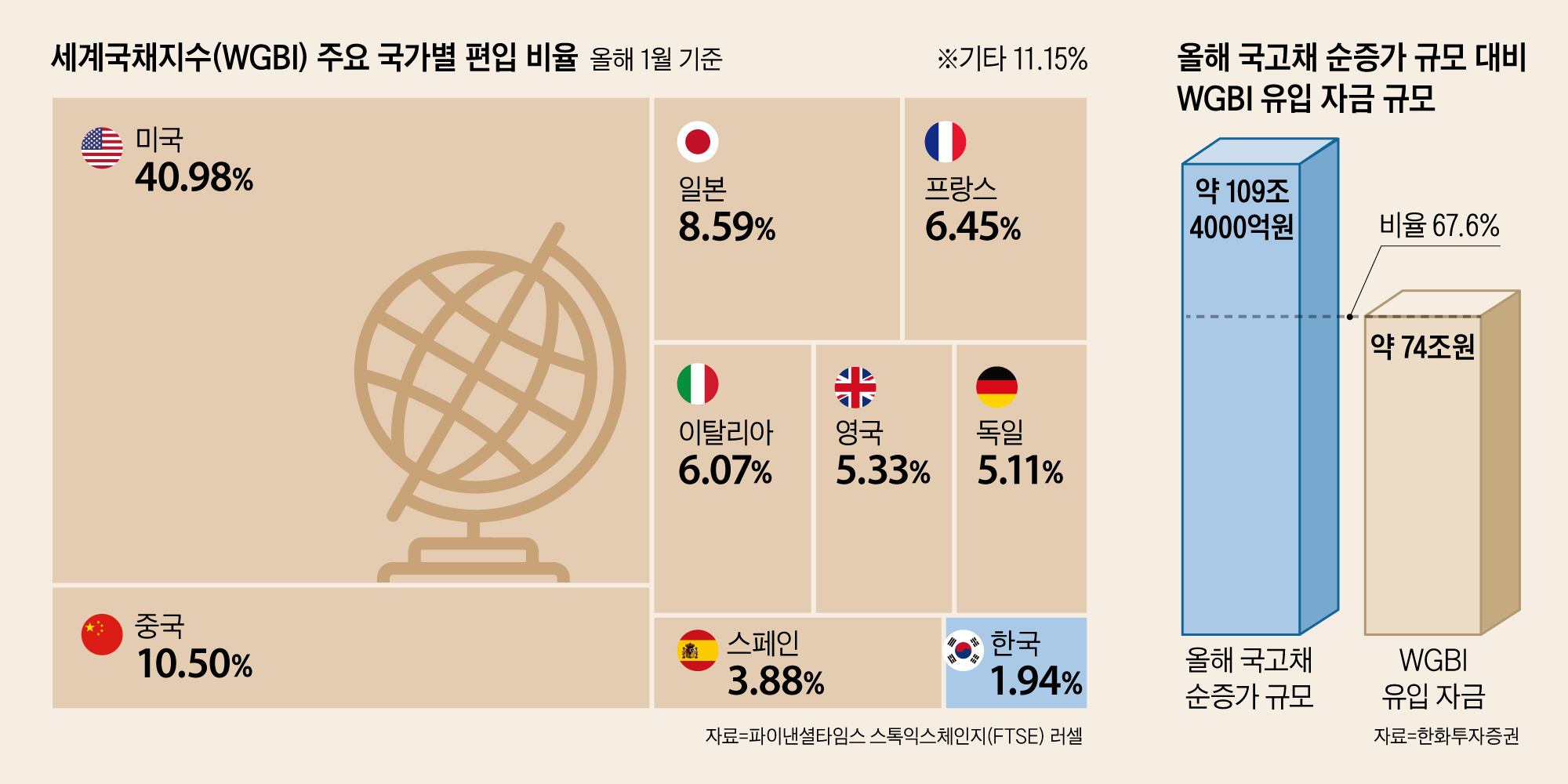
Around two weeks after South Korean government bonds were added to the World Government Bond Index (WGBI), foreign investors were noted to have made net purchases of government bonds totaling 8 trillion Korean won. The WGBI is a global bond index released by FTSE Russell, which is part of the Financial Times Stock Exchange (FTSE) in the United Kingdom. Investment funds that follow this index amount to 2.5 trillion dollars (roughly 3,700 trillion Korean won). Following the inclusion of South Korean government bonds in the index this month, there had been predictions of a substantial inflow of foreign capital, and these expectations have now come true, resulting in a stabilization of the South Korean government bond market.
◇”International Capital Arriving at 10 Trillion Won Monthly”
The Ministry of Finance and Economy stated during the third session of the “WGBI Ongoing Review and Investment Attraction Task Force” that foreign investors’ net acquisitions of government bonds between the 30th of last month and the 13th totaled 7.7 trillion won. When considering bonds not included in the WGBI, the total net purchases by foreigners since the WGBI inclusion amounted to 8.1 trillion won.
The overall foreign buying pattern was spread equally between short- and long-term bonds. According to Shinhan Securities, following the end of March, the holdings of foreign investors in government bonds based on maturity increased as follows: 2-year bonds by 1.4 trillion won, 3-year bonds by 400 billion won, 5-year bonds by 2.1 trillion won, 10-year bonds by 1.2 trillion won, 20-year bonds by 600 billion won, and 30-year bonds by 1.9 trillion won. Kim Chan-hee, a researcher at Shinhan Securities, noted, “Although foreign inflows were varied by maturity until March, they have been evenly distributed since late March, supporting passive fund inflows,” and added, “In the coming eight months, an average of 7.5 trillion to 10 trillion won is expected to be injected each month.”
Specifically, medium- to long-term bonds are anticipated to demonstrate greater resilience. The WGBI naturally assigns higher investment allocations to bonds with larger market capitalizations, and government bonds with longer maturities usually possess larger market capitalizations. Kim stated, “For medium- to long-term bonds (with maturities ranging from 10 to 30 years), where the volume of new issues is inadequate compared to market capitalization, the supply is restricted, resulting in expected stronger performance. Due to inflows into WGBI funds, the interest rates on 20- and 30-year government bonds have reversed 70% of the rate increases triggered by the Iran conflict, showing a more robust recovery than other maturities (which range between 40–50%).” Bond interest rates move inversely to bond prices, meaning that 20- and 30-year bonds, which saw significant rate increases following the war, experienced substantial price recoveries as rates declined.
◇Japanese Capital, Previously Missing, Now ‘Purchasing’
The securities sector is also observing the expansion of demand, marked by a substantial influx of Japanese capital. In the past, Japanese funds seldom invested in South Korean government bonds, but since the inclusion in the WGBI, net purchases by Japanese investors have amounted to 2.8 trillion won.
Kim Ji-man, a researcher at Samsung Securities, said, “Since the inclusion in WGBI, the foreign share in the domestic government bond market has increased from 24.6% to 25.0%, and the average maturity of bonds held by foreigners has extended from 6.56 years to 6.86 years, showing a tendency towards longer-term foreign investment.” He further noted, “The fact that Japanese funds, which previously had almost no investments, are now actively expanding their investments in South Korean government bonds after the WGBI inclusion is positive for diversifying demand.”
Investors can take advantage of the WGBI inclusion by directly purchasing long-term bonds that have a maturity period of 10 years or longer, or by investing in long-term bond exchange-traded funds (ETFs). These long-term bond ETFs are designed to spread investments across long-term bonds with maturities of 10 years or more, including government bonds, in order to achieve consistent interest income and anticipate capital appreciation as bond prices rise when interest rates decline.
Notable examples are Samsung Asset Management’s KODEX Government Bond 10-Year Active and KODEX Government Bond 30-Year Active ETFs, which focus on 10-year and 30-year ultra-long-term government bonds, respectively. A representative from Samsung Asset Management mentioned, “Given that bonds included in WGBI make up about 33% in 20- to 30-year maturities, and the possibility of bond rates decreasing due to WGBI inclusion, investing in long-term bond ETFs can be beneficial for achieving returns.”


 jasdooit
Leave a comment