
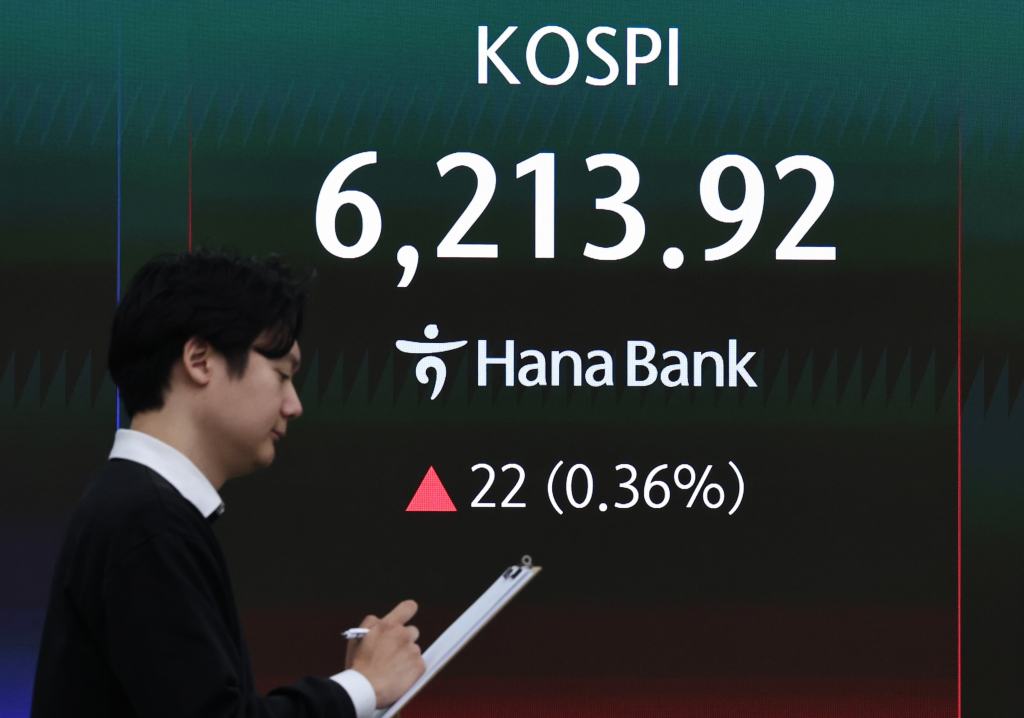
A rise in stock market success has led to increased investments in capital markets, with households’ stock and fund holdings surpassing short-term savings deposits for the first time at the end of the previous year. The shift of “money” from bank savings to the stock market is noticeable in the structure of household financial assets. The proportion of stocks and funds within household financial assets has now gone beyond 26%, showing continued growth.
As per the Bank of Korea’s Financial Assets and Liabilities Outstanding table at the end of last year, household investments in stocks (equity securities) and investment funds reached 1,644.3383 trillion Korean won, exceeding short-term savings deposits (1,514.2369 trillion Korean won) by 130.1014 trillion Korean won. In terms of the share of total household financial assets, stocks and funds represented 26.5%, which is 2.1 percentage points more than the 24.4% for short-term savings deposits. Short-term savings deposits include time deposits and installment savings with maturities of one year or less.
◇Household Savings and Investment Balances Increase by 500 Trillion Won Within One Year
When the Bank of Korea started collecting data on household financial assets using the current standards in 2008, stocks and funds made up 21.9% of total household financial assets, which was less than the 27.2% share held by short-term savings deposits. Even as late as 2024, the value of stock and fund assets had not exceeded that of short-term savings deposits. This occurred because stocks, being high-risk investments, experience price fluctuations that affect investor confidence, whereas short-term savings deposits, which offer principal protection, remained a widely used financial product among all citizens.
However, the scenario shifted as money poured into the stock market with rising stock prices from the second half of last year. In the previous year, household stock and fund assets rose by 535.0829 trillion Korean won compared to the prior year, making up 73.4% of the overall growth in household financial assets. This indicates that almost three-quarters of the increase in financial assets last year came from stocks and funds.
Financial experts in the banking industry observe that although growing stock prices have boosted the value of equities and mutual funds, the main development is the rapid flow of “money movement.” A representative from the financial field stated, “Given that most of the added financial assets are stocks and funds, it suggests that a large number of investors have joined the capital market.”
◇ Aligning Insurance and Pension Assets
The extent of households’ investments in stocks and funds has increased to be comparable with assets set aside for future security, including insurance and retirement plans. By the end of last year, insurance and pensions made up 26.6% of household financial assets, almost matching the 26.5% share held by stocks and funds. The proportion of insurance and pensions has remained below 30% since 2022.
According to analysis, the majority of newly acquired money is being directed towards stocks or investment funds. Cho Young-hyun, a researcher at the Insurance Research Institute, mentioned in a recent report, “With stock and fund investments becoming essential tools for household financial management, new capital is flowing into stocks and funds. The drop in the proportion of insurance and pension assets should be seen as a result of the ‘addition’ effect, where money is moving toward higher-risk investments.”
Some caution that families could suffer losses if they buy too many stocks during a rising market. Kim Dae-jong, a professor at Sejong University, stated, “Although the stock market is expected to do well in the next 1-2 years because of the boom in semiconductors, the problem arises after that. If the market experiences a downturn, those who have mainly built their wealth through stocks may encounter substantial losses.” He further noted, “It is better to invest alongside secure assets like pensions rather than focusing only on high-risk investments, and to spread investments between local and international markets.”




 jasdooit
Leave a comment