
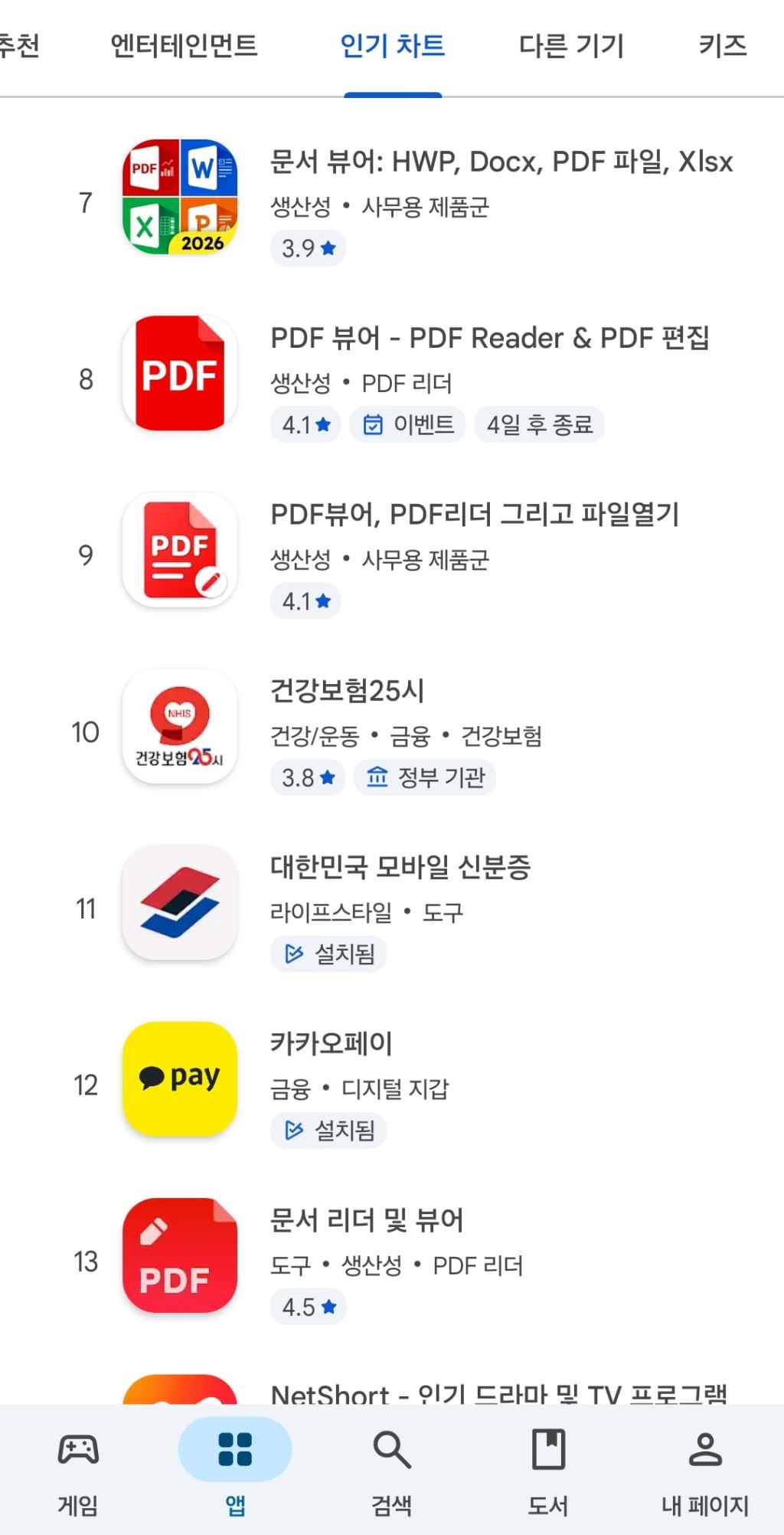
Park, 33, a salaried employee, recently experienced a shock while reviewing the top app rankings on Google Play Store to monitor app trends. Numerous viewer applications that enable users to open PDF or Word documents were listed highly, with comparable names and icons, as though they had been “copied and pasted.” Park mentioned, “It turned out that even though they had different names from other apps, their designs and structures were exactly the same.”
As “vibe coding” technology, which develops applications by merely providing natural language instructions to AI (artificial intelligence), becomes more widespread, a global app ecosystem has raised an unprecedented “app pollution alert.” With the obstacles to coding eliminated, apps generated by “app factories” that lack depth are flooding the market. Industry experts note, “Although they might appear acceptable initially, these apps often fail to receive regular updates, leading to major security issues.”
◇ 20% of the Top 100 Domestic Applications Are Document Viewers
As per a comprehensive survey conducted by this newspaper on the top 100 popular apps on Google Play Store in South Korea on the 12th, roughly 20% (19 apps) were document viewer applications designed for viewing PDF or Word files. Significantly, more than half—10 apps—were launched after February 2025, when the vibe coding trend gained momentum, driven by Anthropic’s large language model (LLM) “Claude.”
The IT sector points to the “low loyalty of utility (tool) apps” and the “immediate need for search intent” as factors behind the surge in viewer applications. Unlike downloading the “Baedal Minjok” app for food delivery or searching “Musinsa” to purchase men’s clothing, users who need to open document files usually search for general terms like “PDF viewer” or “viewer” rather than specific applications.
Additionally, individuals looking for viewer applications are often in pressing circumstances where they require immediate access to documents, leading them to install any app that shows up in search results. This creates an opportunity for new apps to enter the established market. Indeed, online forums often contain messages such as, “A non-developer created an app in a week using Claude.”
◇First-Time in a Decade: New App Sign-Ups See Recovery Driven by Vibe Coding
The worldwide market scenario is comparable. Following the launch of vibe coding in February 2025, the number of new app releases on Apple’s App Store has kept rising. In June 2025, there was a 25% rise compared to the same time frame in the previous year, 40% in August 2025, and 60% in December 2025. Significantly, during the first quarter of this year, the count of new apps added to Apple’s App Store (according to Sensor Tower) amounted to 235,800, marking an 84% growth from the same period last year.
The sustained decrease in new app sign-ups, which continued from 2016 until 2024, saw a recovery as AI development tools became more widespread. Replit, an AI-powered development platform, recently stated that users have launched around 5,000 apps via its service.
◇Viewers, Calculators, QR Code Scanners… ‘Security’ Issues Arise
The focus of “app factories” extends beyond just viewers. When looking at other applications developed by viewer app creators available on the market, the majority are utility apps with basic features and minimal brand recognition, like calculators, video converters, and QR code readers. Detractors claim that these substandard apps, although seemingly ordinary at first glance, can negatively affect platform performance and present significant security dangers.
An insider from the industry stated, “Applications developed using vibe coding feature advanced internal code, giving them the appearance of ‘well-crafted apps,’ which makes it challenging to identify fraudulent applications. Nevertheless, as they lack consistent management, they are extremely susceptible to external threats.”



 jasdooit
Leave a comment