
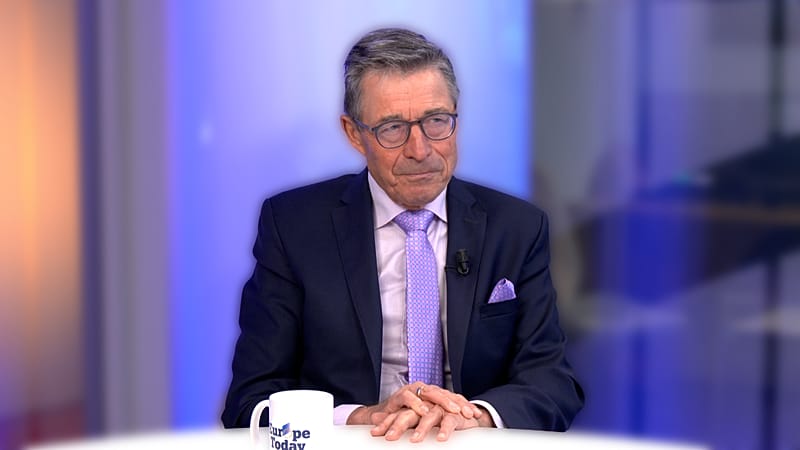
In an interview with Euronews’ morning program Europe Today, former NATO Secretary General Anders Fogh Rasmussen stated that Europe must quickly become independent from the US security system and, when feasible, choose European-developed weapons for future defense purchases.



I view this as the most difficult challenge for NATO throughout the history of a highly successful alliance,” stated Rasmussen, “We in Europe must realize that we need to be capable of standing independently.
“So we must enhance our defense and develop a coalition of those who are willing to create a robust European [defense] component,” he added.
The conflict in Iran has jeopardized Europe’s capability to replenish its defenses, as it typically relies on purchasing US military supplies. This has further increased the pressure on Europe’s ability to supply sufficient weapons and interceptors for the Ukrainian army in its fight against Russia.
The Pentagon is allegedly also planning to redirect arms bought by European nations for deployment in Ukraine towards Iran.
The current Secretary General, Mark Rutte, along with NATO’s top military official, Alexus Grynkewich, emphasized the need for Europe to expand its military capabilities more vigorously during a recent discussion with European Commission President Ursula von der Leyen, according to a NATO representative who spoke with Euronews.
“We need to acquire arms and supplies at this moment, as time is critical, but we should also decrease our reliance on foreign entities such as the United States, as well as other nations,” Rasmussen stated.
He stated in the end that Europe should not be “naive” and, in certain situations, he would recommend “favoring European weapons and ammunition” instead of American or other alternatives.
Several European NATO members, such as France, have been advocating for Europe to opt for defense systems developed within the continent rather than relying on American weapons and equipment, in an effort to decrease dependence on the White House, as the transatlantic bond faces challenges under the Trump administration.
Before serving as NATO Secretary General, Rasmussen held the position of Denmark’s Prime Minister from 2001 to 2009, at the peak of the U.S. conflict in Afghanistan following the September 11th attacks carried out by the global terrorist group Al Qaeda.
Denmark was among America’s key allies during that time, with Danish military casualties and fatalities comparable to those of the US on a per capita basis. When questioned about the condition of relations between his native country and the US, he described it as “painful.”
This has been a deeply painful experience for me,” he stated. “From a young age, I have looked up to the United States. I viewed the United States as a natural leader in the free world.
As the Prime Minister of Denmark, I collaborated closely with former President George W. Bush.
“It has been difficult to accept that we must lessen our reliance on the United States, but this is the current situation,” he remarked.
Rasmussen stated that the future of the 77-year-old NATO alliance was questioned in January after Trump mentioned he would “take” Greenland—a territory that is partially autonomous within the Kingdom of Denmark and the world’s largest island.
If Trump had proceeded with his proposal, it would have eventually dissolved the alliance, he stated.
“It was unprecedented for the leader of the largest ally in a collective defense organization to threaten another ally with the intention of seizing territory by force… If that had occurred, it would have marked the end of NATO,” he stated.
Since then, tensions have worsened between Trump and his NATO allies following their refusal to support him and Israeli Prime Minister Benjamin Netanyahu in securing the Strait of Hormuz after they launched attacks against Iran in February. The Strait, one of the world’s most vital shipping routes that carries 20% of global oil, has since been closed by Iran and is now under a US embargo.
The leaders of the United Kingdom, Germany, France, and Finnish President Alexander Stubb explicitly declined to support Trump, stating that NATO is a defensive alliance and they were not required to engage in a war of aggression.
Rasmussen states that this reaction further irritated the White House, enabling Trump to develop a storyline suggesting that NATO was not present to back its allies, as he asserts.
However, the former NATO leader suggests that Europe has a chance to improve the situation by offering support in return for assurances regarding Ukraine and a more stable trade relationship with no changing tariffs on European products.
He stated, ‘Europe ought to take advantage of this scenario to alter the dynamic between Europe and the United States.’
“We should address President Trump in the same manner he speaks to us, and I suggest we ‘rectify the error’ from the beginning and strive to achieve the best outcome for Europe,” Rasmussen said to Euronews’ Shona Murray.
 jasdooit
Leave a comment