
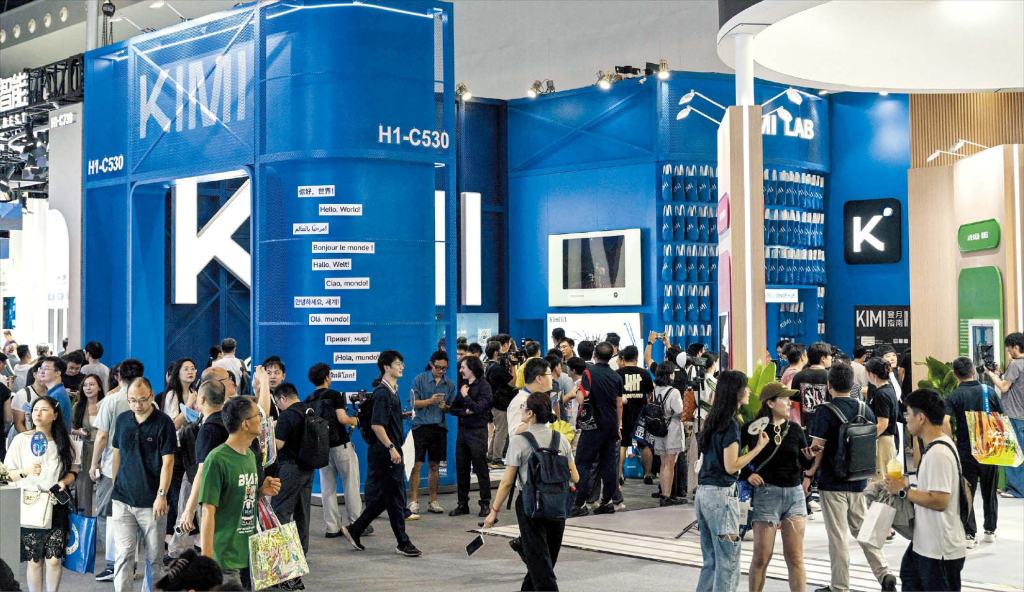
Chinese companies have started exporting not only tangible goods such as semiconductors and computers but also artificial intelligence (AI) models, software applications, and enterprise application programming interfaces (APIs). Businesses focused on data center optical modules and logistics robots are also boosting their export percentages by taking advantage of the increased AI investments from major U.S. technology firms and the high prices these products command in international markets.
The South China Morning Post (SCMP) reported on the 23rd (local time) that Chinese technology firms are broadening their international presence in both software and hardware sectors, fueled by rising global investments in artificial intelligence and increased competition within the domestic market.
China’s exports of physical high-tech products have also increased. In the first half of this year, the export value of integrated circuits reached $177.3 billion (about 271.9 trillion South Korean won), representing a 96% rise compared to the same period last year. Exports of automatic data processing equipment, such as computers, rose by 41% to $138.1 billion (around 211.7 trillion South Korean won), while industrial robot exports climbed 18% to $929 million (approximately 1.42 trillion South Korean won). Industrial robots were shipped to 141 countries and regions. However, the sharp increase in integrated circuit exports was partly driven by global semiconductor price increases.
◇AI Models and Applications Now Exported…MiniMax Generates 73% of Revenue Internationally
A growing trend involves the rise of AI models and software as exportable products. MiniMax, an AI company based in Shanghai, was established in 2022 by Yen Junze, a former employee of SensTime. It is considered one of China’s top generative AI companies, along with ZhipuAI and MoonshotAI. The company went public on the Hong Kong stock exchange in January of this year.
MiniMax provides language and coding models, a video generation service called ‘HailuoAI,’ an AI character chat application named ‘Toki,’ and APIs for businesses and developers. It generates revenue from consumers through subscriptions and in-app tokens, while charging companies according to their API usage.
In 2025, MiniMax’s international sales amounted to $57.7 million (around 88.5 billion South Korean won), representing a 2.7-fold increase from the prior year’s $21.3 million (approximately 32.7 billion South Korean won), and making up 73% of overall revenue. The company mentioned that it acquired 214,000 business and developer clients in more than 100 countries by the end of the previous year. Nevertheless, it did not provide the percentage of paying customers or details on regional revenue distribution.
◇Optical Components and Logistics Robots Also Grow Internationally…Fueled by Major Tech Companies’ AI Funding
In the field of AI infrastructure, Chinese manufacturers of optical modules are taking advantage of the data center investments made by major U.S. technology companies. Optical modules, also known as optical transceivers, transfer data using light signals between servers, switches, and computing devices within data centers. As reported by market research company LightCounting, the majority of U.S. and Japanese firms left the optical transceiver market by 2020, creating an opportunity for Chinese companies to take their place.
Chengdu InnoLight, a Chinese optical module manufacturer, has emerged as the leading supplier globally, supplying its products to major cloud service providers. More than 57% of its revenue in 2024 was sourced from the United States. Eoptlink, the second-largest company in the industry, provides 400Gbps and 800Gbps optical components to Amazon and has obtained certifications from U.S. firms such as NVIDIA. Both companies derived more than 90% of their 2025 revenue from international markets.
GPlus, established in Beijing in 2015, provides autonomous mobile robots (AMRs) for moving items, shelves, and pallets within logistics facilities, alongside management software. In 2024, the company generated 2.39 billion Chinese yuan (around 522 billion South Korean won) outside of mainland China, with international sales surpassing 75%. About 80% of new orders came from abroad, and purchases from the Americas increased by more than 50%.
China’s export industries are growing beyond electronics and machinery into areas such as artificial intelligence models, data center parts, and robotics. A representative from the technology sector stated, “The overseas growth of Chinese AI companies might heighten price competition with local AI businesses. The rising global use of AI models and increased demand for inference could enhance the need for HBM, server DRAM, and enterprise SSDs from Samsung Electronics and SK Hynix.”


 jasdooit
Leave a comment