
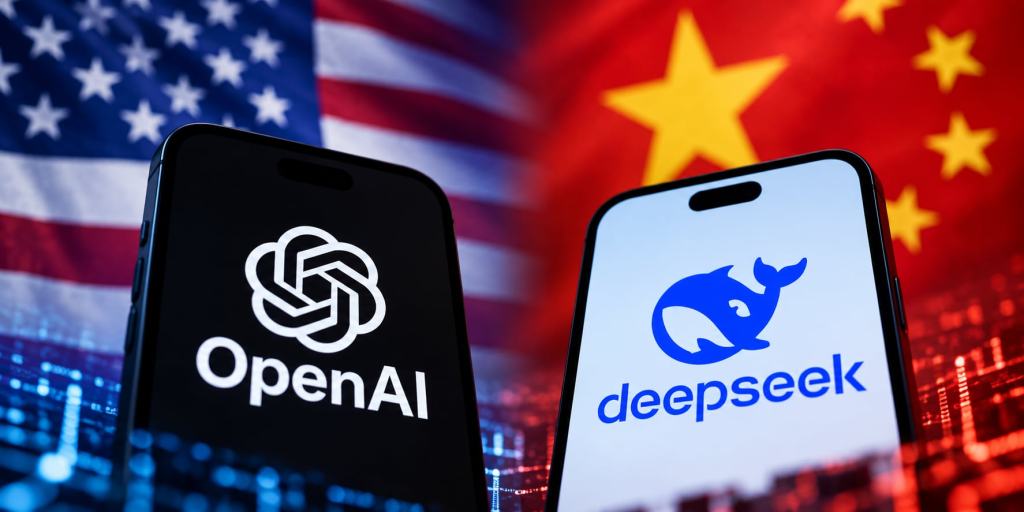
Chinese artificial intelligence (AI) model usage fees have been found to be 70% cheaper on average than U.S. competitors. While Chinese companies are expanding their market share by emphasizing low prices, U.S. firms are responding with a differentiated strategy: setting high prices for premium models and lowering costs for entry-level models.
The Wall Street Journal, citing an analysis by U.S. investment bank Jefferies on October 1 (local time), reported that the average price gap between U.S. and Chinese AI models widened from 60% in August to 70% in September. This means that if a U.S. model costs 100 dollars, a Chinese model averages 30 dollars. The widening gap was also influenced by the release of high-priced new models in the U.S.
AI model prices are primarily compared based on API usage fees paid by businesses and developers when utilizing external AI. Costs depend on the volume of data processed and responses generated, making price differences more significant as companies increase their AI usage. In particular, the spread of “AI agents,” which handle tasks by repeatedly calling multiple models, has led to increased adoption of low-cost Chinese models.
◇U.S. Raises Prices for Premium Models, Lowers Entry-Level Prices in Response
To counter China’s low-price offensive, U.S. AI companies are differentiating pricing based on model performance. According to Jefferies, OpenAI set the API fee for its top-tier model, GPT-6 Astra, 150% higher than the previous GPT-5.6 Sol. Meanwhile, the fees for GPT-6 Sol and Luna were reduced by 50% and 56%, respectively, compared to their previous-generation equivalents. Anthropic also lowered the usage fee for Claude Opus 5.5 by 24% from its predecessor.
In the entry-level market, the pricing competition shifts. Jefferies noted that the API fee for GPT-6 Luna is 74% cheaper than that of DeepSeek V4.1 Flash, a Chinese model. This indicates that Chinese models are not universally cheaper than U.S. models across all price tiers.
Chinese companies are actively supplying open-weight models (where trained weights are publicly disclosed), allowing businesses to operate them on their own servers. However, self-hosting still incurs costs for semiconductors, servers, and management personnel.
A source from the tech industry stated, “For Chinese AI companies leading with low-cost models, the challenge lies in converting increased usage driven by price competition into actual revenue, given the massive investments made in model development and data centers.”





Leave a comment