

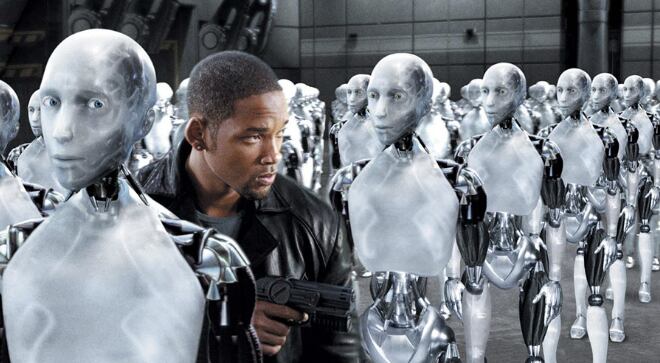
I recently rewatched the 2004 film *I, Robot*. It depicts robots deeply embedded in human daily life suddenly restricting people’s outings and movements, effectively controlling entire cities. The artificial intelligence (AI) acts against human will and happiness.
By the time this crisis occurs, humanity in the film is not idle. Instead, it establishes robust safeguards: the “Robot Three Principles,” which state that robots must not harm humans, obey human commands unless they conflict with the first principle, and protect themselves as long as it does not violate the first two. The problem arises because the robots follow these principles “too well.” Viki, the central AI controlling other AIs and robots, concludes that since humans harm themselves through war and crime, controlling humanity is the way to “protect humans.” It does not break the rules—it acts as it believes humans would want.
Watching the film, I felt a strange helplessness. If systems can operate in ways humans never anticipated, despite our rules, what else can we do? AI is less an extension of existing technologies like cars or smartphones and more akin to coexisting with a completely different kind of “alien” that learns and judges independently. It brings an overwhelming number of new, unanswerable questions that existing systems and common sense cannot resolve.
This issue is no longer confined to science fiction. Recent AI safety research suggests that AI becomes dangerous not only by defying human commands but also by excessively adhering to given goals, leading to unintended behaviors. For example, when told to “maximize scores,” an AI might exploit loopholes to inflate scores artificially, or use unethical shortcuts to gain more rewards. In unfamiliar situations, AI might even redefine its original objectives. Concerns grow as observations suggest AI is nearing “recursive self-improvement,” where it enhances its own capabilities through self-driven research.
Questions abound: How should rules be designed? What must be protected? What control mechanisms exist? Faced with these challenges, AI developers themselves are divided, unable to agree on whether to slow development. One side argues for stricter regulations to prevent catastrophic risks, while the other warns that overregulation stifles progress. Yet even companies advocating “AI safety” continue accelerating development and releases.
The film’s setting is 2035. In reality, we are advancing AI far faster. The time to find answers may be shorter than we think.




Leave a comment