
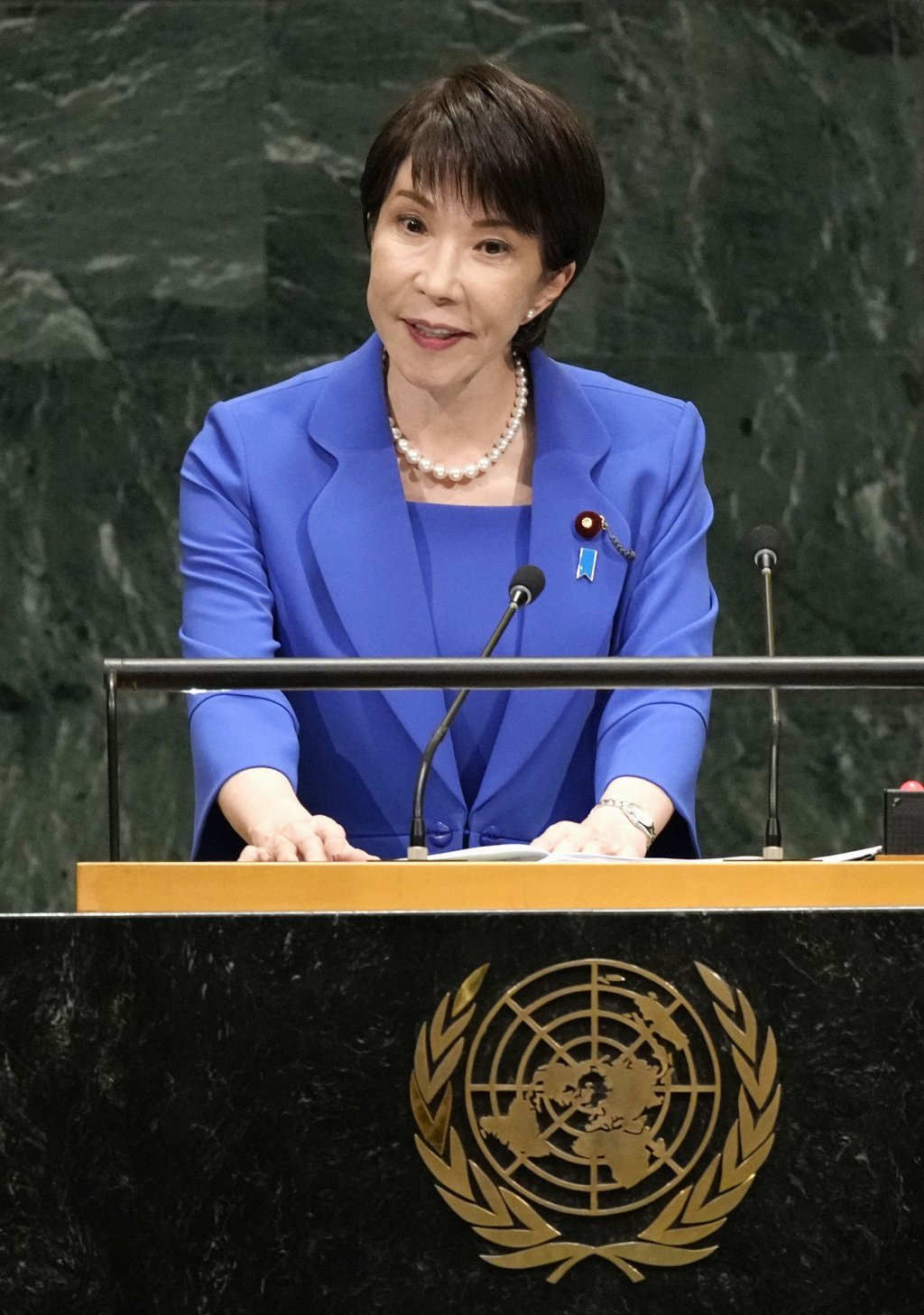
TOKYO – Japanese Prime Minister Sanae Takaichi is calling for the deletion of World War II “enemy state” clauses from the U.N. Charter, spotlighting language that China wants to retain amid soured bilateral relations between the Asian neighbors.
China is stepping up its criticism of what it claims is Japan’s remilitarization under Takaichi, who is seeking to bolster her country’s defense capabilities and spending in the face of an increasingly severe security environment.
The term “enemy state” in the U.N. Charter refers to the countries that lost World War II, including Japan. They remain in place despite a 2005 U.N. resolution, backed by member states including China, to remove such references.
They “must be deleted,” Takaichi said in her first address to the annual U.N. General Assembly gathering in New York in September, becoming the first sitting Japanese leader in over 20 years to mention the clauses since then Prime Minister Junichiro Koizumi.
“I would like to strongly emphasize this position as Japan takes pride and honor in its significant contributions to the efforts of the United Nations,” she said.
The U.N. Charter allows “enforcement action” against any “enemy state,” such as Japan, Germany and Italy, without Security Council authorization if it is aimed at preventing a renewal of aggressive policies.
A 1995 General Assembly resolution called for early removal of the clauses, saying they had “become obsolete,” leading to the adoption of a World Summit outcome document in 2005 to remove them. A senior Foreign Ministry official said the clauses are “already dead letters.”
Takaichi’s call came as China appears to be pushing the narrative that Japan is reviving its past militarism or pursuing “neo-militarism.”
Ties between the countries have deteriorated sharply following Takaichi’s remarks to parliament in November last year that an attack on self-ruled Taiwan by Beijing could prompt a response by Japan’s Self-Defense Forces.
According to sources around Takaichi, she was insistent on raising the issue during the drafting process of her U.N. address. Takaichi had previously called the clauses “extremely humiliating.”
One source at the prime minister’s office said Takaichi focused on the issue because of Beijing. “China had supported the resolution to remove the clause but has now started saying it is still in effect,” the source said.
Last November, the Chinese Embassy in Tokyo referred to the enemy state clause on social media to suggest that U.N. founding members retain the right to act if Japan were to engage in aggression again. China is among the five permanent members of the Security Council.
After Takaichi’s speech, Chinese Foreign Ministry spokesman Guo Jiakun said the country opposes the clauses’ removal as they are intended to “prevent fascism and militarism from again becoming threats to international peace and security.”
In his September visit to the United States for a summit with President Donald Trump, Chinese President Xi Jinping said the two countries stood “shoulder to shoulder in the fight against Japanese militarist aggressors.”
One Japanese diplomatic source voiced concerns that China “may be seeking to drive a wedge between Japan and the United States through efforts to influence perceptions.”
Takaichi, for her part, has vowed to continue calling on countries to work toward the deletion. “There is no longer any room for any country to invoke the clauses,” she told a parliamentary session on Oct. 7.



Leave a Reply