
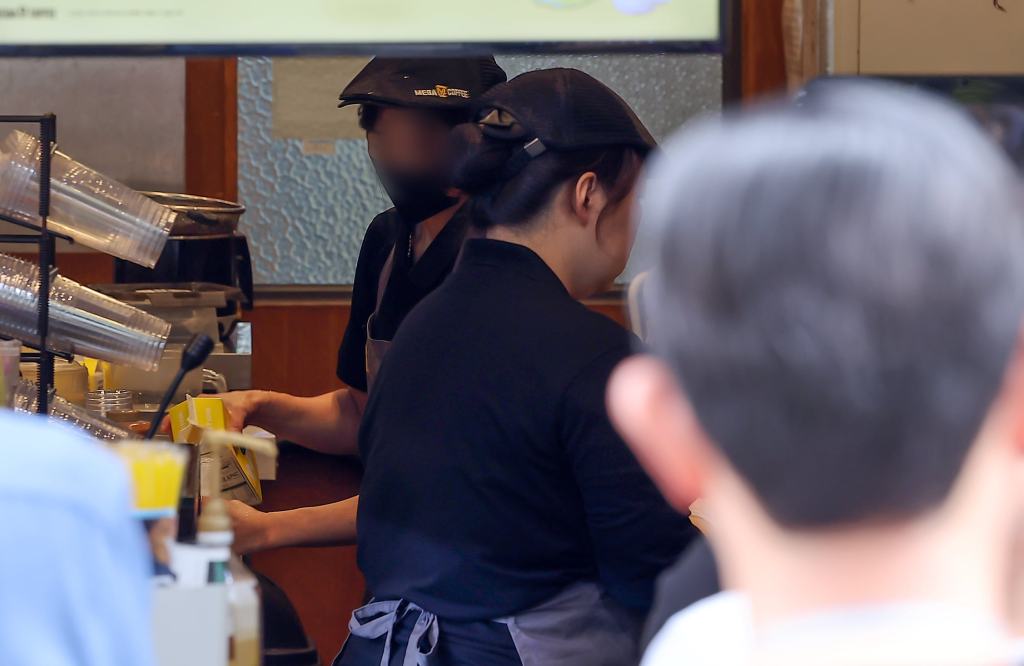
This year, the proportion of non-regular workers reached the highest level since the government began compiling statistics, surpassing the previous record set in 2021, when the pandemic peaked. The monthly wage gap between regular and non-regular workers also widened to nearly 2 million Korean won, the largest since records began.
According to the ‘Economically Active Population Survey by Employment Type Additional Survey Results’ released by the Ministry of Data and Statistics on the 21st, as of August this year, non-regular workers numbered 8.671 million people, accounting for 38.5% of all wage workers (22.526 million people). This ratio increased by 0.3 percentage points compared to the previous year (38.2%), surpassing the previous record of 38.4% set in 2021. The number of non-regular workers also reached the largest scale since the statistics began in 2003, marking the third consecutive annual increase since 2024.
The proportion of non-regular workers had decreased for two consecutive years from 2022 (37.5%), when the aftermath of COVID-19 began to subside, to 2023 (37%), but rebounded to 38.2% in 2023. It has since gradually increased, reaching the highest level since the Ministry of Data and Statistics began compiling non-regular worker ratios in 2003.
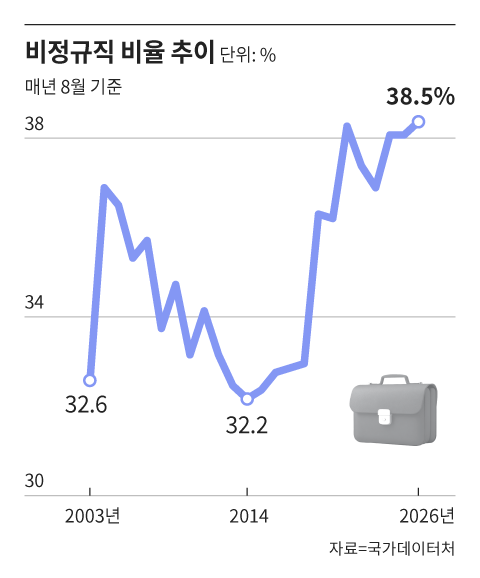
The increase in the proportion of non-regular workers is attributed to a sharp rise in their numbers, with the growth rate of non-regular workers exceeding ten times that of regular workers over the past year. In August this year, regular workers numbered 13.855 million people, an increase of 10,000 from the previous year. Non-regular workers reached 8.671 million people, up by 103,000 from a year ago.
Non-regular workers increased in sectors such as health and welfare (+112,000 people), accommodation and food services (+43,000 people), arts and sports (+38,000 people), finance and insurance (+27,000 people), manufacturing (+8,000 people), and transportation and warehousing (+5,000 people).
The average monthly wage of non-regular workers from June to August this year was 2.112 million Korean won, a mere 1.1% increase from a year ago. This growth rate is about one-third of the inflation rate (3.1%) over the same period.
In contrast, regular workers’ average monthly wage was 4.052 million Korean won, a 4% increase from the previous year. This is the first time the average monthly wage of regular workers has exceeded 4 million Korean won. The wage gap between regular and non-regular workers widened to 1.94 million Korean won this year, an increase of 132,000 Korean won from last year (1.808 million Korean won). This gap is also the largest since the Ministry of Data and Statistics began compiling the data.
The wage ratio of non-regular workers relative to regular workers was 52.1%, a 1.5 percentage point decrease from last year (53.6%). Kim Nak-hyun, a director at the Ministry of Data and Statistics, interpreted, “The increase in non-regular workers aged 60 and older also had an impact.”
The number of ‘temporary workers (Temporary Workers)’—a category comparable to OECD standards—was 6.345 million people, an increase of 185,000 from the previous year. The proportion of temporary workers among wage workers rose to 28.2%, up 0.7 percentage points from a year ago. The OECD standard includes fixed-term, dispatched, and daily workers but excludes part-time, outsourced, and special employment types, resulting in some differences from domestic non-regular worker statistics.
In terms of the proportion of temporary workers available for international comparison last year, South Korea recorded 27.5%, higher than the Netherlands (25.8%), Japan (14.2%), Canada (11.8%), and Germany (11.5%).



Leave a Reply