

As autumn arrives and evenings grow longer, it’s officially time to bid farewell to British Summer Time.
At 2.00am this morning, the UK turned the clocks back, ushering the nation into another six months of Greenwich Mean Time.
Although you may have appreciated the extra hour of sleep, many nations across the globe have already discarded the yearly clock change.
Now, specialists are adding their voices to an increasing number of advocates urging the UK to follow suit.
Once widespread, Daylight Saving Time (DST) is now a rarity in Britain, which stands increasingly isolated in its practice.
Around half of the countries that once adopted DST have since abandoned the tradition of resetting clocks.
In just the past decade, nations including Azerbaijan, Iran, Jordan, Namibia, Russia, Samoa, Syria, Turkey, Uruguay, and most of Mexico have all discontinued the practice.
Currently, only roughly one-third of countries around the world still observe DST, while 139 others maintain a single time zone throughout the year.
Britain first adopted Daylight Saving Time in 1916, during the peak of the First World War, as a measure to conserve fuel for lighting by extending the use of natural daylight during longer summer evenings.
Between 1968 and 1971, there was a short-lived effort to discontinue the practice when the UK tried running on British Summer Time throughout the entire year.
The trial was ultimately scrapped due to widespread complaints about frigid, dark mornings in winter, especially in northern Scotland.
As a result, the UK remains among a shrinking group of nations that continue to adjust their clocks forward and backward annually.
The custom is largely preserved in Europe, where most countries still shift their clocks forward in spring and back in autumn.
Even within this region, however, several nations—including Armenia, Azerbaijan, Belarus, Georgia, Iceland, Russia, and Turkey—have abandoned the practice.
Egypt holds a unique distinction: it is the only country in Africa to observe Daylight Saving Time, and also the only one to have both discontinued and reinstated it within the past two decades.
The North African country suspended DST in 2015 but reintroduced it in 2023 as part of a government plan aimed at reducing energy consumption.
The sole other North African exception is Morocco, which maintained permanent Daylight Saving Time, effectively operating on GMT+1, from 2018 until this September, when the policy was finally reversed following prolonged public criticism.

Daylight Saving Time is applied beyond Europe, primarily in North America and Australia, though these countries apply it inconsistently across their territories.
In Australia, DST is observed in most regions except for Queensland, the Northern Territory, Western Australia, Christmas Island, and the Cocos Islands.
Chile adjusts its clocks with the seasons, with the exception of the Aysén and Magallanes regions in its sparsely inhabited southern area.
Similarly, Mexico discontinued DST in 2022 but allowed Baja California and several municipalities near the U.S. border to continue observing it to remain aligned with their American neighbors.
The United States features one of the most unusual setups, applying DST throughout most states except Hawaii and certain areas of Arizona.
Arizona was granted an exemption from DST due to the extreme heat experienced in the Sonoran Desert.
During a 1967 trial of DST, residents were compelled to endure higher temperatures for longer durations and operate air conditioning for extended periods, resulting in a significant rise in electricity costs.
The exception is the portion of the state located within the boundaries of the Navajo Nationwhich observes Daylight Saving Time to maintain alignment with neighboring tribal territories in New Mexico and Utah.
As a growing number of regions around the globe abandon Daylight Saving Time for pragmatic reasons, specialists are urging the UK and other remaining jurisdictions to do the same.
Professor Jagdish Khubchandani from New Mexico State University stated to the Daily Mail that he generally supports discontinuing DST.
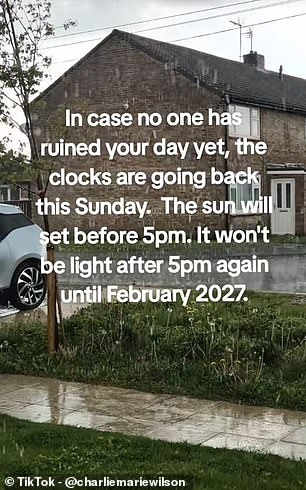

This is due to mounting evidence indicating significant physical, psychological, and safety consequences associated with adjusting the clocks.
Although shifting the clock backward by an hour may appear minor, numerous bodily systems are highly sensitive to daily sleep patterns, and even small alterations cantrigger a ‘mini jet-lag’ condition.
Professor Khubchandani states: ‘Regarding physical health, multiple studies have documented sudden increases in heart attacks and strokes. Additionally, temporary disturbances in blood pressure, heart rate variability, and stress hormone levels are among the observed outcomes.’
‘Concerning mental well-being, individuals might experience episodes of depression or noticeable shifts in emotional state.’
Our most recent research also indicates that individuals already living with mental health conditions are more vulnerable to shifts in their psychological well-being when the clocks change.
Similarly, a study carried out in Sweden has linked the time shift to a 10 per cent rise in the use of psychoactive substances.
This increase is equivalent to the spike in drug use observed by researchers after severe injuries or car crashes in the United States.
Experts have even discovered that the frequency of serious, potentially life-threatening mistakes rises significantly after the time adjustment.
Certain studies suggest that the likelihood of fatal traffic accidents goes up by approximately six per cent following the spring daylight saving time transition.
Professor Andrey Rzhetsky of the University of Chicago, who authored a comprehensive review on the health consequences of Daylight Saving Time, said to the Daily Mail: ‘The root issue is straightforward: the springtime transition causes stress in many individuals.’
‘Perhaps due to heightened stress and reduced concentration among medical staff, there’s roughly a 10 per cent increase in complications related to childbirth and maternal health.’
Professor Rzhetsky further stated: ‘From my standpoint, it ought to be eliminated considering the health risks we identified.’
Even though the impacts of advancing clocks in spring and resetting them in autumn differ, both transitions have been linked to significant health issues.
A research group from the University of Kent recently examined 157 studies drawn from 36 nations that investigated the consequences of time changes.
The analysis showed that when clocks move forward in spring, there is a rise in heart attacks and fatal traffic incidents, yet a decrease in crimes involving physical violence.
Conversely, when clocks are set back by an hour during autumn, overall mortality and workplace accidents tend to drop, while violent crimes go up.
Sleep researchers explain that even minor time adjustments can trigger significant impacts because they disrupt our internal biological rhythms.
Dr Jeffrey Kelu, a specialist in the body’s natural cycles at University College Dublin, said to the Daily Mail: ‘Our circadian clock operates on a roughly 24-hour schedule that controls sleep patterns, hormone levels, metabolism, body temperature, emotional state, and immune responses.’
‘When this internal clock aligns with the natural day-night pattern, we experience better sleep and improved functioning. Misalignment—such as from jet lag or shift work—is linked to worse sleep quality, reduced mood, and, over time, increased risks of cardiovascular and metabolic disorders.’
Crucially, the primary cue for regulating our circadian rhythm is morning exposure to sunlight, which makes adaptation slower during the shorter days of autumn and winter.
‘Adjusting the clocks creates an immediate shift in social time, but our biological clock changes only gradually, leaving many people feeling out of sync for several days,’ Dr Kelu noted.
Because of this, numerous scientists are now advocating for a permanent single time zone that better matches the sun’s natural cycle, thereby avoiding abrupt disruptions.
Dr David Kuhlmann, a sleep medicine specialist and representative for the American Academy of Sleep Medicine, said to the Daily Mail: “Our biological clock is governed by the natural light-dark pattern, and keeping daylight saving time year-round would result in darker mornings and increased evening light, potentially interfering with our sleep patterns and making it more difficult to sustain a consistent and healthy sleep schedule.
The American Academy of Sleep Medicine strongly advocates for ending the practice of changing clocks twice a year, favoring permanent standard time as it most closely matches the body’s natural circadian rhythm.




Leave a Reply