
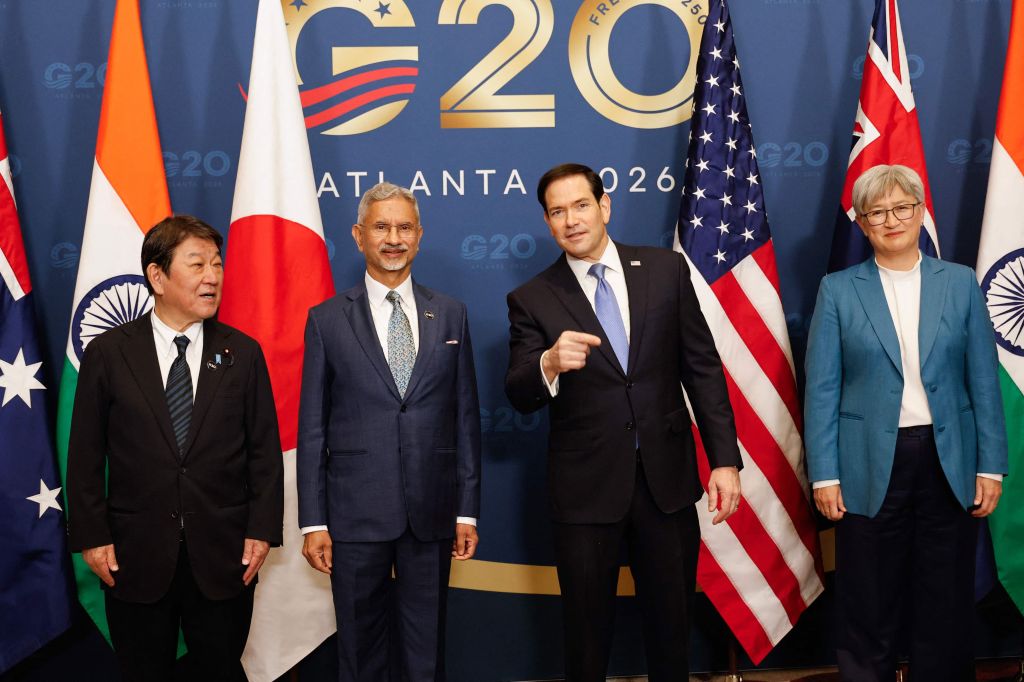
On October 31, the State Department disclosed that Secretary of State Marco Rubio reaffirmed the U.S. dedication to a “Free and Open Indo-Pacific” (FOIP) during discussions with QUAD foreign ministers on the margins of the G20 foreign ministers’ gathering in Atlanta, Georgia. At a subsequent press briefing, Rubio emphasized, “The QUAD is not designed to target any particular nation,” though he noted, “Certain troubling actions and conduct are consistently attributed to one country,” implicitly referring to China. The QUAD’s focus on maritime safety and enhanced naval collaboration underscores growing apprehensions about China’s activities in the South China Sea, East China Sea, and the West Sea near South Korea, which are seen as undermining freedom of navigation.
As outlined in the QUAD joint statement issued by the State Department on the same day, the group anticipates launching the “Sea Dragon 2027” exercise under the “Indo-Pacific Surveillance Cooperation Initiative.” This U.S.-led multinational anti-submarine training involves maritime patrol aircraft from multiple nations detecting and monitoring real submarines. When questioned about future QUAD cooperation, Rubio said, “Maritime domain awareness extends beyond surface activity to include underwater surveillance and identifying threats to freedom of navigation. Our goal is to deepen this capability.” He added, “The real challenge isn’t convening meetings but turning dialogue into tangible outcomes. I believe we’re gaining strong momentum—over the past year, we’ve made meaningful progress.
Rubio revealed plans for a QUAD leaders’ summit to be held alongside the November ASEAN summit in Manila, Philippines. The previous QUAD leaders’ meeting took place in September 2024 under President Joe Biden; if held, this would mark a revival after a gap of two years and two months. This stands in contrast to another trilateral forum involving South Korea, the U.S., and Japan, which has yet to convene a leaders’ summit since the second term of the Trump administration. The host nation, the Philippines, has also been intensifying security ties with both the U.S. and Japan amid ongoing territorial disputes with China in the South China Sea.
The QUAD foreign ministers discussed key issues including securing critical mineral supply chains, ensuring energy stability across the Indo-Pacific, enhancing infrastructure resilience, and advancing safe, robust digital connectivity—particularly concerning undersea cables. They voiced “serious concern over non-market practices that result in overcapacity, disrupting global supply networks, and economic coercion such as export controls,” all of which are widely understood to target China.


Leave a Reply