
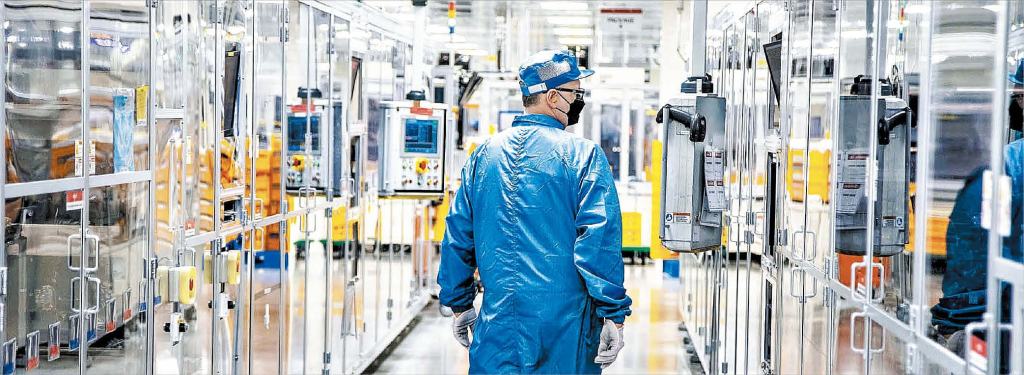
The South Korean battery sector is expected to deliver stronger-than-anticipated third-quarter results, fueled by rising demand for energy storage systems (ESS) tied to AI-powered data centers. Yet beneath this positive outlook lies a deeper structural challenge: a shrinking presence in the fundamental electric vehicle (EV) market as Chinese manufacturers consolidate their global leadership. Chinese firms are now capturing most of the gains from the rebounding EV markets in Europe and Asia.
Following LG Energy Solution’s recent announcement of record quarterly revenue—9.6434 trillion won—and an operating profit of 756 billion won this month, Samsung SDI—scheduled to release its earnings on the 29th—is forecasted to report 191.3 billion won in operating profit, according to FnGuide’s consensus estimate, continuing its two-quarter streak of profitability. Meanwhile, SK On is projected to post a loss of 230 billion won, a notable improvement from its first-quarter deficit of 349.2 billion won, indicating signs of stabilization.
◇ Chinese Companies Dominate Gains from EV Market Revival
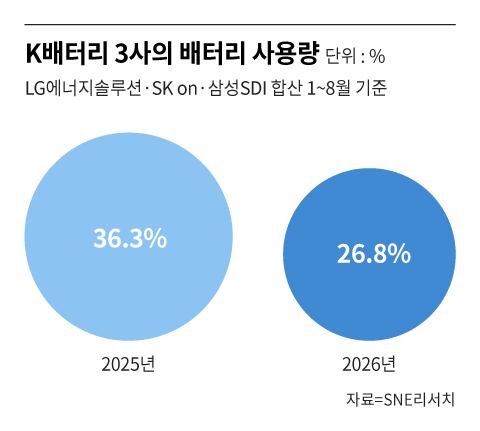
The core issue remains weak performance in the global EV battery segment. Data from SNE Research shows that non-Chinese EV battery consumption rose 23.7% year-on-year between January and August. This growth was largely driven by a 45% increase in EU pure EV sales to 1.64 million units and a 77% surge in Asian markets outside China. However, the combined battery usage of Korea’s three top battery makers fell 12.8% year-on-year during the same period. As a result, their global market share (excluding China) dropped from 36.3% last year to 26.8% in the first eight months—a decline of 10 percentage points. All of this lost ground was absorbed by Chinese companies. CATL and BYD, the leading Chinese battery producers, saw their global market share (excluding China) climb from 31.1% in 2024 to 37.9% last year, and further to 44.7% by August this year.
The main reason Korean battery manufacturers missed out on the global EV recovery—especially in Europe—is the market’s shift toward small, affordable EVs. According to European Transport & Environment (T&E), sales of mass-market EVs priced under 25,000 euros (roughly 37 million won) in the EU are projected to reach seven times their 2024 levels this year. Governments are actively expanding access to low-cost EVs through subsidies targeting lower-income consumers. In North America—the biggest market for Korean firms—EV battery demand has sharply declined due to the halt of purchase incentives, while Southeast Asia remains dominated by budget-friendly electric passenger cars and two-wheelers.
High-nickel batteries, a key product line for Korean manufacturers, are ill-suited for low-cost EVs. Automakers are increasingly turning to lithium iron phosphate (LFP) batteries, which offer better cost efficiency. Globally (excluding China), LFP battery adoption rose from 15.6% to 27.5% over the past year.
◇ North American ESS as ‘Lifeline’ Rather Than a Cure-All
Korean battery firms’ improved third-quarter results stem from a mix of strong demand for North American ESS and U.S. policies that exclude Chinese-made products. However, these figures also include one-time compensation payments from local automakers who failed to meet minimum order commitments—contributing to an inflated sense of financial strength that may not reflect sustainable performance.
A significant vulnerability for South Korean companies lies in the fact that LFP batteries are the dominant choice in the energy storage system (ESS) market. China maintains control over the supply chain for essential raw materials and components used in LFP batteries. Even if South Korean firms increase their ESS battery sales in the U.S., their profit margins will stay limited unless they lessen their dependence on Chinese inputs. Hwang Kyung-in, head of the Strategic Industry Analysis Division at the Korea Institute for Industrial Economics and Trade, remarked, “While extending their timeline through North American ESS markets, South Korean companies must build cost efficiency and technological edge in mainstream segments such as LFP and mid-nickel batteries to challenge China’s overwhelming dominance.”


Leave a Reply