
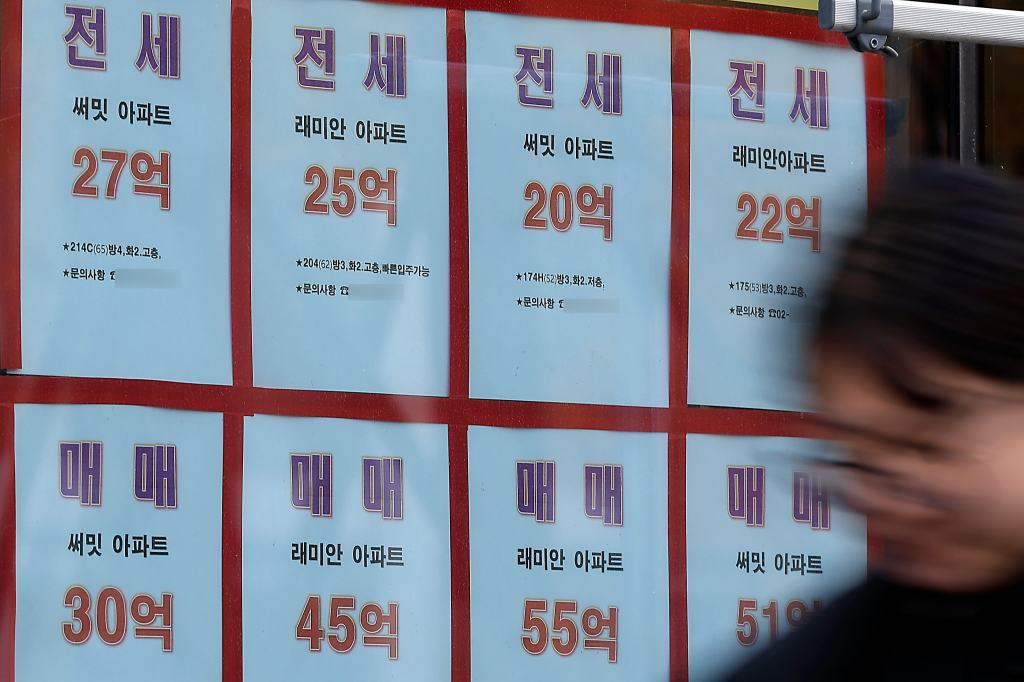
From the past six years up to last year, jeonse prices across the capital region—encompassing Seoul, Gyeonggi, and Incheon—increased by over 38%. With jeonse prices continuing to climb this year, worries are intensifying that tenants will face even greater financial pressure due to rising loan interest rates and stricter lending rules.
As per the Ministry of Data and Statistics’ Household Finance and Welfare Survey, as of March 2025, the average jeonse deposit for households residing in jeonse properties nationwide stood at 217.97 million Korean won. This represents a 34.9% increase (an additional 56.35 million won) compared to 2019, when such data collection began (161.62 million won).
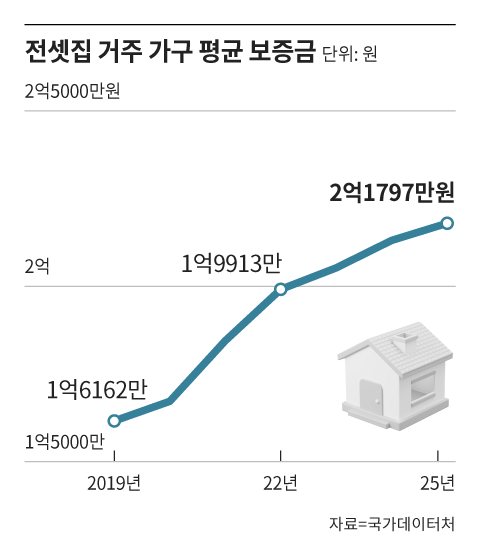
The surge in jeonse prices has been particularly sharp in the capital region, where premium housing is concentrated. In 2025, the average jeonse deposit for households in this area reached 259.02 million Korean won—a 38.8% rise from 186.63 million won in 2019.
Borrowing from banks and other financial institutions to cover jeonse deposits has grown at an even faster pace. The average financial debt (including both secured and unsecured loans) used to secure jeonse deposits nationwide rose from 30.33 million won in 2019 to 46.39 million won in 2025, marking a 53.0% increase (16.06 million won)—18.1 percentage points higher than the deposit growth rate.
The share of financial debt used to secure jeonse deposits relative to the total deposit also increased, climbing from 18.8% in 2019 to 21.3% in 2025, a rise of 2.5 percentage points.
Tenant financial strain is projected to worsen further. This year, both jeonse and monthly rent prices have climbed, and loans for jeonse deposits have surged significantly. At the same time, borrowing costs are rising. According to the KB Financial Group Management Research Institute’s ‘KB Housing Market Review October 2026,’ nationwide jeonse prices rose by 0.32% in September—slightly more than the 0.30% increase in August. The capital region saw a 0.56% rise, with Seoul and Gyeonggi increasing by 0.64% and 0.59%, respectively. The institute attributed the spike in jeonse prices to shrinking new housing supply, greater use of tenant renewal rights, and a shift from home purchase demand to rental demand. The Ministry of Data and Statistics also reported that the consumer price index for jeonse and monthly rent rose 1.4% year-on-year last month—the highest increase since December 2022.
Jeonse loan interest rates are likewise trending upward. Data from the Bank of Korea’s monetary and financial statistics show that the annual interest rate on new jeonse loans at deposit banks dropped to 3.70% in May 2025 but has since climbed, reaching 4.57% by September this year.





Leave a Reply