
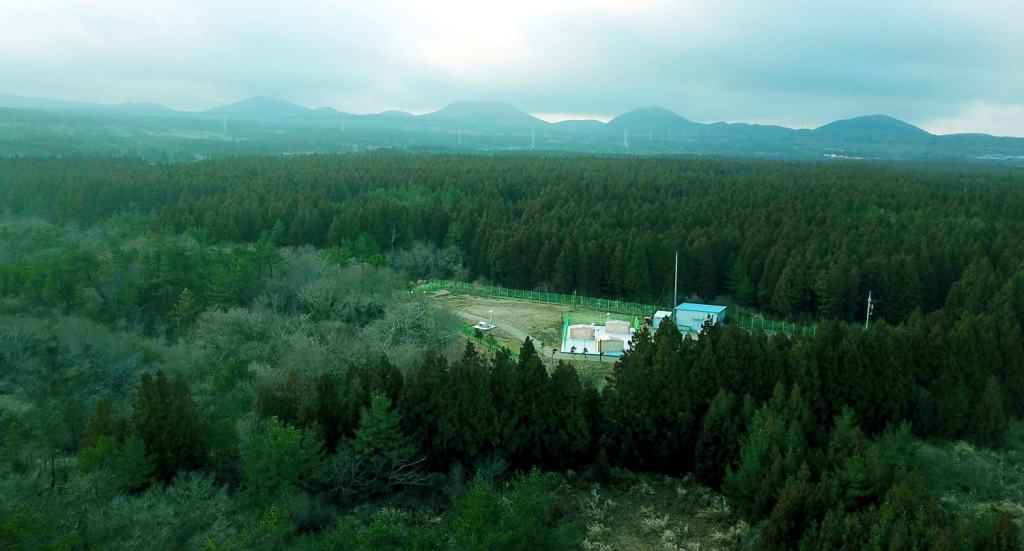
Jeju Samdasoo has maintained the top spot in South Korea’s bottled water market since its introduction in 1998. The key to its success is the scientific and structured management of the raw water quality, sourced from Jeju’s untouched natural surroundings. Jeju is an island where Mount Halla, Gotjawal, oreums, and coastal areas are all present. Basalt formations, shaped by millennia of volcanic activity, gradually filter rainwater, creating pure groundwater. This natural purification process has led to water recognized as a unique clean water source worldwide.
Jeju Samdasoo, a type of ‘volcanic bedrock water’ sourced exclusively from Mount Halla, is characterized as a soft water with low mineral content, a gentle flavor, and a well-balanced mix of natural minerals including calcium, magnesium, and silica. Its pure and refreshing taste stems from Jeju’s volcanic landscape and an extended filtration process.
Jeju Samdasoo draws water from around 420 meters below the surface within Hallasan National Park, a region free from human disturbance. By relying on one specific source, it ensures consistent flavor and quality regardless of seasons, weather, time, or place.
As stated in the Jeju Island Hydrogeological and Groundwater Resource Comprehensive Survey Final Report, the typical age of this groundwater is 31 years. Rainwater that infiltrates Hallasan National Park at an altitude of 1,450 meters travels through volcanic soil and a scoria layer for over 31 years, undergoing natural purification processes that remove contaminants.
A representative from the Jeju Development Corporation, which produces and sells Jeju Samdasoo, stated, “We have acquired 716,600 square meters of land, equivalent to 100 soccer fields, surrounding the water source to fully prevent external pollution that might impact water quality. We are focusing particularly on protecting the water source by designating the Mount Halla area as a special management zone for groundwater and limiting development, among other initiatives.”
The Jeju Development Corporation continuously tracks groundwater levels and temperatures around the clock using a system of 113 water quality monitoring stations. Additionally, it performs more than 20,000 water quality assessments each year, which is ten times the number required by the Ministry of Environment’s regulations, and openly shares the findings on its online platform.
The quality advantage of Jeju Samdasoo is also backed by scientific studies. The ‘Drinking Water Research Institute,’ the sole facility of its kind within South Korea’s bottled water sector, features skilled personnel and modern equipment focused on analyzing water quality and researching safe drinking water.
Recognized in 2021 as the first bottled water company to achieve national certification as a ‘drinking water quality testing institution,’ it carries out water quality assessments on groundwater and spring water directly. To retain its status as a nationally certified organization, it needs to successfully undergo annual inspections by the National Institute of Environmental Research and the Ministry of Environment, thus guaranteeing the objectivity and transparency of its test outcomes.
Due to this management approach, Jeju Samdasoo has not encountered any instances of breaching water quality regulations in the 27 years since its introduction in 1998. It consistently meets the requirements set by international certification organizations like the U.S. FDA and Japan’s Ministry of Health, Labour and Welfare, demonstrating its global quality and safety standards.
Jeju Samdasoo has long upheld and implemented the belief that safeguarding the ecosystem that sustains the water source is crucial for ensuring clean water over time. Key initiatives include the preservation of Gotjawal, referred to as the ‘lungs of Jeju’ and the source of groundwater. The company has contributed a fund of 2 billion South Korean won to acquire private land within Gotjawal, leading efforts to stop uncontrolled development.
It is also emphasizing the sustainability of groundwater. 97% of Jeju Island’s tap water supply depends on groundwater. To safeguard this, an AI-driven advanced water resource management system has been implemented. Jeju Samdasoo has created the ‘Integrated Water Resource Information System for Water Sources (i-SGMS)’ to gather extensive data including rainfall, groundwater levels, and changes in water quality in real time. Utilizing deep learning artificial intelligence (GRU) technology, it consistently monitors water sources and groundwater levels, and forecasts groundwater changes through big data analysis to take proactive measures.
It also implements a rigorous policy limiting the amount of groundwater that can be extracted. The annual recharge of groundwater on Jeju Island is about 1.758 billion tons, while Jeju Samdasoo is allowed to extract only 1.656 million tons per year, which is 0.09% of the total recharge.
Baek Kyung-hoon, head of the Jeju Development Corporation, stated, “Jeju Samdasoo maintains scientific management and sustainable water practices to safeguard its distinct asset of a single water source from Mount Halla. Guided by the principle of preserving Jeju’s pristine resources, we will keep fulfilling our public responsibility in protecting the global environment.”

 jasdooit
Leave a comment