

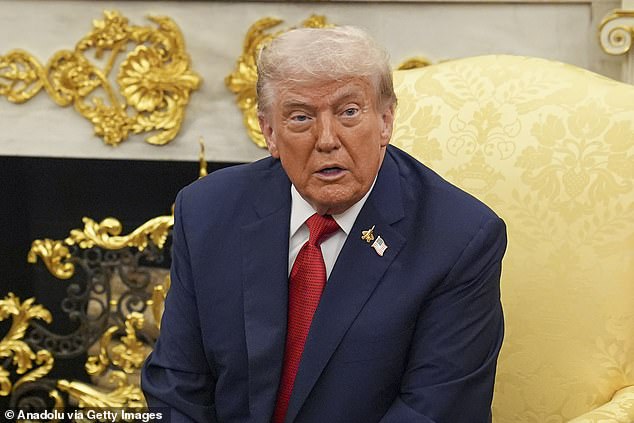
Donald TrumpHe stated he would be applying a 100 percent tax on any film produced outside the United States.
The U.S. President did not outline the timing or method for implementing the tariff, but should he carry out the recent threat, it would represent the first instance of Trump imposing a charge on a service instead of a physical product.
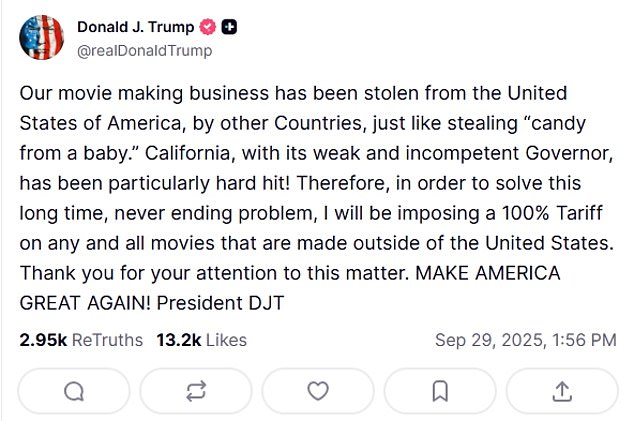
Trump shared the announcement through a post on his Truth Social platform, asserting that American film production is falling behind global rivals.
“Our film production company has been taken away from the United States of America by other nations, much like taking ‘candy from a baby,’” he wrote.
He proceeded to condemn He continued to censure He moved on to denounce He went ahead to rebuke He carried on to attack He followed up with a critique He then expressed disapproval He proceeded to castigate He continued to express criticism He went further to criticizeGavin Newsom, CaliforniaThe governor has been described as ‘weak and incompetent,’ with the state suffering significant consequences.
Therefore, to address this long-standing, never-ending issue, I will be implementing a 100% Tariff on all movies produced outside of the United States. Thank you for your attention to this matter. MAKE AMERICA GREAT AGAIN! President DJT
Nevertheless, it was not immediately evident which legal power Trump would employ to enact a 100 percent tax on imported films.
The president first warned of a 100 percent tax on foreign-made movies in May of this year but provided minimal information, causing uncertainty among entertainment leaders about whether it would affect certain nations or all imports.
It is typical for both major and smaller films to have production elements in the US as well as other countries.
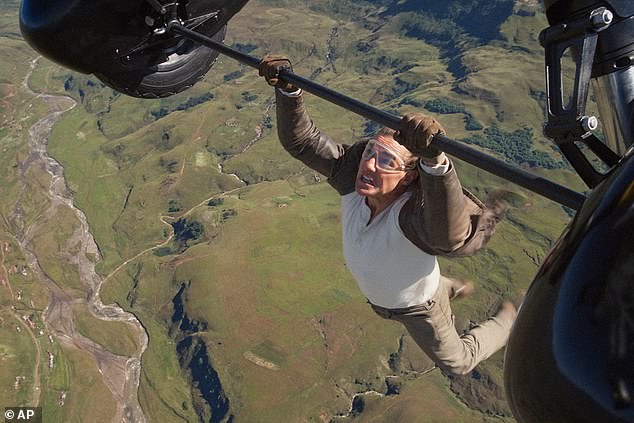
High-profile films such as the soon-to-be-released Mission: Impossible – The Final Reckoning are frequently filmed across different countries. The movie featuring Tom Cruise was shot in Britain, Norway, South Africa, and Malta.
The vice chairman of United Talent Agency, one of the biggest companies in Hollywood, informed CNN at that time that Trump’s action would essentially stop film production globally: ‘It has the power to bring the film industry to a complete halt – which is the opposite of what Hollywood requires following two strikes and a shortage of content.’
At that moment, Trump stated he had given the Department of Commerce and the Office of the US Trade Representative permission to levy a 100 percent tax “on any and all films entering our country that are made in other countries.”
The leader has consistently expressed worries regarding film production shifting abroad.
Just before assuming his position, he revealed that he had selected actors Mel Gibson, Jon Voight, and Sylvester Stallone as ‘special ambassadors’ to Hollywood, aiming to bring it ‘BACK-BIGGER, BETTER, AND STRONGER THAN EVER BEFORE!’
Kirsty Bell, the head of production company Goldfinch, stated that the entertainment sector is experiencing a downturn “throughout the entire Western world,” although she emphasized that tariffs are not the solution.
She stated: “The problem isn’t that international movies are surpassing local ones, but rather that, first of all, films are less expensive to produce abroad due to the absence of tax incentives in some regions… the unions, the lower labor costs, and budget allocations have significantly decreased over the past two years, all influenced by shifts in how people watch content.”
People are no longer visiting cinemas as frequently, and there has been a decrease in subscription services alongside the growth of social media platforms and content creators… the entire industry has undergone significant changes.
She stated, “The solution isn’t tariffs if his goal is to revitalize the film industry in Hollywood. It’s about creating a new environment for filmmaking that stands apart from anything seen previously.”
There are significant transformations required in the structure of the entertainment industry.
Bell questioned the functionality of the tariff and mentioned that blockbusters like Barbie, distributed by the US film studio Warner Bros Pictures, “was almost entirely filmed in the UK.”
“If those American movies aren’t partially made or made in the UK, freelancers will end up without work. I’m telling you, they really will be out of work,” she stated.
Studio executives also informed Reuters earlier this year that they were ‘confused’ about how a movie tax could be implemented, considering that contemporary films frequently involve production, funding, post-production, and visual effects spread across various countries.
However, this move indicates Trump’s intent to apply protectionist trade policies to cultural sectors, creating uncertainty for studios that rely significantly on global box office earnings and international co-productions.
The decision has sparked doubt among legal and trade experts. Some claim that movies represent a type of intellectual property and are part of the international trade of services, a sector where the US typically has a surplus, leading to doubts about the legal justification for tariffs.
Collaborations with international studios have also grown more frequent, raising questions about how these films would be categorized.
Hollywood plays a significant role in the US economy, creating over 2.3 million jobs and generating $279 billion in revenue in 2022, as reported by the Motion Picture Association.
However, following the Hollywood strikes and the Covid pandemic – which altered how Americans watched films, choosing to view them at home rather than in cinemas – the sector has faced challenges in regaining its previous pace, according to industry experts.
The tweet from Trump did not specify whether the television show would be affected.
In a subsequent post, the president issued another trade warning — a promise to levy tariffs “on any nation that does not manufacture its furniture in the United States.”
However, he once again did not indicate when these tariffs were supposed to be put into effect.
It followed the president’s statement on Thursday that he intended to impose individual tariffs, varying from 25 percent to 100 percent, on branded pharmaceuticals, kitchen cabinets, and large trucks.
They were scheduled to begin on Wednesday, he mentioned, with patented pharmaceutical products facing 100 percent tariffs unless companies were establishing production facilities in the United States.
Trump once again emphasized his warning regarding imported furniture, stating that North Carolina “has entirely lost its furniture industry to China and other nations.”
- Could a strict 100% tax imposed by Trump lead to the downfall of international filmmakers and trigger a worldwide trade conflict within the film sector?
- Is Trump launching a conflict against Hollywood through his striking new 100% film tax initiative?
- What caused anger within the film sector as Trump warned about imposing taxes on foreign films?
- Could President Trump’s latest tariff proposal pose a significant risk to the growing foreign film production industry?
- What effect will Trump’s aggressive tariff policy have on Hollywood’s endurance and provoke a strong trade reaction?


 jasdooit
Leave a comment