
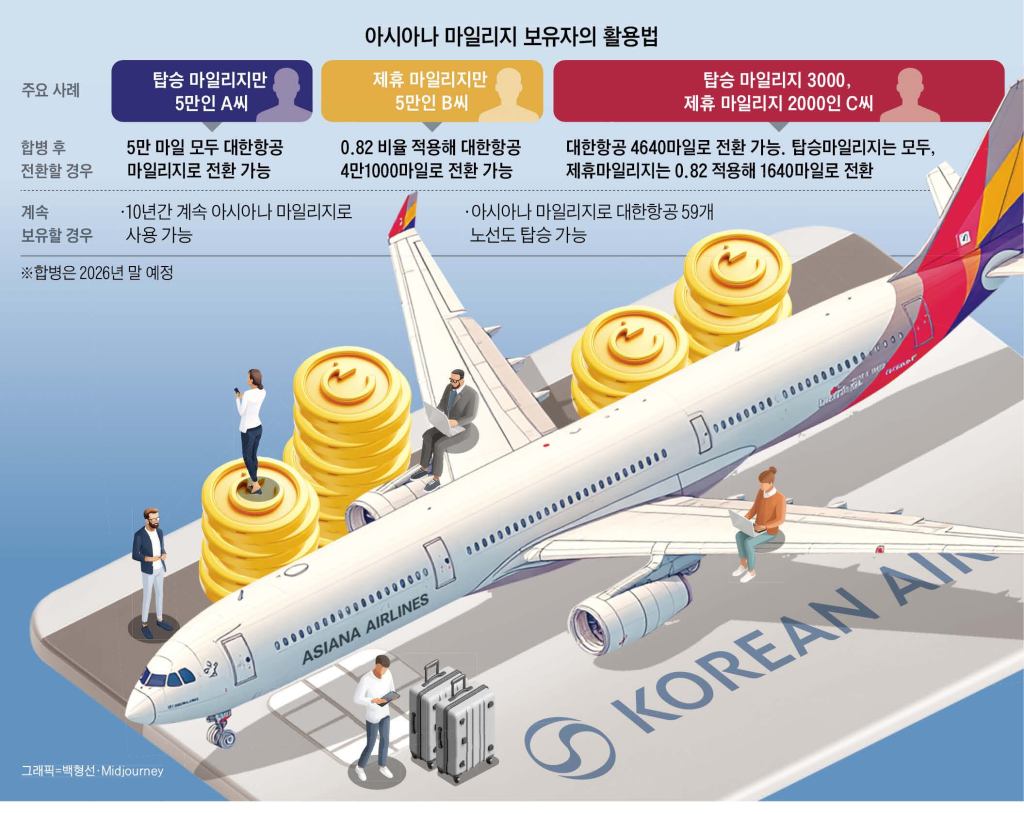
The Korea Fair Trade Commission (KFTC) disclosed on the 30th its intention to combine Asiana Airlines’ loyalty points for customers after the merger with Korean Air. The main detail is that Asiana Miles will remain valid for 10 years following the completion of the merger. Moreover, ‘flight’ miles obtained through air travel will be exchangeable for Korean Air Miles at a 1:1 rate, whereas ‘affiliate’ miles collected via credit cards and other means will be exchangeable at a 1:0.82 rate. This integration strategy will be finalized after a two-week public feedback period and a complete KFTC committee evaluation, with implementation anticipated as early as the end of next year once the merger is completed.
Q1. What will become of Asiana Miles following the merger?
Asiana Miles will be handled independently for a decade following the merger. The remaining duration of current miles will be completely secured. This implies that passengers can keep using them without needing to switch to Korean Air Miles during this time. After the combined Korean Air begins operations, Asiana Miles—previously available only on Asiana’s 69 routes—will also be applicable to Korean Air’s 59 unique routes, enhancing their value. The rules for redeeming miles to buy bonus tickets or upgrade seats will continue to follow Asiana’s initial guidelines.
Q2. What is the process to convert Asiana Miles into Korean Air Miles?
After the integration, customers can convert their Asiana Miles into Korean Air Miles at any time through Korean Air’s website. However, all miles must be converted in a single transaction. ‘Airline miles’ earned from flights will be converted at a 1:1 ratio, whereas ‘affiliate miles’ from credit cards and other sources will be converted at a 1:0.82 ratio. For instance, a customer with 10,000 airline miles and 10,000 affiliate miles will receive 18,200 Korean Air Miles (10,000 + 8,200). The 1:0.82 ratio for affiliate miles seems to resolve concerns about unfair treatment, as Korean Air typically gives 1 mile for every 15 Korean won spent on credit cards, while Asiana offers 1 mile for every 11–12 Korean won.
Q3. Is it better to keep Asiana Miles or switch them?
Customers should first review the percentage of affiliate miles they own. As Asiana Miles can be kept and utilized under current conditions for 10 years, converting affiliate miles—which leads to a loss—is not required. However, if airline miles make up a larger share, merging them into Korean Air Miles might provide greater ease. Combining both mileage systems could also allow for the application of long-haul bonus tickets. Furthermore, members should take into account that consolidating miles may result in a reassessment of their membership level. If this reassessment leads to a higher tier than previously held, the conversion becomes more beneficial. Notably, during the reassessment, airline miles are combined, and the higher of the existing or new tier is applied.
Q4. What will occur to Asiana’s top-tier membership categories?
Asiana passengers will automatically be granted equivalent Korean Air membership levels, providing comparable advantages after the merger. A KFTC representative mentioned, “No customer will be placed in a lower tier than their present status.” In order to match Asiana’s five-tier system, Korean Air introduced a new ‘Morning Calm Select’ tier to its prior three-tier structure. Asiana Platinum members will correspond to Korean Air’s Million Miler tier, Diamond Plus (lifetime) members will be aligned with Morning Calm Premium, Diamond Plus (24-month) and Diamond members will be part of the new Morning Calm Select tier, and Gold members will be associated with Morning Calm.


 jasdooit
Leave a comment