
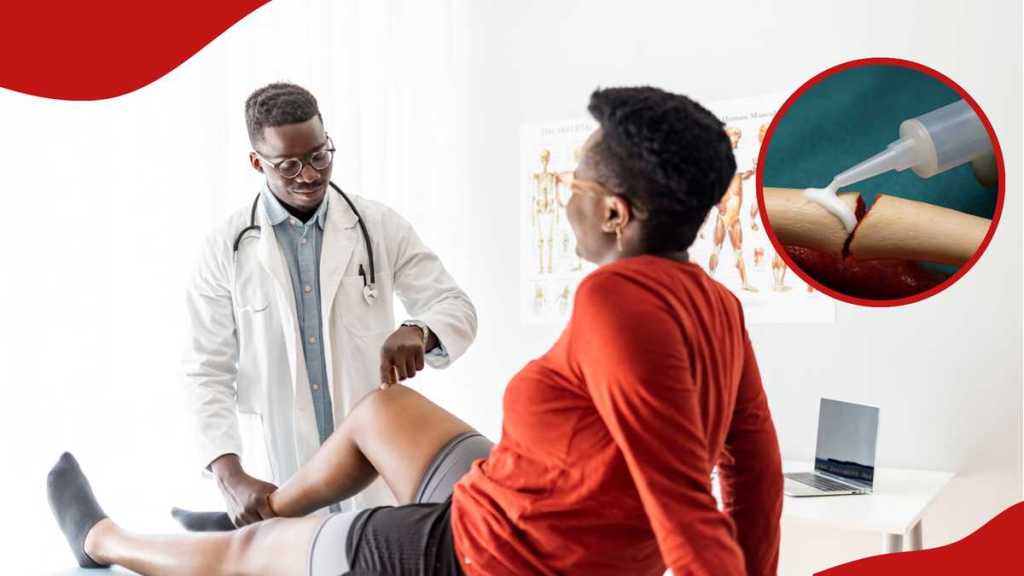
- A group of Chinese researchers introduced a novel bone glue that can mend broken bones within just three minutes, sparking optimism for a potential worldwide transformation in orthopaedic treatment.
- The adhesive, evaluated in more than 150 instances, substituted metal plates and screws by means of a single injection via a small incision.
- Drawing inspiration from oysters attaching themselves to rocks, the material adheres to bone pieces even in blood-rich environments where conventional glues fall short.
- Researchers said the breakthrough came after four decades of trials, with results showing faster healing and fewer complications
Didacus Malowa, a journalist at .co.ke, brings over three years of experience covering politics and current affairs in Kenya.
Researchers in China have announced a significant medical advancement through the creation of ‘Bone-02,’ a biocompatible adhesive capable of repairing broken bones within just three minutes.

The innovation, developed at Zhejiang University’s Sir Run Run Shaw Hospital, could transform orthopaedic treatment worldwide, offering a fast, minimally invasive alternative to traditional surgeries that often rely on metal plates and screws.
How does Bone-02 function in comparison to conventional surgery?
As per reports from Global Times and other sources, the adhesive enables physicians to mend fractured bones with a single injection via a minor incision.
Unlike conventional surgical approaches that take hours and require follow-up operations, Bone-02 bonds shattered fragments in minutes and is naturally absorbed by the body within six months, removing the need for implant removal.
Orthopaedic surgeon Lin Xianfeng, part of the development team, said the glue works even in blood-rich environments, where traditional adhesives fail.
Tests demonstrated that the adhesive’s bonding strength is greater than 400 pounds, with compressive strength approximately 10 MPa and shear strength close to 0.5 MPa.
In one instance, a patient suffering from a broken wrist received treatment via a single injection made through a 3 cm incision.
The break was stabilized within three minutes and completely recovered in three months with no issues.
What motivated the development of this bio-inspired adhesive?
Experts mention that the idea was inspired by oysters, which produce a natural adhesive that allows them to stick securely to underwater areas that are regularly subjected to waves, dampness, and wear.
By adopting this principle, the team developed a bio-inspired adhesive that withstands pressure and maintains stability in moist settings, which are comparable to the conditions found within the human body.
The breakthrough focuses on one of the biggest issues in orthopaedics: complex fractures, where bones shatter into several pieces.
These wounds are challenging to address using plates or screws since accurately positioning small pieces is frequently unattainable.
Inability to restore correct positioning can result in bone deterioration, slower recovery, or injury to the joint, which may develop into post-traumatic arthritis.
Bone-02 solves this by enabling quick attachment of pieces without requiring major surgical procedures.
Who was responsible for the creation of Bone-02?
A study from The China Academy indicates that the progress has taken several decades to achieve, with Professor Fan Shunwu, who started investigating the concept over 40 years ago, handing his idea on to Lin.
A significant moment occurred when Lin noticed oysters firmly attached to bridge supports in his coastal hometown of Wenzhou.
The revelation motivated the group to investigate if an analogous concept might function within the human body.
Following extensive research, design, and safety evaluation, the adhesive proved to be a viable option.
Bone-02 has been applied in over 150 clinical cases throughout China, with results indicating quicker recovery, lower infection rates, and improved healing outcomes when compared to conventional metal fixation methods.
Medical professionals state that its minimally invasive approach also decreases tissue damage, reduces surgery duration, and eliminates dangers associated with major incisions and hardware-related issues.



 jasdooit
Leave a comment