
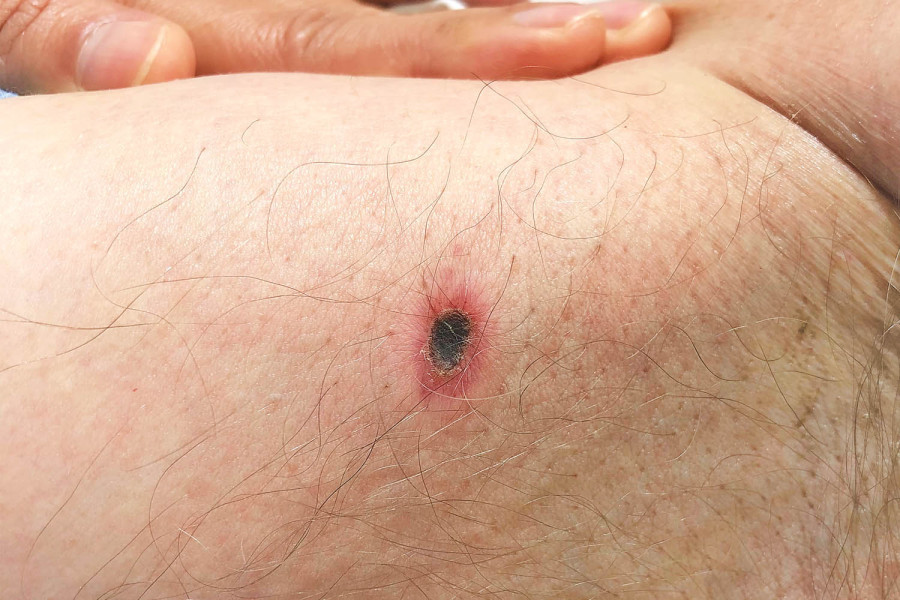
Nepal, September 30 — A 40-year-old man was recently hospitalized at Sukraraj Tropical and Infectious Disease Hospital (STIDH) after experiencing fever for five days, along with intense headache, joint pain, red eyes, and nausea. During the examination, a scab referred to as “eschar” was found on his right thigh. He also mentioned having difficulty breathing when exerting himself. Serological tests confirmed the presence of scrub typhus. In a similar case, a 30-year-old woman was admitted to STIDH with a five-day history of high fever, headache, and severe abdominal pain. She too reported experiencing noticeable shortness of breath. Another female patient was admitted to STIDH after having a fever for seven days, and she had already experienced shortness of breath before the fever started. All these patients are from Kathmandu.
Previously, most cases of scrub typhus in Nepal came from suburban or rural regions. However, in recent weeks, the STIDH laboratory has identified dozens of daily cases of scrub typhus among feverish patients in Kathmandu, signaling a rare but quickly developing outbreak. In other words, Kathmandu is now experiencing one of its most significant scrub typhus outbreaks.
Rickettsial disease, caused by the bacterium Orientia tsutsugamushi, is spread to people via the bite of infected larval mites, often referred to as chiggers, with rodents serving as primary carriers. Research carried out by the Nepal Health Research Council (NHRC) revealed that chiggers were present in 25 percent of the rodents tested, indicating a substantial risk of an outbreak. Since rodents are frequently found in homes in Kathmandu, the likelihood of future outbreaks remains high.
Common symptoms of scrub typhus usually emerge between five to 20 days following contact with an infected chigger mite, with an average incubation time of 10-12 days. Symptoms often include a high fever, skin rash, intense headache, redness in the eyes, swollen lymph glands, nausea or vomiting, and excessive sweating. Notably, I have noticed that shortness of breath is present in nearly all patients, a symptom that is frequently missed by medical professionals. It may typically manifest in a mild manner and is not commonly found in standard medical references. However, during the 2025 Kathmandu outbreak, individuals experienced difficulty breathing. A key indicator is the formation of a dark scab, referred to as “eschar,” at the location of a chigger mite bite.
Earlier, I noticed “eschar” marks on the chest, buttocks, groin, thighs, and underarm areas. In the current outbreak, eschars were found in one out of three patients (around 33 percent). Indeed, many patients are unaware of eschars. This may be due to their occurrence in less noticeable or uncommon parts of the body.
Scrub typhus usually reaches its highest incidence during the rainy season, when other infectious diseases like dengue, leptospirosis, typhoid fever, and malaria are also prevalent. As a result, initial symptoms often overlap, making it difficult to differentiate based solely on clinical signs. Nevertheless, the occurrence of high fever, difficulty breathing, and an eschar is a strong indicator of scrub typhus, although laboratory tests are still necessary for confirmation. Currently, there is no vaccine available for scrub typhus; however, the condition can be successfully treated with antibiotics, which are easily obtainable in Nepal.
Another troubling matter is the rising occurrence of co-infection with the dengue virus. Currently, the dengue virus is spreading together with scrub typhus in Kathmandu. Consequently, numerous individuals presenting with fever are being identified with simultaneous infections. Recently, two febrile patients from the same family tested positive for both scrub typhus and dengue, showing evidence of a dual infection. Their medical symptoms were similar to those of scrub typhus, while laboratory results, such as low white blood cell count, elevated liver enzymes, and reduced platelet levels, aligned with dengue. Both patients recovered without any complications and did not require hospitalization.
Several studies indicate that being infected with both scrub typhus and dengue can result in more serious health issues, such as pneumonia, meningoencephalitis, and multiple organ failure. While these combined infections are becoming more common in Kathmandu, there hasn’t been a notable increase in severe cases yet. Nevertheless, the potential for serious illness due to these co-infections in the upcoming year remains a concern.
The reasons behind the rising cases of scrub typhus in urban regions like Kathmandu remain partially unclear, although various elements are thought to play a role. Fast-paced urbanization, changes in climate, and greater interaction between rodents and humans are likely responsible for the spread of this illness. Human actions, such as visiting green spaces, gardening, or trekking in surrounding hilly zones, can heighten the chances of coming into contact with chigger mites that live in bushes and grassy areas. In contrast, indoor activities may also result in scrub typhus, as rodents are frequently found in homes in Kathmandu. Many people who visit STIDH with rodent bites show how common rodents are in the city. Interestingly, most patients do not mention participating in outdoor activities, indicating that the disease might be transmitted indoors rather than solely through outdoor exposure, as was previously thought.
Overall, Kathmandu is currently facing an ongoing outbreak of scrub typhus following a prolonged period without cases. There is also a rising pattern of co-infection, with dengue virus circulating simultaneously with scrub typhus. While severe illness resulting from this co-infection has not been reported yet, it remains a possibility that cannot be excluded in the near future. In Kathmandu, the spread of scrub typhus might mainly take place indoors rather than through outdoor exposure, according to most patients. However, additional research is required to validate or challenge this finding.




 jasdooit
Leave a comment