
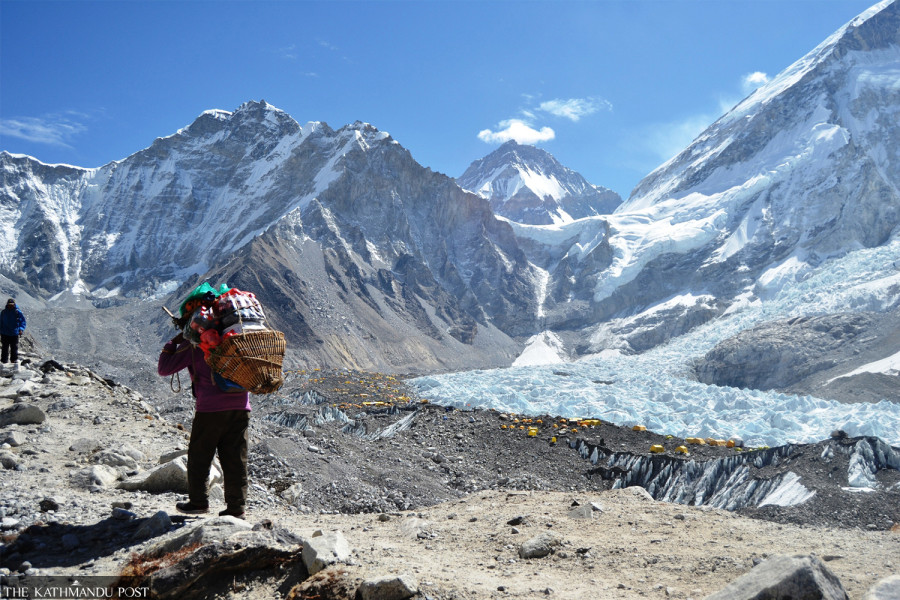
Kathmandu, September 30 — Nepal is getting ready to announce a five-year plan for cleaning Mount Everest, after a Supreme Court directive, as the world’s highest mountain–frequently referred to as Earth’s tallest garbage site–faces ongoing issues with waste accumulation.
Experts claim that the concerning level of waste gathered during each season highlights the critical importance of eco-friendly climbing methods. The thawing snow and ice due to global warming reveals trash that was once hidden and even human remains, increasing pollution of the water source and creating health dangers for people living downstream.
A preliminary version of the Clean Mountain Strategy (2025-2029), obtained by the Post, suggests a financial allocation of Rs308 million for initiatives aimed at cleaning up Everest.
However, insiders claim the actual cost will surpass Rs1 billion.
The proposal includes creating a group called “Mountain Rangers,” made up of climbers, to oversee and handle trash at Everest Base Camp and higher stations. The draft also suggests investigating the use of drones to gather waste located above the base camp.
For many years, the problem of litter has left a mark on the Everest area. Many climbers, Sherpas, instructors, and porters discard large amounts of trash—such as oxygen cylinders, plastic bottles, ropes, food remnants, and human waste—which contaminates both the mountain slopes and the communities below.
Plastic continues to pose a significant threat.
A single plastic bag may require as long as 500 years to break down naturally. When burned, it releases harmful substances into the atmosphere; when buried, it contaminates the earth. With the rise in climbing activity, plastic waste has gradually climbed higher on the mountain, transforming Everest into a clear representation of environmental disregard.
The approach is included in the Supreme Court’s directive,” stated Himal Gautam, head of the Department of Tourism. “It is currently a draft, but will be put into action shortly.
The draft highlights that reduced climbing seasons due to deteriorating weather conditions require more rigorous control. It suggests restricting climbing permits by evaluating the mountain’s ability to accommodate visitors and the availability of services.
The Supreme Court previously directed the government to grant permits exclusively following the declaration of the maximum number of climbers. This instruction was issued during periods of congestion on the summit ridge and as waste accumulation increased.
As per the Himalayan Database, a reliable climbing record maintained by the late Elizebeth Hawley, over 200 individuals lost their lives on the Nepal side of Everest from 1953, the year Edmund Hillary and Tenzing Norgay Sherpa made their historic ascent, up to 2022.
Data on waste collection also highlights the scale of the issue. The Sagarmatha Pollution Control Committee stated that 85 tons of trash were removed during the 2024 spring season, including almost 28 tons of human waste. The Nepali Army collected an additional 11 tons.
To ease the burden, Nepal has significantly increased climbing charges. According to new rules, the fee for foreign climbers using the south route during spring has risen from $11,000 to $15,000 per person.
According to the suggested plan, climbers will also need to pay a refundable waste deposit, which will be given back only when trash is returned, along with a non-refundable environmental charge.
A part of the income generated from climbing activities will be set aside for environmental cleanup efforts, including measures to engage the local community.
The approach indicates that expedition operators should also be subject to waste management charges based on the “polluter pays” concept.
A fund for a Mountain Cleanup Initiative will be established, and hikers will be obligated to transport their human waste in containers.
Industry experts state that Nepal is already behind schedule.
“In 2010, we suggested a $100 non-reimbursable charge per climber,” stated Dambar Parajuli, head of the Expedition Operators Association Nepal. “If it had been put into effect, the fund would have surpassed Rs1 billion by now.” China adopted a comparable policy in 2014.
As per Parajuli, Camp IV on Everest is the most contaminated location, and its cleanup demands significant resources. “We project at least Rs1 billion over five years,” he mentioned. “However, recurring policy shifts caused by unstable governments have hindered ongoing efforts.”
The proposed plan enforces more rigorous guidelines for equipment and supplies.
Teams responsible for securing ropes above the base camp must submit an annual report on their use of ladders and nylon ropes—approximately 400 kg of which is left behind every year, as stated by the Nepal Mountain Academy. These ropes, frequently covered by snow, may remain in place for many years.
Banners and prayer flags located above the base camp need to be biodegradable and follow uniform standards.
Non-biodegradable items need to be returned for inspection. Each climber is required to carry back a minimum of 3 kg of garbage, which will be checked at Camp II by both Mountain Rangers and waste management groups.
Toilet bags will be required beyond the base camp, with officials verifying that climbers return them. Each climbing expedition’s gear list will also be recorded to maintain responsibility.
The approach also highlights openness and worldwide involvement. Advancements will be communicated globally, and an external independent monitoring group will carry out yearly evaluations. A GPS-driven tracking system will be tested to keep track of climbers’ locations.
Furthermore, the government intends to incorporate environmental consciousness into regional syllabi and implement educational resources across the country.
Certain actions have already been initiated.
Starting from 2024, climbers beyond the base camp must utilize waste bags as part of a program led by the Sagarmatha Pollution Control Committee and Khumbu Pasang Lhamu Rural Municipality.
Given Everest’s worldwide reputation is on the line, officials believe the new approach will reconcile climbing aspirations with environmental care. However, specialists warn that if funding does not match the magnitude of the problem, the world’s tallest mountain’s image as the most noticeable waste site may continue.



 jasdooit
Leave a comment