

Human beings are just a bit more intelligent than chimpanzees,” “It is claimed that humans are the smartest creatures on Earth, yet they are also the most damaging.
Renowned primatologist Dr. Jane Goodall, 91, who significantly advanced the field of ethology through her research on chimpanzees and reshaped perspectives on human nature, died on the 1st in California, U.S. The Jane Goodall Institute (JGI), which she established, stated, “Dr. Goodall passed away from natural causes while on a lecture tour in the U.S.” Prominent media outlets such as the Washington Post and France’s Le Monde covered her passing, describing her as “a person who made a deep impact on modern science.”
Goodall became well-known for her daily observations and documentation of wild chimpanzee behavior in Tanzania’s Gombe forest, beginning in 1960. In November of that year, she witnessed a male chimpanzee called David Greybeard using a modified stick to extract ants, which demonstrated that “chimpanzees create and use tools” for the first time. This finding challenged the long-standing idea that humans were the only species capable of making tools. Her research later received worldwide recognition after being featured in National Geographic. Her study at Gombe continues to be one of the most enduring observational studies of wild animals.
Her approach was distinct from conventional academic practices during her era. She gave names to individual chimpanzees—such as Flo and Fifi—rather than using numbers, a method that faced criticism as “anthropomorphism” for attributing emotions and characteristics to them. Nevertheless, years of collected video and documentation demonstrated intricate social behaviors including hunting, forming alliances, grieving, and power dynamics, which significantly transformed perspectives in the study of animal behavior. The Washington Post remarked, “Her findings challenged the arrogance that ‘animals act on instinct’ and ‘humans are rational.’”
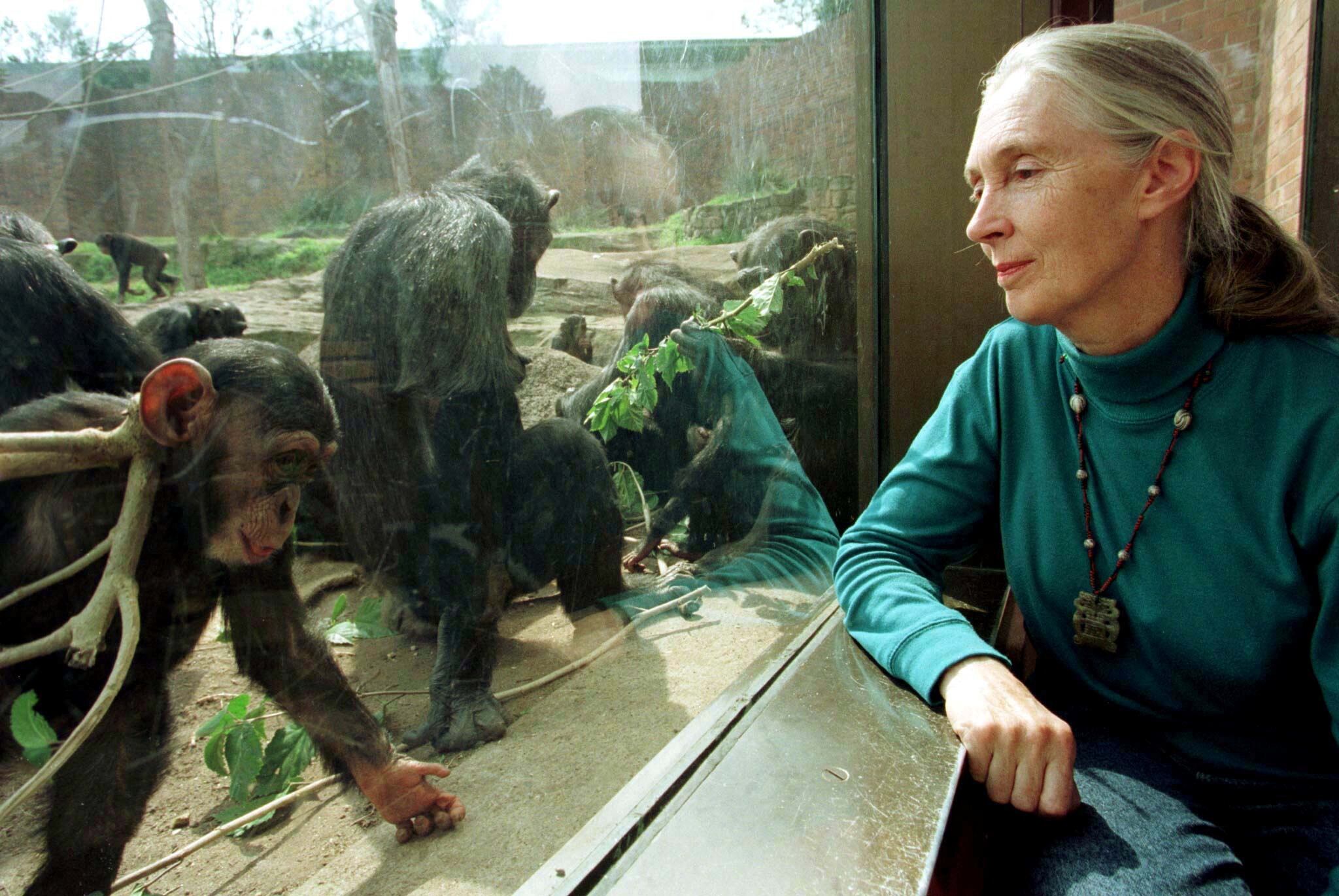
In the late 1970s, Goodall shifted from being a field scientist to a conservationist. In 1977, she founded JGI to safeguard Gombe’s research and broaden habitat conservation initiatives in collaboration with African communities. In 1991, she initiated Roots & Shoots, a youth-driven program aimed at protecting endangered species and local environments, which gained traction in schools and communities around the globe. Reuters noted, “Seeing habitat destruction turned the scientist into an activist.”
Numerous international accolades came her way. In 2002, she became a UN Messenger of Peace. In 2021, she was honored with the Templeton Prize for advancements in human spirituality and ethics, and in January of this year, she received the U.S. Presidential Medal of Freedom, the country’s top civilian award. She was commended for “promoting human values and peace through science and environmental preservation.”
Goodall promoted a philosophy of “hope.” In her 1999 book *Reason for Hope: A Spiritual Journey*, she shared insights about her life, saying, “Opting for hope instead of despair is what motivates action.” Even in her later years, she gave hundreds of lectures each year around the globe. Time magazine referred to her as “a quiet yet determined advocate for hope.” Throughout the COVID-19 pandemic, she connected with Generation Z via online talks and podcasts.
Born in 1934 in London, England, she was the daughter of a businessman and former British Army officer, and a writer. She spent her childhood in Bournemouth, a seaside town in southern England. From an early age, she exhibited a strong fascination with animals, especially chimpanzees. Her mother consistently encouraged and supported her enthusiasm. Her bond with chimpanzees started with a stuffed chimpanzee named Jubilee, given to her by her father. This “comfort item,” which she treasured all her life, is now on display at JGI.
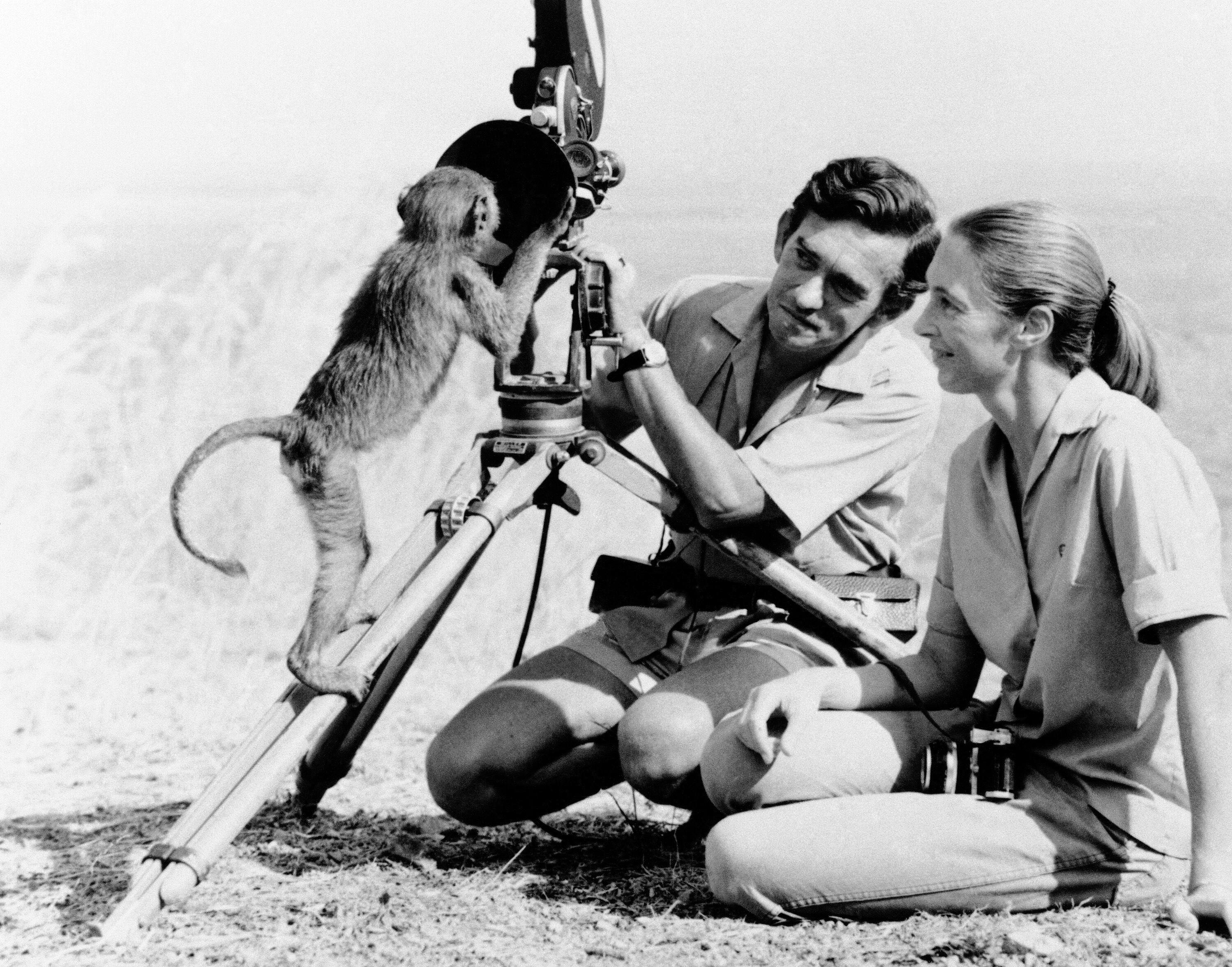
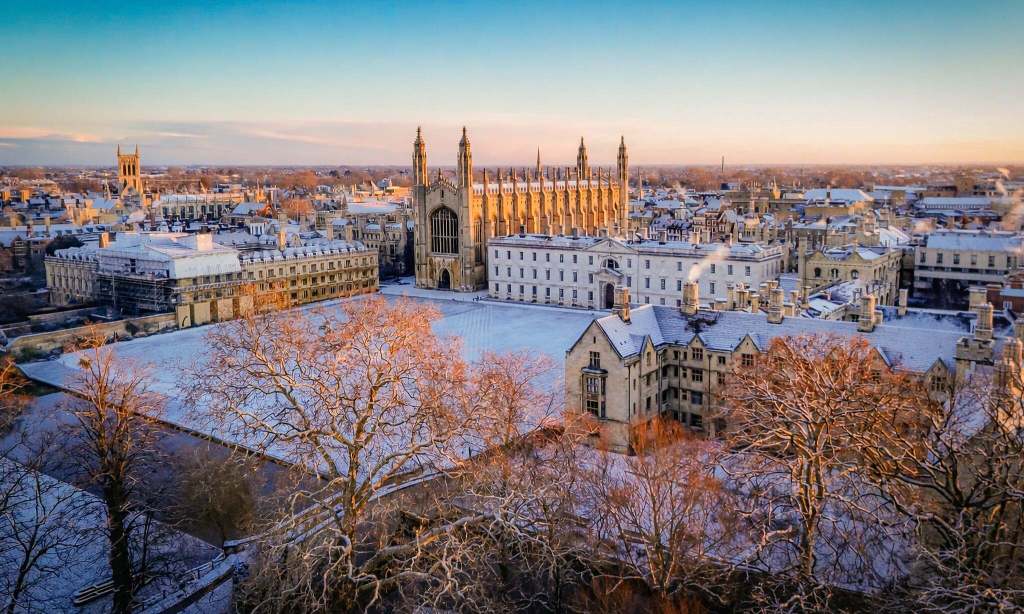
Goodall’s journey into chimpanzee research was supported by British paleoanthropologist Dr. Louis Leakey, a trailblazer who uncovered Homo habilis fossils in East Africa and demonstrated that humans originated in Africa. Leakey encountered Goodall while she was serving as his secretary in Africa in 1957, and he was impressed by her sharp ability to observe. Although she had no formal academic qualifications, he chose her to head the Gombe chimpanzee study. The project’s achievements enabled her to obtain a Ph.D. from Cambridge University in 1966.
In 1964, Goodall married Dutch wildlife photographer Hugo van Lawick, and they had a son named Hugo Eric Louis. However, their marriage faced challenges due to differing research methods and ways of living, which eventually led to their divorce in 1974. Their son grew up in Gombe, interacting with chimpanzees—something his father reportedly did not support. In 1975, Goodall married Derek Bryenson, who was the director of Tanzania’s national parks, but he passed away in 1980. She later reflected, “I learned to deal with grief through nature.”
The Guardian described her as “an unyielding champion for the natural world,” while Le Monde recognized her as “a trailblazer who encouraged us to reconsider humanity through the lens of chimpanzees.” Goodall challenged the distinction that clearly divides humans and animals in nature. Her impact—ranging from habitat restoration and handling human-wildlife interactions in the era of zoonotic diseases to motivating youth-driven climate initiatives—demonstrates that the languages of science and ethics can come together.

 jasdooit
Leave a comment