
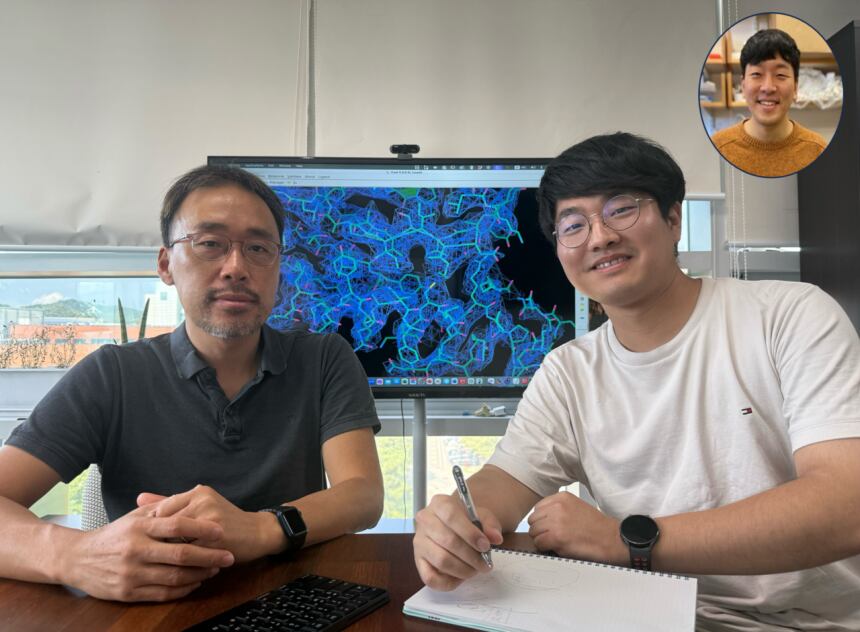
A research group from KAIST has found that the Huntington protein is essential for constructing the neuronal cytoskeleton in healthy situations. The results were featured in the global academic publication *Science Advances* on the 19th of the previous month.
◇Huntington Protein Contributes to Neuronal Cytoskeleton Formation
A team of researchers headed by Professor Song Ji-jun from KAIST’s Department of Biological Sciences reported on the 1st that they discovered, through the use of methods like cryo-electron microscopy and different cell biology techniques, that the Huntington (HTT) protein—responsible for Huntington’s disease—interacts with and reinforces the cytoskeleton inside nerve cells.
The research was carried out through an international partnership involving the Institute of Science and Technology Austria (ISTA), Sorbonne University and the Paris Brain Institute in France, as well as the Swiss Federal Institute of Technology Lausanne (EPFL).
Although the Huntington protein is frequently thought to be responsible only for Huntington’s disease, it is actually advantageous. It helps move substances inside cells. Nevertheless, genetic changes can interfere with normal cell activities and result in the illness.
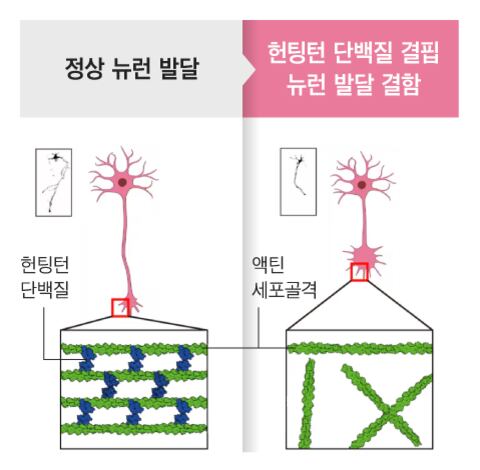
Expanding on this, the KAIST team further found that the Huntington protein directly organizes the cytoskeleton and establishes its structural support. Significantly, they identified for the first time that pairs of Huntington proteins position the cytoskeleton at intervals of about 20 nanometers, forming a structure crucial for the formation of neural networks.
◇Failure in Structural Development Occurs Without Huntington Protein
The group also noted that neurons without the Huntington protein were unable to form appropriate structural structures. This discovery is anticipated to offer fresh insights into why Huntington’s disease leads to neuronal impairment and dementia-like characteristics.
The first author, Kim Jaesung, a doctoral student at KAIST, said, “We have recently clarified the molecular function of the Huntington protein, which was previously unknown, providing a new way to comprehend the mechanisms behind Huntington’s disease, an illness that currently has no cure.”
Professor Song Ji-jun stated, “Discovering the new role of the Huntington protein could lead to important consequences, not just for Huntington’s disease, but also for research into other degenerative conditions that involve issues with the cytoskeleton, like Alzheimer’s, Parkinson’s, and muscular atrophy.”



 jasdooit
Leave a comment