
SaturnEnceladus, the moon, might containalienlife existing far beneath its subterranean seas, as stated by the European Space Agency (ESA).
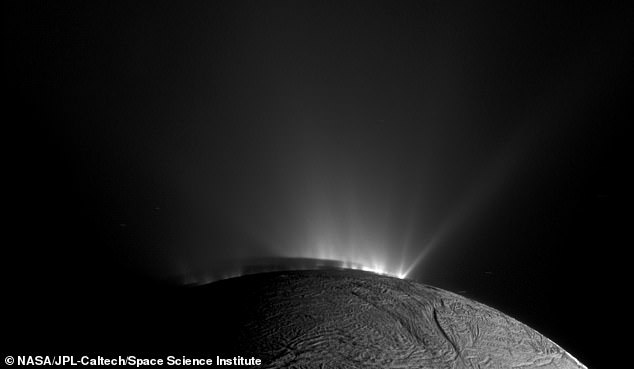
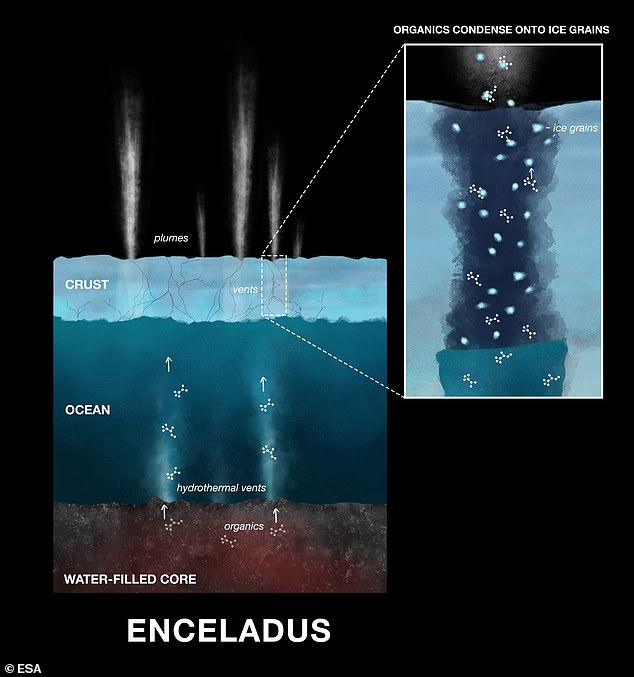
Although the moon might seem desolate, near the South Pole,small ice particles are continuously being ejected into the cosmosthrough gaps in the frozen surface.
By utilizing data gathered by the Cassini probe, researchers have discovered that these ice particles contain a variety of intricate organic compounds.
A recent study suggests that some of these molecules might be involved in the sequence of chemical processes that eventually result in life.
The scientists state that this finding indicates Enceladus now “meets all the criteria” to be a place able to sustain life.
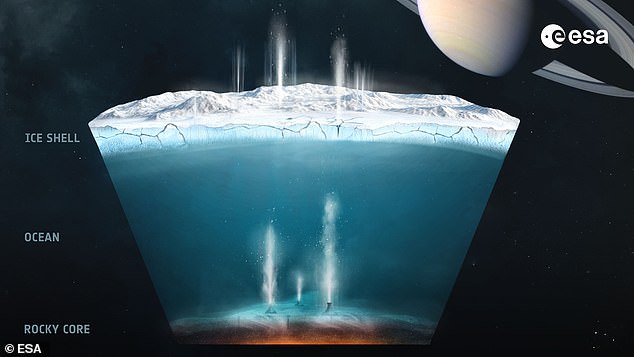
The moon possesses a continuous supply of liquid water, an energy source provided by hydrothermal vents, and the appropriate combination of chemical elements along with complex organic molecules.
This does not necessarily confirm that life is already present on Enceladus, but itincreases the probability that Saturn’s moon could support life.
Lead researcher Dr. Nozair Khawaja from Freie Universität Berlin stated: ‘Even if no signs of life are found on Enceladus, this would still be a major discovery, as it prompts important questions about why life isn’t present in such an environment when the necessary conditions exist.’
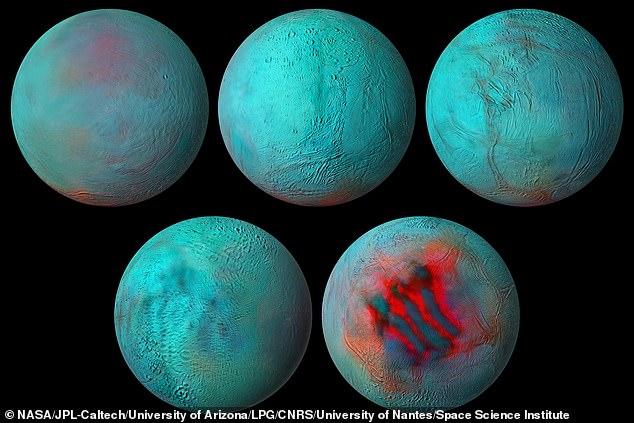
With a diameter of 310 miles (500 km) – about as wide as Arizona – Enceladus is Saturn’s sixth–largest moon.
On the surface, conditions are exceptionally cold with temperatures as low as –201°C (–330°F).
Nevertheless, in 2005, researchers found that a vast body of water was located beneath the frozen layer.
Water jets burst forth like geysers from openings near the South Pole, and although some return to the surface, others escape and create a ring around Saturn that follows the moon’s path.
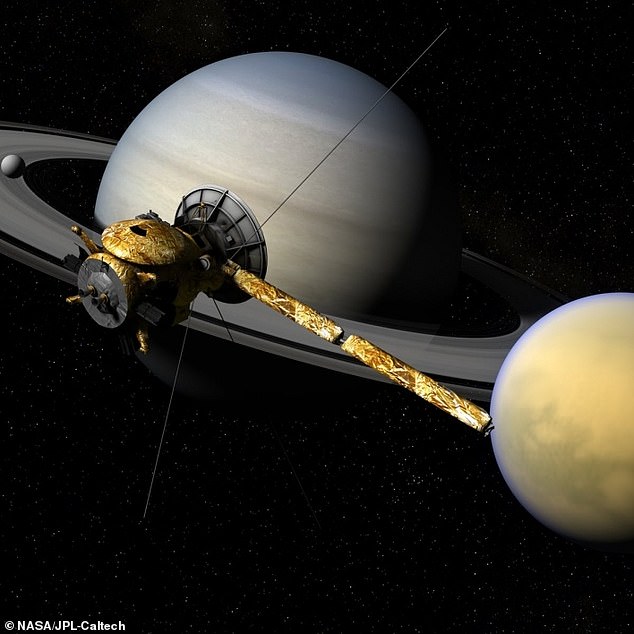
When the Cassini probe passed through Saturn’s rings, it collected samples of these ice particles and discovered that theyshowed signs of complex chemical reactions that could be associated with life.
Dr Khawaja says: ‘Cassini was detecting samples from Enceladus all the time as it flew through Saturn’s E ring.
‘We had already found many organic molecules in these ice grains, including precursors for amino acids.’
But some of these grains were hundreds of years old, so the scientists couldn’t be sure whether the chemicals within had been altered by radiation from the sun.
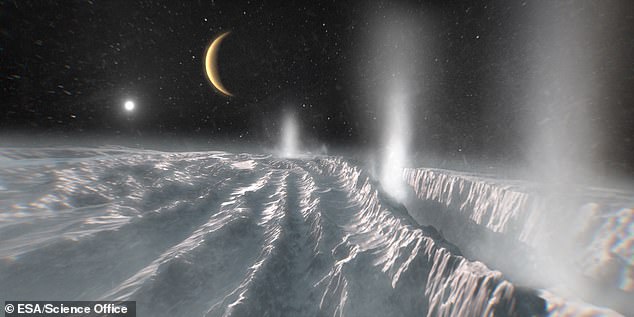
That changed when Cassini flew straight through Enceladus’ spray in 2008, gathering ice crystals on its Cosmic Dust Analyser (CDA) as they emerged from the moon’s interior.
As Cassini sped through the cloud at 11 miles per second (18 km/s), it obtained the most recent and rapid data ever recorded.
That velocity significantly impacts the data’s quality, as it enables researchers to distinguish water from other intriguing compounds.
“At lower collision speeds, the ice breaks apart, and the signal from groups of water molecules can mask the signal from specific organic molecules,” says Dr. Khawaja.
But if the ice particles strike the CDA quickly, water molecules do not aggregate, allowing us to observe these previously concealed signals.
Following years of analyzing the extensive data gathered by Cassini, Dr. Khawaja and his colleagues have ultimately verified that these new ice crystals also include organic compounds.
These molecules contained some that had been identified near Saturn and some previously undiscovered compounds.
This implies that the molecules present in Saturn’s rings and in Enceladus’ icy geysers must have originated within the moon’s ocean, rather than being produced afterward through interactions with sunlight.
On our planet, these organic compounds play a role in the sequences of chemical processes that result in life, suggesting the exciting chance that Enceladus might host living organisms.
Dr. Khawaja states: ‘There are numerous potential routes from the organic molecules identified in the Cassini data toward compounds that could be biologically significant, which increases the probability that the moon is capable of supporting life.’
In the future, the European Space Agency intends to send a mission to Enceladus, aiming to gather additional ice particles from the plumes at the South Pole and potentially touch down on the moon’s surface.
This would mark the first instance in which a space agency has successfully touched down on Enceladus, potentially providing further insights into the potential environment suitable for life.
- Can NASA’s massive Europa Clipper project reveal the mysteries of a hidden icy moon that may contain extraterrestrial life?
- Might NASA’s ambitious Europa Clipper mission reveal the fascinating building blocks of life beneath its rugged icy surface?
- Is it possible that alien life might be nearer to Earth than previously thought, hiding beneath the frozen surface of Miranda, one of Uranus’ moons?
- Has NASA discovered clear signs of ancient water that could have supported life on Mars?
- Could human scientists have been observed on Saturn’s moon Titan, revealing hidden alien mysteries?




 jasdooit
Leave a comment