
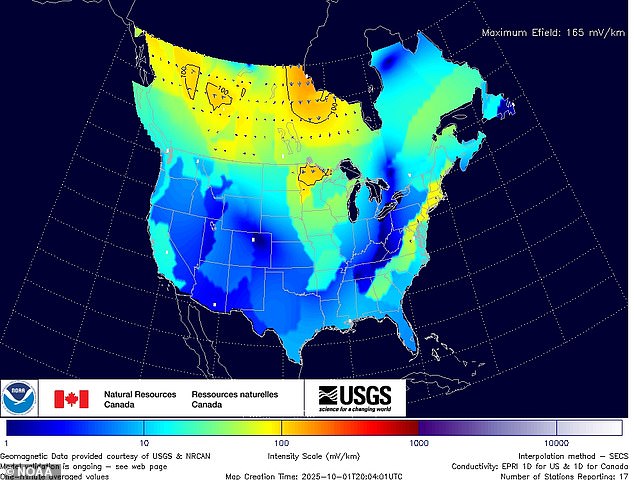
A moderate space weather alert was issued on Wednesday following the appearance of holes on the sun.
Changes in the Earth’s magnetic field are known as geomagnetic storms.resulting from charged particles emitted by the sun, like solar wind.
These weather events may cause small disruptions in the power supply, impact satellite functions, and result in auroras that can be seen in northern regions.
The National Oceanic and Atmospheric Administration (NOAA) stated that the effects will be slight, with only limited consequences for certain technological systems.
The warning stated that U.S. states located at higher latitudes, mainly above approximately 55° geomagnetic latitude, might face slight power variations, including the northern parts of Washington,Wisconsin, New York, Michigan and Maine.
Other northern states close to the Canadian border, such asMinnesota, North Dakota and Montana, could also be impacted.
The warning was activated when the geomagnetic K-index, which measures fluctuations in Earth’s magnetic field, hit 5 at 3:46pm ET.
As per NOAA’s prediction, intense geomagnetic activity is anticipated to reach its highest point between 5:00 PM and 8:00 PM ET, with the Kp index expected to rise to approximately 5.7, marking a moderate G2-level storm.
The heightened activity in Earth’s magnetic field has resulted from a flow of high-speed particles originating from a gap in the sun’s atmosphere,called a coronal hole.
This flow of particles, referred to as solar wind, moves at velocities as high as 500 miles per second.
The magnetic field transported by the solar wind across space, known as the Interplanetary Magnetic Field, has changed direction toward the south on multiple occasions.
These changes may lead to increased instability in the Earth’s magnetic field.
Consequently, the geomagnetic storm has ranged from G1 (Minor) to G2 (Moderate) on the NOAA Space Weather Scale, a framework employed by researchers to characterize the intensity of space weather events.
Picture a powerful wind striking a flagpole. Such storms are categorized on a scale ranging from G1 (minor, similar to a gentle breeze) to G5 (severe, comparable to a hurricane).
NOAA has cautioned that there is a high probability of geomagnetic storm conditions occurringcontinue through the eveninglike a rapid flow of solar wind, moving at speeds between 430,000 and 500,000 miles per hour, keeps impacting Earth.
Besides the effects on technology, the solar storm is anticipated to create stunning auroras, commonly referred to as the northern lights.
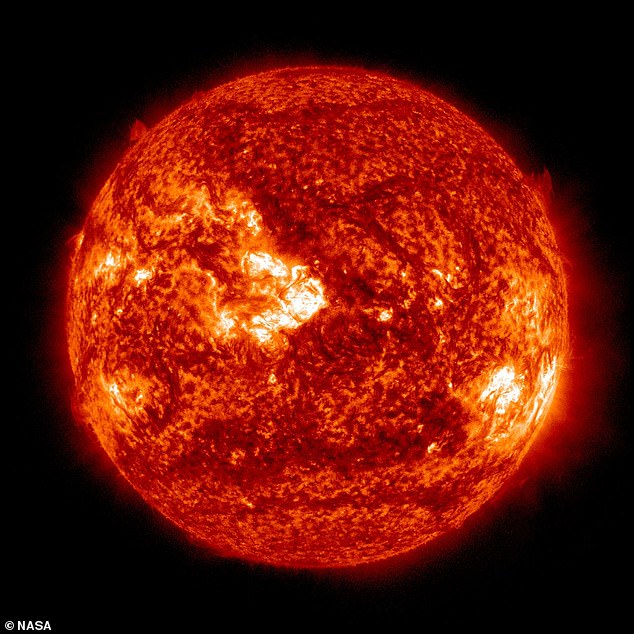
These vibrant light shows happen as charged particles from the sun interact with gases in Earth’s atmosphere, producing stunning shades of green, pink, red, and purple.
Usually observed only close to the poles, auroras can appear more towards the south during intense geomagnetic storms.
In this scenario, people living in Alaska, Oregon, Idaho, Montana, North Dakota, Minnesota, Wisconsin, and New York mightget a view of the lights later on Wednesday night.
Experts recommended that although the storm is not expected to lead to major issues, those managing power grids in high-latitude areas and satellite systems should keep an eye on the situation, while amateur radio enthusiasts might experience disruptions in high-frequency communications.
NOAA stated that geomagnetic storms are a normal aspect of space weather, resulting from the sun’s active processes, and usually fade as the high-speed solar wind diminishes.passes Earth.
- Will a moderate geomagnetic storm cause disturbances in technology tonight? NOAA alerts about possible power grid issues and radio outages during this fascinating Northern Lights occurrence.
- Could NASA’s geomagnetic storm monitoring lead to breathtaking auroras or cause harm to Earth’s power systems and satellites?
- Could stunning auroras illuminate the skies as far south as New York during a threatening geomagnetic storm?
- For how long might the hazardous G3 geomagnetic storm threaten Earth’s systems, and are you prepared for significant disruptions?
- What potential effects could a large geomagnetic storm have on everyday life and technology worldwide?



 jasdooit
Leave a comment