
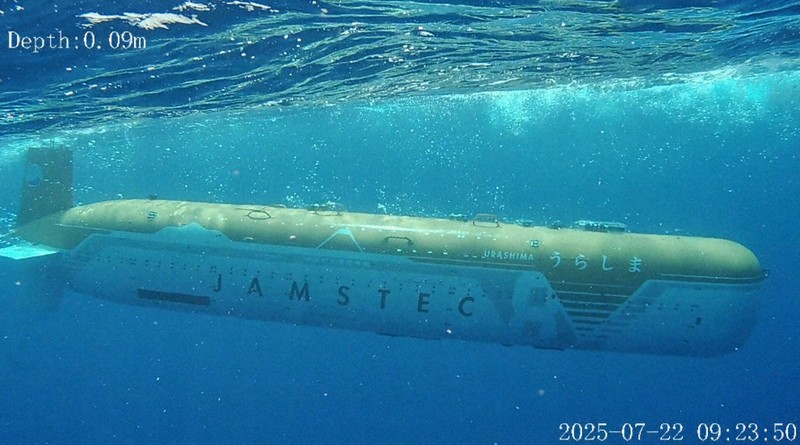
The Mainichi addresses certain queries that readers might have regarding Japan’s Urashima 8000 submersible and its expeditions.
Question: What is the Urashima 8000 autonomous underwater vehicle (AUV)?
Answer: Initially, it was known as the AUV Urashima, able to reach depths of 3,500 meters. It began undergoing changes in 2022 to enable deeper dives.
Deep underwater, the vehicle travels approximately 100 meters above the ocean floor, employing sonar to chart the topography and firmness of the terrain, along with geological formations lying up to 100 meters beneath the seabed. Although sonar mapping can be conducted from surface vessels, the Urashima 8000 offers 100 times greater detail than surface-based observations because of its close proximity to the ocean floor.
Q: How does it move through the deep ocean?
A: As GPS signals cannot penetrate the deep ocean, navigation paths are pre-set. The vehicle communicates with its surface ship using sonar to precisely locate itself, and it continuously measures acceleration to assess its position along the route.
A: What type of studies are being carried out?
A: Following several trial voyages, in July the Urashima 8000 explored the Izu-Ogasawara Trench, which is the deepest trench near Japan. It also carried out test observations at Takuyo-Daisan Seamount off the Boso Peninsula of Chiba Prefecture, believed to contain abundant rare mineral resources such as cobalt-rich crusts, and in the Japan Trench near Miyagi Prefecture in the northeastern part of the country, which was the epicenter of the 2011 Great East Japan Earthquake.
A: What has been found out?
A: In the Izu-Ogasawara Trench, the ocean floor, which was once believed to be flat, was found to have complex features with valleys approximately 40 meters deep. Toshiya Fujiwara, a senior researcher at the Japan Agency for Marine-Earth Science and Technology (JAMSTEC), shared his astonishment and joy, stating, “I was amazed by the detailed data and felt a pleasant sense of wonder regarding its interpretation.”
Q: What extent has been examined?
A: Fujiwara’s research group examined a region comparable to Koto Ward in Tokyo (covering roughly 41 square kilometers) over a distance of 141.7 kilometers and 25 and a half hours of travel in the Japan Trench. They discovered a cliff with a maximum elevation difference of approximately 60 meters running north-south, thought to mark the boundary of the land that shifted eastward during the Great East Japan Earthquake, along with several ridges and grooves featuring elevation differences between 30 and 50 meters to the west.
Investigating the underground structure showed that the sediment layers were shifted or curved in certain areas, featuring intricate fault networks extending in north-south and east-west directions. Fujihara mentioned, “We aim to conduct a thorough analysis of the data and understand how this landscape developed.”
Q: Is Urashima responsible for all of Japan’s deep-sea exploration activities?
A: Capable of diving to approximately 8,000 meters, the vehicle can access 98% of Japan’s Exclusive Economic Zone (EEZ). Nevertheless, although it is effective for large-scale seabed mapping, it is not able to fully reach the ocean floor to capture images from the bottom or gather samples of sediment and marine life.
Q: Are there alternative approaches?
A: Different types of exploration vehicles are being created for various functions and underwater depths.
For the “Full Depth” challenge at the deepest part of Earth’s surface, which is 11,000 meters, a system that includes an underwater observation device installed on the seabed and a compact autonomous exploration vehicle is under development. The observation device features a substantial power source for continuous monitoring and communication with surface ships. It has already been successfully tested at a depth of 9,200 meters. The small exploration vehicle, expected to start functioning around 2027, will move independently along the seafloor while gathering samples of marine organisms and rocks.
Q: Is it possible for humans to descend that far?
A: The manned submersible Shinkai 6500 from Japan has uncovered many significant findings. Constructed in 1989, it was at the forefront of deep-sea exploration, yet research organizations and private enterprises abroad are currently creating vehicles capable of descending even deeper. The Shinkai 6500 is expected to reach the end of its designed operational life in the 2040s, although no definite plans for a replacement have been established due to the high costs and technical difficulties involved.
The present strategy aims to make the most of current vehicles and carry out research expeditions effectively by allocating different tasks to a range of exploration vehicles, including those that are unmanned. The mother ship Yokosuka, which houses several exploration vehicles, is also expected to be replaced by the 2030s, enabling the simultaneous use of multiple vehicles and increasing efficiency threefold.
Q: Does this imply that research will continue to progress?
A: Japan’s deep ocean areas offer a wide range of research opportunities, such as disaster prevention concerning earthquakes, tsunamis, and undersea volcanoes, along with studying marine plastic pollution and exploring valuable mineral resources on the seabed and deep-sea life forms. The upcoming missions of different exploration vehicles are eagerly awaited.
(Japanese original by Tomoko Mimata, Lifestyle, Science and Environment Department)

 jasdooit
Leave a comment