

- MORE: A puzzling cosmic object could be responsible for an unknown signal sent towards Earth 48 years ago
NASAhas become dark just hours before humans are set to have their closest view of the enigmatic object hurtling through oursolar system.
The interstellar object named 3I/ATLAS is set to approach as close as 18 million miles toMarson October 3, its nearest approach to a planet this year.
Two space probes circling the planet Mars, Mars Express and ExoMars, are getting ready to capture Earth’s most detailed image and nearest scans of the mysterious object, which researchers have largely determined is an unusual comet from another part of the solar system.
Nevertheless, once these readings are received, NASA might choose to say nothing about the actual nature of the object.
NASA has stated that its official website will remain unchanged during the government shutdown, leading to thousands of federal workers being sent home without receiving their salaries.
It’s unclear whether NASA staff will make any announcements regarding the object’s close pass by Mars, similar to the history-making press conference that unveiled the finding of microorganisms on Mars in September.
The shutdown couldn’t have come at a worse time, as scientists say Friday’s flyby could answer many questions about the mysterious comet, including whether it’s actually an object of extraterrestrial origin.
Harvard astrophysicist Avi Loeb has argued that 3I/ATLASpossesses too many complicating features to be merely a straightforward comet passing through the solar system.
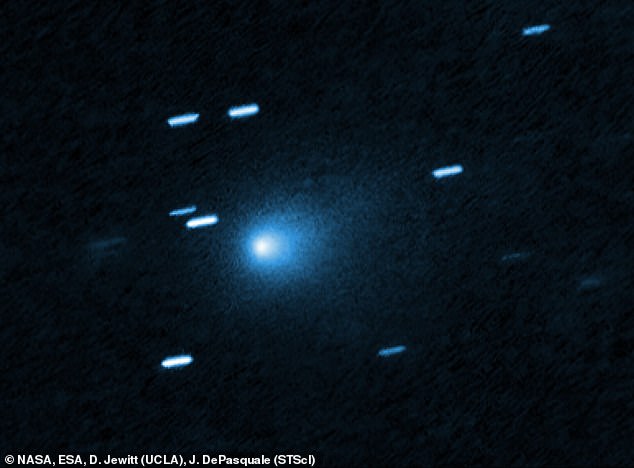
‘Hopefully, we will gain a lot more insight into 3I/ATLAS in the next few days,’ Loeb said to the Daily Mail on Thursday.
The professor mentioned that both Mars Express and ExoMars began their observations of the object on October 1 and will keep analyzing it until Tuesday, October 7.
Loeb mentioned that he is intrigued by several of the results the space probes will be able to gather while being so near to 3I/ATLAS, stating that the data might finally reveal if it is a comet or an artificial object.
“The image and structure would be the two most significant observations,” Loeb disclosed.
Since being identified by an amateur astronomer this summer, the general belief has been that 3I/ATLAS is a comet with a chemical makeup that is different from anything previously observed.formed inside our solar system.
In September, researchers from Michigan State University revealed that 3I/ATLAS was releasing gas or dust into space well before it began its journey toward our sun, an uncommon behavior for a far-off comet.
Their study in the Astrophysical Journal Lettersdetermined that this indicated it contained a distinctive set of molecules, such as carbon monoxide, an odorless gas commonly generated by burning wood or fossil fuels.
Nevertheless, Loeb and his team have uncovered additional evidence suggesting the interstellar object is something different,including its remarkably unique path through the solar system and its possible enormous dimensions.
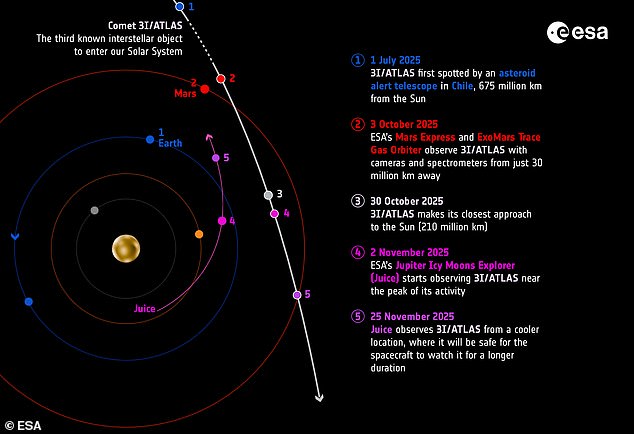
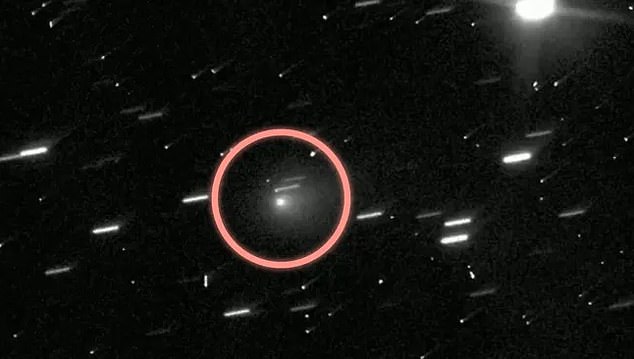
According to previous scans and images of the supposed comet, Loeb estimated that 3I/ATLAS could be more than three miles in length.
However, NASA has mentioned that it might be as short as 1,444 feet long, which would still classify it as a ‘city-killer’ if it were to hit Earth.
“The recent data gathered during the Mars encounter is expected to shed light on some of the peculiarities of 3I/ATLAS, such as its unusual size and makeup, but it won’t account for its unique orientation relative to the planets’ ecliptic plane and its rare timing in approaching Mars, Venus, and Jupiter,” Loeb explained.
NASA and the European Space Agency have stated that the significant meeting on Friday regarding Mars should also address uncertainties about the comet’s path through space and its characteristics.
High-definition images and spectral data will offer greater insight into the object’s core, tail, and coma – the luminous, hazy cloud of gas and dust that surrounds it.
Nevertheless, certain researchers have already rejected other hypotheses regarding 3I/ATLAS.
Jonathan McDowell, an astronomer and astrophysicist affiliated with the Harvard–Smithsonian Center for Astrophysics, stated: ‘It is undoubtedly a natural comet; claims to the contrary are dismissed by those who are true comet specialists.’
- Could the recent interstellar find by NASA, 3I/ATLAS, be our nearest brush with extraterrestrial machinery, or simply a luminous comet passing through the cosmos?
- Is the enigmatic interstellar object 3I/ATLAS a harmless comet or a threatening UFO that heralds disaster for Earth?
- Will the upcoming trip beyond Earth reveal further mysteries of comet 3I/ATLAS, sparking our quest for extraterrestrial life?
- Harvard versus skeptics: Is the enigmatic 3I/ATLAS an extraterrestrial invention or a terrestrial comet? Explore the controversy captivating researchers!
- Is the massive 3I/ATLAS an impressive extraterrestrial vehicle or merely a typical comet moving through our solar system?





 jasdooit
Leave a comment