
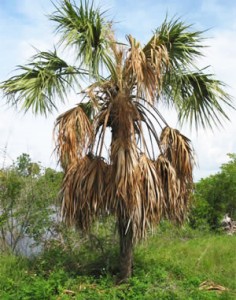
Palm trees enhance the scenery throughout Africa, flourishing in a wide range of habitats including deserts and rainforests. Central Africa is the most diverse region, with 52 species, followed by West Africa with 38 and East Africa with 18. These trees are part of a worldwide family that includes 2,600 palm species.
Africa has a limited number of palm species in comparison to other tropical areas globally. Nonetheless, palms are crucial to the social and economic aspects of life for many people across the continent. They serve as a source of food and drinks for both humans and animals, are utilized in healthcare and traditional medicine, and are transformed into building materials. Additionally, they hold significant spiritual and cultural value.
Read more: The loss of Madagascar’s unique palm trees will devastate ecosystems
Several botanical studies have placed the palm family, along with the grass and legume families, among the most economically and culturally significant plant groups in numerous rural areas across the continent.
We are a team of botanists from Benin, Côte d’Ivoire, and Switzerland, bringing together many years of expertise on the native palm species of Africa. Our study focuses on developing effective methods for preserving these palms and finding ways for local communities to utilize them in a sustainable manner.
At a recent Conference on African Flora in Ghana, we launched a new pan-African network for palm specialists from the continent to study and protect palms. Researchers from Guinea, Sierra Leone, Nigeria, Gabon, Congo, Ethiopia and Tanzania signed up for projects related to palm biology, uses and conservation.
We formally named this new network thePalm Scientists’ African Network.
Read more: Red gold: the rise and fall of West Africa’s palm oil empire
The network places palms at the centre of conservation projects. This is important because African palms are disappearing due to deforestation, overexplotation, and human-induced habitat loss. Some, such as Hyphaene guineensis or Sclerosperma profizianum, are rare. Their extinction would harm not only ecosystems but also the people who rely on them.
The African Network of Palm Scientiststhus also seeks to combine knowledge, record traditional understanding of palms, and educate the following wave of palm specialists.
The gradual growth pattern of a vulnerable tree
Although just a small number of palm species are found in Africacurrently face extinction, most palm species throughout the continent arenow in decline. Ghana is home to Sclerosperma profizianum, while Sierra Leone and Liberia are known for hosting several species of Eremospatha, which are considered some of the most endangered.
The oil palm (Elaeis guineensis), date palm (Phoenix dactylifera), and coconut (Cocos nucifera) are cultivated, while other species that are collected are primarily wild.
Even in the absence of disturbances, the natural regrowth of palms occurs at a slow pace. The seeds may require several months or even years to sprout, and the young plants also develop very gradually. They demand highly particular environmental conditions, like elevated temperatures and increased humidity. Certain species, such as rattan palms, can take several decades before reaching the required size for harvesting.
One of the key objectives of our study is to determine precisely the duration required for palms to germinate and become suitable for long-term harvesting.
Unfinished elements in the palms’ enigma
Elaeis guineensis (African oil palm), Cocos nucifera (coconut palm), and Phoenix dactylifera (date palm) have received significant attention due to their extensive use in food and beauty products.
Nevertheless, several African palm species including Borassus aethiopum (African fan palm), Raphia hookeri (raffia palm), Hyphaene compressa (doum palm), and the rattan palms (Laccosperma, Eremospatha, Calamus) are still not well recorded. This is true even though they are utilized for starch, fiber, wine production, and construction materials, as well as their significance in local traditions. For instance, the fruits of Borassus aethiopum are edible, and the palm is used for extracting wine, but improper tapping methods might threaten its survival.
Read more: A database initiative in Africa has documented 65,000 plant species – and continues to expand
In general, researchers still lack a complete understanding of the variety of African palms, their distribution across various environments, and their ability to adapt to changing conditions. This indicates that we have not yet determined the most effective methods for their sustainable management.
With the advancement of climate change, it is probable that certain palm species will struggle to adjust. Unusually high temperatures will decrease water supply and raise the salt concentration in the soil past the threshold that palms can handle.
What should occur next
First, the Palm Scientists’ African Networkwill assess the dangers that certain palm species encounter. We will subsequently suggest strategies tailored to regional conditions to support the preservation of palms.
Second, categorizing all African palm species and noting their locations is essential. We believe that at least 15% of indigenous African palms are not fully recorded (no flowers or fruits that could be beneficial to humans or animals have ever been observed and gathered from these palms).
Botanists across Africa must also carry out further studies on the reproductive methods of local palms, the conditions required for their seeds to sprout, and the genetic variation among them, in order to identify the most effective strategies for preserving these trees.
Read more: Fabulous plant life in Burkina Faso and Mali: new botanical discovery announced
Third, further study is required to determine how the palms mightcontribute to food security, climate adaptationand the preservation of biodiversity. Palms are significant not only to humans but also to various herbivores (mammals, birds) that heavily depend on palm leaves and fruits for their daily sustenance.
Fourth, a strategy for domestication is essential. Domestication refers to cultivating and encouraging the growth of palms in a managed manner that yields economic advantages. This can be achieved in agricultural plots. Nevertheless, we also suggest that it should take place under semi-controlled conditions within the forest. This approach may lessen the strain on wild palms, enhance the incomes of rural communities, and integrate palms into agroforestry systems (the practice of growing trees alongside crops).
Read more: Mistletoes, carob trees, and birds collaborate within Nigeria’s forest ecosystem
Although the new Palm Scientists’ African NetworkOnly focusing on the diversity of African palms, the conservation methods we create will be beneficial for preserving other plant species. Loss of biodiversity disturbs the fragile equilibrium of ecosystems across the globe. Safeguarding Africa’s palms may be essential for the survival of both humans and animals.
Fred Stauffer, Curator, Geneva Botanical Garden and Conservatory (CJBG)
Doudjo Noufou Ouattara, Associate Professor at Nangui Abrogoua University, located in Abidjan, Côte d’Ivoire, and Research Associate at the Swiss Center for Scientific Research in Côte d’Ivoire, with a focus on the Palm family (Arecaceae), Nangui Abrogoua University
Kifouli Adéoti, Lecturer at the Faculty of Science and Technology, University of Abomey-Calavi in Benin
Copyright 2025 The Conversation Africa. All rights reserved. Shared by AllAfrica Global Media ().
Tagged: Africa, Environment, Climate
Provided by SyndiGate Media Inc. (Syndigate.info).




 jasdooit
Leave a comment