
A dental specialist who had attained professional success experienced a sense of emptiness in his life until a unique exhibition in Turin,Italy, changed everything.
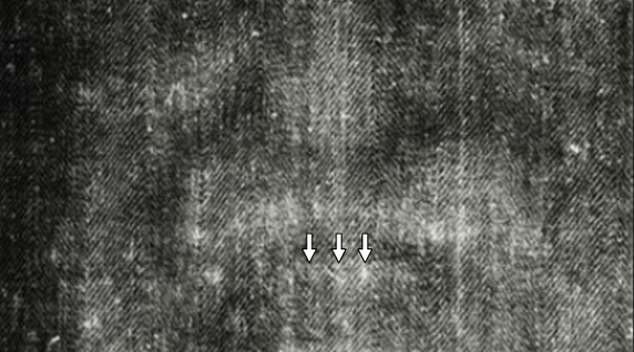
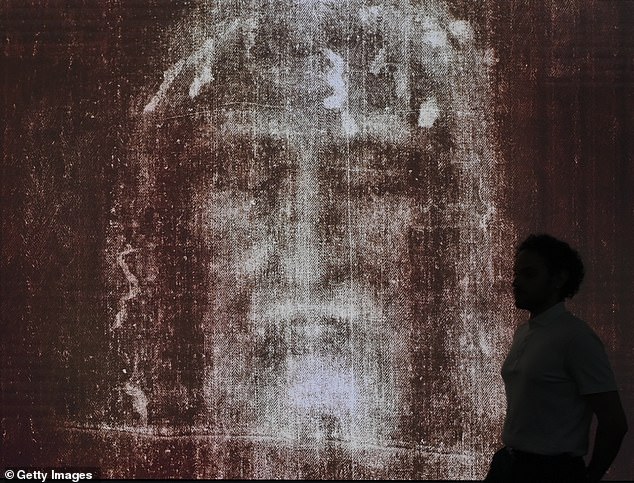
Dr John Sottosanti stood in front of the Shroud of Turin, the ancient linen thought to have wrapped Jesus’ body following his crucifixion, when he observed something very few had ever seen: the subtle shape of human teeth under the fabric’s mark.
In a recently conducted, not yet peer-reviewed study, Sottosanti found that he was able to identify the sharp edges of the lower front teeth, referred to as the incisal plane.
Although previous scholars have discussed the existence of upper and lower teeth, he determined that only the lower teeth are visible, probably because the upper teeth were concealed by the mustache and lips.
Right after death, a process known as primary flaccidity takes place, during which all the muscles in the body loosen, including those in the jaw,’ Sottosanti said. ‘This may cause the jaw to fall open and the teeth to move apart.
The level of detail, he stated, is remarkable: the lower teeth on the Shroud indicateThe body released a surge of glowing energyAt the time of the Resurrection, strong enough to leave an impression even on the tiniest physical characteristics.
“Assume that teeth, situated behind the lower lip, are clearly visible in the image on the Shroud,” Sottosanti stated.
In that scenario, their existence supports the idea that a surge of energy occurred during the resurrection, enabling them to appear in that form.
Nevertheless, not every expert is persuaded by the outcome.
Dr. Kelly Kearse, an immunologist who has conducted extensive research on the Shroud of Turin, stated to the Daily Mail: ‘The presence of visible teeth on the Shroud is a matter of personal interpretation and has been discussed for many years.’
In my view, though I’m not sure if it’s significant, I think it’s hard to determine due to the pattern of the fabric, which looks white in the negative picture.
Despite the skepticism, Sottosanti cited multiple published papersrecording dental findings in the impression.
Among these were photographs captured in 1982 by archaeological chemist Dr. Giles Carter, who proposed that X-radiation originating from inside the body could have formed the Shroud’s image, including details such as teeth and bones.
The research also emphasized the contributions of Dr. Alan Whanger, a Professor Emeritus at Duke University Medical Center, and his wife, Mary, who created the “Polarized Image Overlay Technique” to examine the Shroud.
By using a polarized filter to combine positive and negative images, they asserted that they could observe 20 upper and lower teeth, along with their roots.
In a 2023 conversation, New Testament scholar Gary Habermas stated: ‘You can clearly observe what seems to be teeth and roots… You can see the roots through the hair and the skin.’
Sottosanti responded, saying: “Habermas claims you can observe all the roots of the upper and lower teeth. I disagree, as throughout the Shroud image, there is a blending of the image with the weave pattern.”
In the region of the lower lip, at a specific location as you move away from the tops of the teeth, the pattern becomes more noticeable, and the vertical lines seem to resemble roots.
These markings go beyond the typical length of the teeth, indicating it is the pattern, not the real roots. Vertical lines can also be seen on the cheeks, chin, and other parts of the image.
The dental specialist mentioned that his knowledge of oral anatomy and surgical background enabled him to recognize what he thinks are sections of the lower teeth.
He claimed that these teeth look lighter compared to the nearby jawbone, indicating that the body’s impression preserved intricate anatomical features.
According to Sottosanti, the finding is remarkable: the lower teeth suggest that at the time of the Resurrection, the body emitted a surge of luminous energy strong enough to leave even the finest details on the linen.
“Imagine that teeth, situated behind the lower lip, are clearly visible in the image on the Shroud,” Sottosanti stated.
In that scenario, their existence supports the idea that a surge of energy occurred during the resurrection, enabling them to appear in that form.
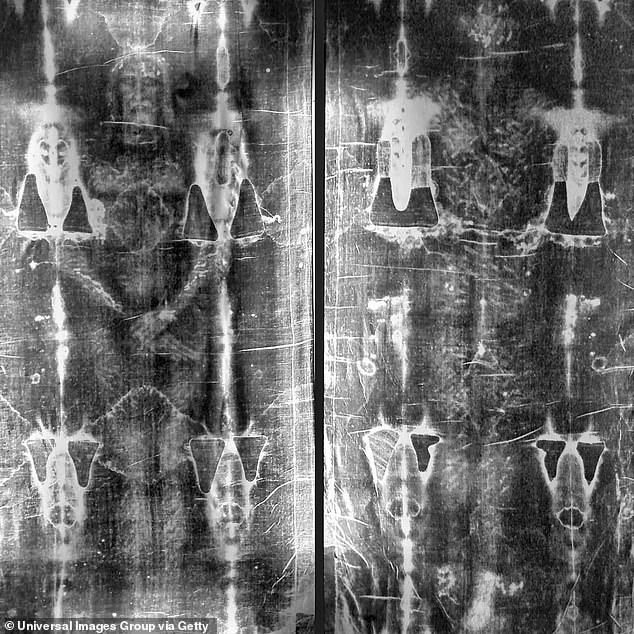
The Shroud displays a light, brownish depiction of a man who is five feet six inches tall, showing sunken eyes and injuries across his body that correspond to the wounds Jesus endured during his crucifixion.
Over 170 academic articles, reviewed by peers, have been released regarding the enigmatic linen since the 1980s, with numerous ones suggesting it is authentic.
A 1980 study examined a small section of the shroud and determined it to be from between 1200 and 1400.
Nevertheless, numerous scholars have proposed that the sample was an alteration made hundreds of years later.
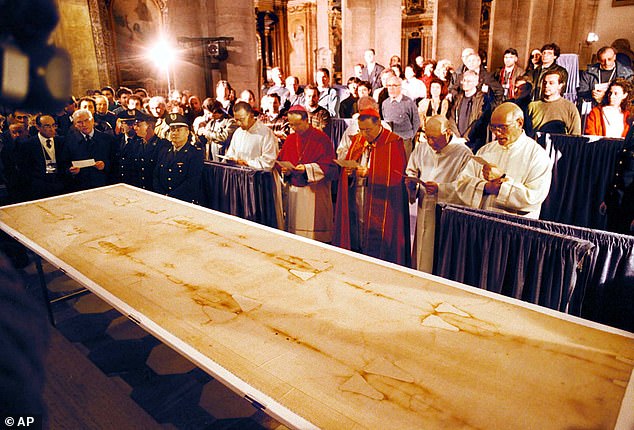
The shroud has intrigued historians, religious leaders, doubters, and Catholics since it was first shown to the public in the 1350s.
The French knight Geoffroi de Charny presented it to the dean of the church in Lirey, France, declaring it to be the Holy Shroud.
- Could new discoveries regarding the Shroud of Turin resolve the long-standing discussion about Jesus’ unclean burial?
- Has scientific analysis ultimately revealed the reality behind the Shroud of Turin’s ancient, mysterious picture?
- Is recent scientific research confirming the Shroud of Turin’s clear link to the biblical stories about Jesus?
- Is recent forensic analysis refuting the authenticity of the Shroud of Turin, indicating that it is actually an intricate medieval creation?
- Do the mysterious marks on the Turin Shroud truly correspond to the biblical stories of Jesus’ crucifixion, and is this artifact genuinely his shroud?



 jasdooit
Leave a comment