

Mr. Kim, a young job seeker in his 20s, first reserved a local lodging for a trip to Cambodia during this year’s Chuseok holiday but later canceled the booking. This change occurred following an increase in violent crimes against South Koreans in Cambodia, including kidnappings, arrests, and killings. “I had intended to visit Angkor Wat, a well-known spot for Koreans, but recent reports of criminal activities in Cambodia led me to cancel the trip,” Kim mentioned.
Once renowned for its cultural landmarks such as Angkor Wat and coastal getaways, Cambodia has now become a “nation dreaded by travelers.” With the rise in violent crimes targeting South Koreans, incidents like Kim’s—deciding to cancel visits to Cambodia—are becoming more common. On the afternoon of the 10th, Foreign Minister Cho Hyun called upon Cambodian Ambassador to South Korea Kuon Phonlatanak to request corrective actions.
As per the Korea Tourism Organization, 106,686 South Korean travelers visited Cambodia between January and July this year, marking an approximate 9% drop compared to the same period last year, which recorded 117,223 visitors. Following the end of the COVID-19 pandemic in 2022, the number of South Korean tourists visiting Cambodia had been consistently rising until this year’s decline.
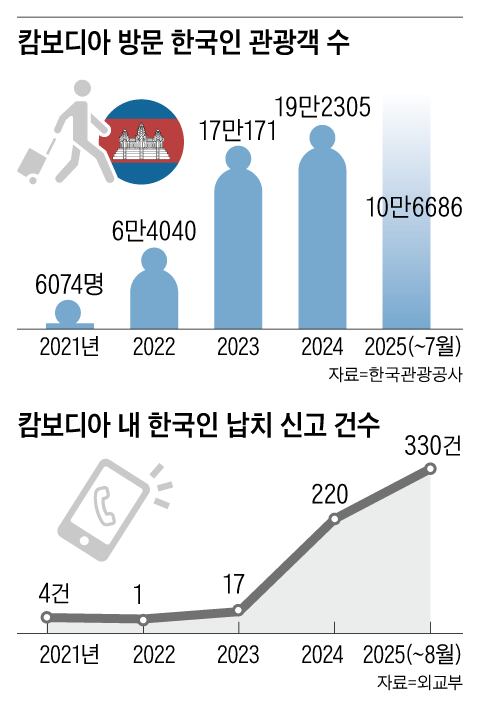
The main cause behind the drop in South Korean tourists visiting Cambodia is the increase in violent crimes. According to data provided by the Ministry of Foreign Affairs to Democratic Party of Korea lawmaker Park Chan-dae, the number of kidnapping reports in Cambodia increased from 4 cases in 2021, 1 case in 2022, and 17 cases in 2023 to 220 cases in the previous year. This year, the number has risen to 330 cases by August, exceeding the total from the previous year. The number of kidnapping incidents involving South Koreans has increased many times over the past two to three years.
In July, a young college student in his 20s, Mr. A, left home to attend an event in Cambodia but was found dead there on August 8. About a week after he left, Mr. A’s family received a threatening phone call from a man with a Korean-Chinese accent: “Mr. A caused issues in Cambodia and is being held. Send 50 million South Korean won, and we will release him.” However, they lost contact with the person four days later. Eventually, Mr. A’s body was discovered near Bokor Mountain in Kampot Province, an area known as the “crime complex” where South Koreans often become victims of job scams and detentions. The cause of death was cardiac arrest resulting from torture.
On the 21st of the previous month, a South Korean man in his 50s was abducted and subjected to torture by four Chinese individuals and one Cambodian near a café in Phnom Penh, the Cambodian capital. Around the same time, an office worker in his 40s, who had traveled to Phnom Penh on a five-night, six-day trip, lost contact with his family and was later discovered in a coma.
Many of the victims are South Koreans in their 20s and 30s who went to Cambodia seeking employment. A police official stated, “With international fraud organizations, such as those involved in voice phishing and romance scams, moving into Cambodia, violent incidents have risen. Young South Koreans, attracted by job advertisements offering ‘quick money with no special skills required,’ are becoming targets.” Some individuals who traveled to Cambodia for job interviews had their passports taken by criminal groups, were held against their will, and forced to work in voice phishing operations—some even losing their lives.
As the circumstances deteriorated, the Ministry of Foreign Affairs issued a Level 2 travel warning (advising caution) for Phnom Penh and specific travel alerts for Sihanoukville and other areas.
Cambodian expatriates state, “Numerous crimes against South Koreans go unreported.” An expatriate who has resided in Phnom Penh for more than two decades mentioned, “Until just a few months ago, at least one South Korean died from drug overdoses in Sihanoukville each month, yet these incidents were not widely covered in the media. These situations typically arise when South Koreans involved in voice phishing operations have conflicts with their Chinese employers or encounter financial issues.” Another expatriate noted, “Among the expatriate community, views are split: some prefer to remain quiet to prevent a decline in tourism income, while others argue for taking active measures against voice phishing groups to ensure the safety of South Korean tourists.”
Experts link Cambodia’s emergence as a center for violent activities to criminal organizations from China, Laos, and Myanmar moving there to escape tougher policing in their own nations. The country’s long-standing authoritarian government, corrupt police force, and lack of adequate staff have made it susceptible to violent crimes and hindered effective investigations. Residents openly condemn Cambodian authorities for their inactive approach towards crimes committed by Chinese criminal groups.





Leave a Reply