
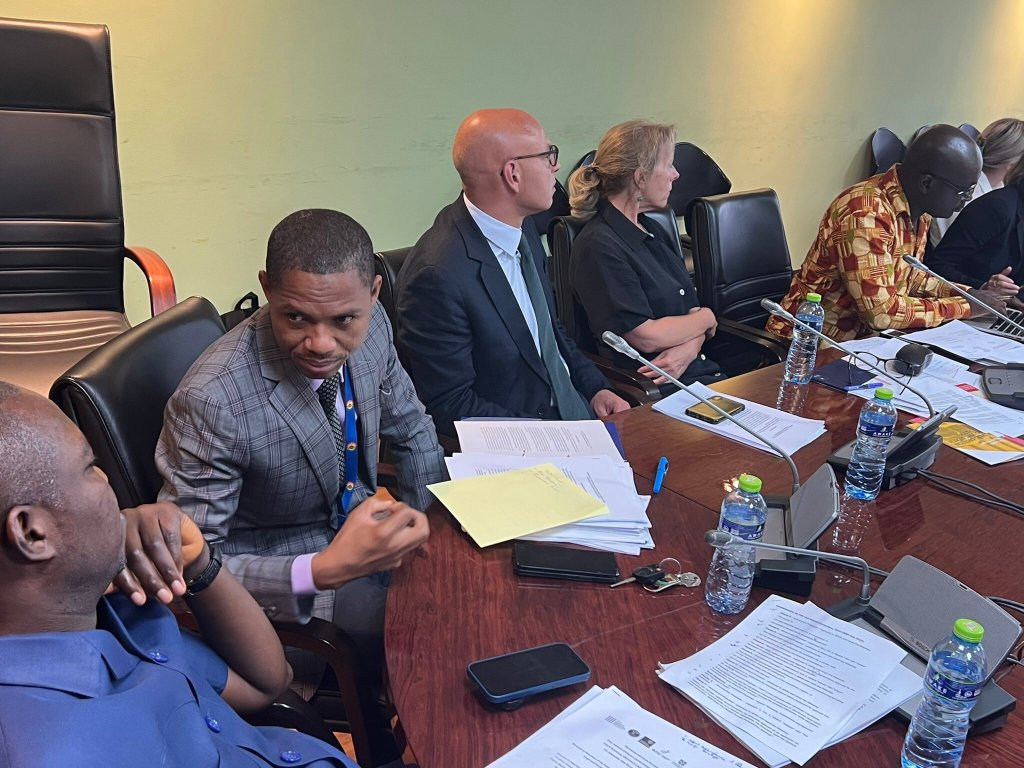
By Rune SKINNEBACH, Frederik LANDSHÖFT & Diarra Dimé LABILLE
On this occasion of the World Day against the Death Penalty, our collective attention is directed towards justice, human dignity, and the strong commitment to rehabilitation. This day serves as an opportunity to celebrate Ghana’s advancements in moving towards abolition, while also reinforcing our efforts to promote a world without state-authorized executions.
French author Albert Camus highlighted the central paradox of the death penalty: “But what is capital punishment if not the most deliberate form of murder, which no criminal act, no matter how carefully planned, can match?”
What message does it send to our society when the government, despite its authority, organizes and carries out the taking of a human life? It conveys that in response to a grave wrongdoing, our most effective reaction is to imitate the act of killing. We are capable of higher standards than that.
Ghana should be acknowledged for its human rights track record and the advancements it has achieved in eliminating the death penalty. The nation has been effectively “abolitionist” for a long time and has not performed an execution for at least thirty years.
Indeed, the final execution occurred in 1993. In 2023, Ghana’s parliament decided to remove the death penalty, aligning with numerous African nations that have taken similar actions in recent years. The sentences of the 170 men and six women currently on death row were changed to life imprisonment.
However, the complete elimination of the death penalty is yet to be achieved, as Ghana’s Constitution still allows for the punishment of high treason with death. We remain optimistic that the last legislative actions will be taken, as Ghana’s political stance on this issue has been clear for a long time.
The global movement is clearly shifting toward the elimination of the death penalty. In Africa, 26 nations have fully abolished capital punishment, with Zimbabwe being the latest to do so in December 2024. Last year, Zambia and Côte d’Ivoire both joined the Second Optional Protocol of the ICCPR, demonstrating their ongoing dedication.
In February 2025, the Kenyan Parliament formed a committee to examine the country’s laws regarding capital punishment. Currently, most countries around the globe have eliminated it either in law or in actual application.
The following World Congress against the Death Penalty in Paris in July 2026, along with the upcoming regional World Congress against the Death Penalty in Japan this November, will help enhance political efforts and promotion for its elimination.
The worldwide change stems from a deep recognition of the shortcomings of the death penalty. It is final and cannot be undone. The death penalty contradicts the right to life and continues to be a brutal, inhumane, and degrading form of punishment. Throughout history, there have been numerous heartbreaking cases of judicial mistakes that resulted in the execution of innocent individuals. An increasing amount of research indicates that the death penalty is not more effective in deterring crime compared to imprisonment.
The collaboration between the European Union and Ghana has been enduring and diverse, founded on mutual values and a joint perspective for the future. Striving for human dignity is a fundamental aspect of this alliance.
Our appeal goes beyond eliminating a penalty; it focuses on creating a fairer and more efficient correctional system. We urge all parties involved in Ghana to become part of the international group of abolitionist nations by 1) enacting the necessary changes to the “Armed Forces Act,” 2) suggesting constitutional updates to remove the death penalty even for high treason, and 3) ratifying the Second Optional Protocol to the International Covenant on Civil and Political Rights (ICCPR).
Member states of the European Union (EU) are united in their dedication to the complete elimination of the death penalty under all situations. By completely ending the death penalty, Ghana can strengthen its position as a regional pioneer in human rights and encourage other countries in West Africa and throughout the continent to adopt similar measures.
On this Day of Condemnation for the Death Penalty, we reach out in collaboration to the government and citizens of Ghana. Let us unite to place the death penalty in the past, and create a future where justice is based on human dignity, rather than planned execution.
Rune Skinnebach serves as the European Union Representative in Ghana, while Frederik Landshöft is the German Ambassador to Ghana and Diarra Dimé Labille, the French envoy-to-be in Ghana
Provided by SyndiGate Media Inc. (Syndigate.info).



Leave a Reply