
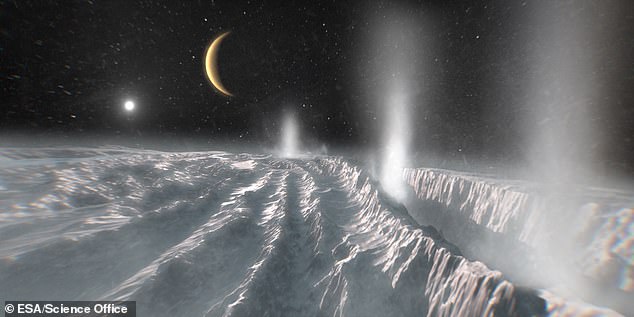
SaturnEnceladus, the moon, might containalien life, scientists have discovered.
New findings from NASAThe Cassini mission has discovered heat escaping from the moon’s northern pole.
This implies that the moon’s extensive subterranean ocean could possess a far more consistent climate than was previously assumed.
As per the scientists, this suggests it could be an ideal location for life to develop.
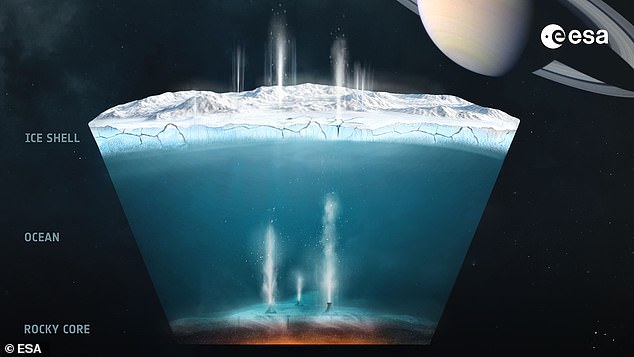
Although the icy surface of Enceladus is lifeless, its subsurface oceanspossess all the required elements for life
Nevertheless, up to this point, researchers remained uncertain if the planet’s core temperature could remain consistent for a sufficient duration to allow life to develop.
Scientists are still unable to confirm if life exists on the moon, but they have recently demonstrated that Enceladushas a sea where life has a possibility of existing.
Co-author Dr. Carly Howett, from the University of Oxford, stated to Daily Mail: ‘We believe life requires stability to endure – therefore, demonstrating that Enceladus’ energy is consistent suggests its underground environment likely is as well.’
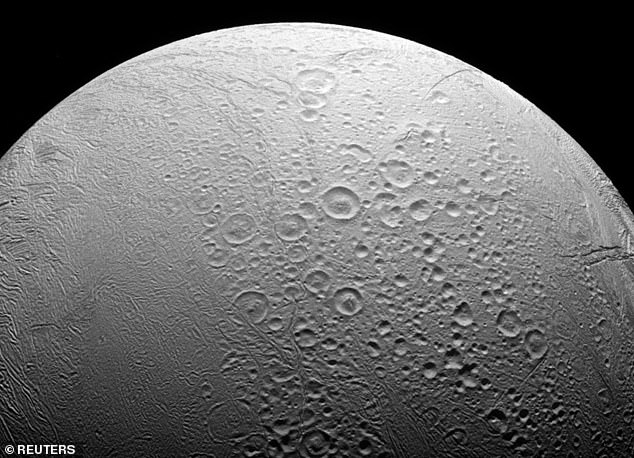
Measuring 310 miles (500 km) in diameter — roughly the width of Arizona — Enceladus ranks as Saturn’s sixth-largest moon.
At first glance, the environment is extremely chilly, with temperatures reaching as low as –201°C (–330°F).
However, underneath the surface, there is sufficient thermal energy to sustain a vast, liquid ocean of water.
The moon receives warmth through a phenomenon known as tidal heating, in which it is compressed and elongated by Saturn’s gravitational force.
This energy stops the moon from becoming entirely frozen, yet underground oceans could only sustain life if the incoming energy balances the outgoing energy.
Dr. Howett states: “If Enceladus is losing more energy than it is gaining, eventually the entire moon will cool down, and Enceladus’ ocean will freeze – which would be disastrous for life!”
If it is absorbing more energy than it is losing, the ocean will warm up and melt the ice cover from underneath – this will alter both the ocean’s temperature and its chemical composition.
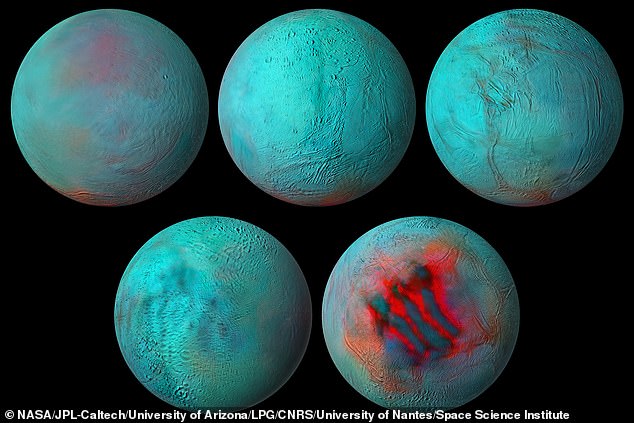
Earlier research has calculated the amount of energy that Enceladus releases via its active South Pole,where water jets are continuously spoutingvia tectonic cracks referred to as ‘tiger stripes’.
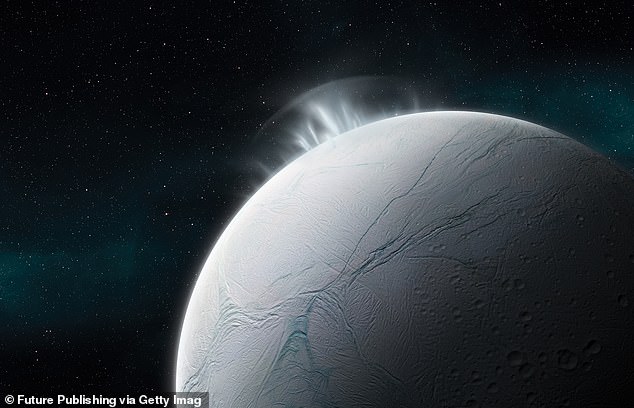
However, determining how much energy the whole planet loses through its oceans is very challenging since it warms the entire ice sheet simultaneously.
This implies there is just a slight variation from the regular day-night temperature pattern at any specific moment.
“These minor temperature rises are most easily detected on a cold surface, and likely where the ice shell is at its thinnest,” says Dr. Howett.
The northern polar area of Enceladus met these criteria.
By utilizing data from the Cassini spacecraft, scientists examined the surface temperature of the North Pole during the depths of winter and in the summer season.
This showed that the area near the pole was approximately 7°C (7 Kelvin) hotter than predicted.
Based on this information, Dr. Howett and her colleagues determined that the moon is losing 46 milliwatts of energy per square meter, which equals 35 gigawatts of energy across the whole planet.
In conjunction with the recognized energy loss from the active South Pole, Enceladus’ overall energy loss increases to 54 gigawatts.
This image is nearly identical to the calculated overall energy contribution from tidal heating, demonstrating that it is in equilibrium.
Dr. Howett states that this “suggests Enceladus has an ocean that is enduring and consistent, increasing the likelihood of life developing within it.”
Researchers are uncertain about the form that life might take, as we have only observed how life developed on a single planet, yet it may have some common features with life found on Earth.
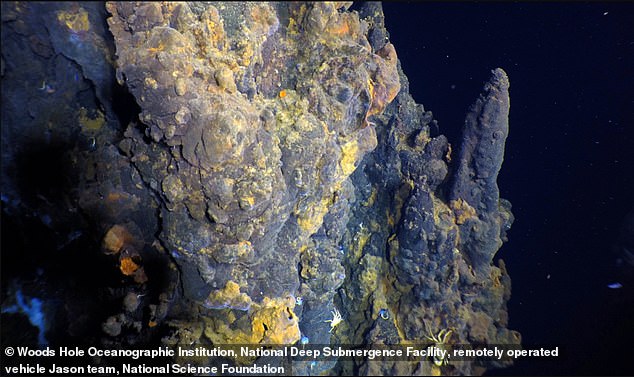
It could be that life on Enceladus resembles the organisms found near deep-sea hydrothermal vents on Earth, according to Dr. Howett.
There we observe creatures that resemble shrimp, crabs, and lobsters. So perhaps in that way – but maybe not in the slightest!
The following steps will involve determining if the oceans on Enceladus have been present for a sufficient duration to allow life to develop.
If the oceans are sufficiently ancient, it could warrant launching another mission to search for chemical indicators of life within the icy geysers at the South Pole, or even to penetrate the ice and explore the ocean beneath.
- Has the enigmatic moon Enceladus of Saturn finally unveiled signs of alien life hidden beneath its frozen surface?
- Could NASA’s massive Europa Clipper project reveal the mysteries of a hidden icy moon that might contain extraterrestrial life?
- Could alien oceans contain lively ecosystems similar to the remarkable chemosynthetic communities found deep in Earth’s trenches?
- Can NASA’s ambitious Europa Clipper mission reveal the fascinating building blocks of life beneath its rugged icy surface?
- Is there a possibility that alien life might be nearer to Earth than previously thought, hiding beneath the frozen surface of Uranus’ moon Miranda?




 jasdooit
Leave a comment