
Key Messages
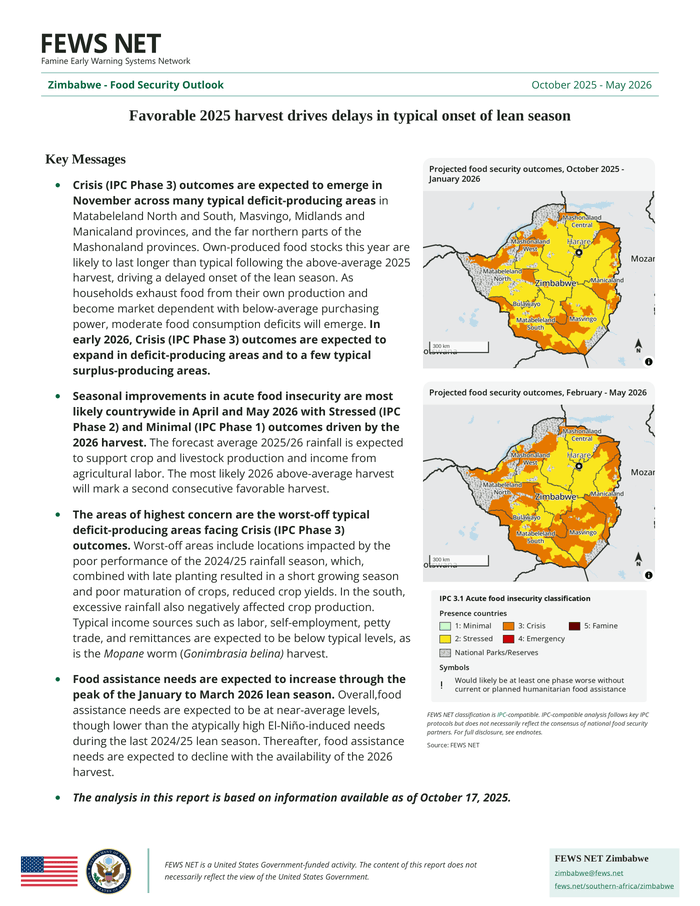
- Crisis (IPC Phase 3) situations are anticipated to develop in November in numerous regions that usually experience shortagesIn the provinces of Matabeleland North and South, Masvingo, Midlands, and Manicaland, as well as the northernmost areas of the Mashonaland provinces, this year’s home-grown food supplies are expected to last longer than usual due to the above-average harvest in 2025, resulting in a later start to the lean season. As families use up their own produce and become reliant on the market with reduced buying capacity, moderate food consumption gaps will begin to appear.In early 2026, it is anticipated that Crisis (IPC Phase 3) situations will spread in regions that typically experience shortages and also affect some areas that usually produce surpluses.
- Significant improvements in acute food insecurity are expected across the country in April and May 2026, with Stressed (IPC Phase 2) and Minimal (IPC Phase 1) conditions resulting from the 2026 harvest.The projected average rainfall for 2025/26 is anticipated to enhance agricultural output and income derived from farming activities. The most probable 2026 harvest, which is above normal, will signify a second straight positive harvest.
- The regions of greatest worry are the most disadvantaged typical areas that lead to deficits, experiencing a Crisis (IPC Phase 3) situation.Areas that are most affected include places where the 2024/25 rainfall season performed poorly, leading to delayed planting, a shortened growing period, and crops not reaching full maturity, which has led to lower harvests. In the south, heavy rains also had a negative impact on agricultural output. Common sources of income like wage labor, self-employment, small-scale trading, and remittances are anticipated to be lower than usual, as is theMopane worm (Gonimbrasia belina) harvest.
- The demand for food aid is anticipated to rise during the height of the lean period from January to March 2026.Food assistance requirements are anticipated to remain close to average, but lower compared to the unusually high needs caused by El Niño during the previous 2024/25 lean season. After that, food assistance needs are expected to decrease as the 2026 harvest becomes available.
Provided by SyndiGate Media Inc. (Syndigate.info).



 jasdooit
Leave a comment