
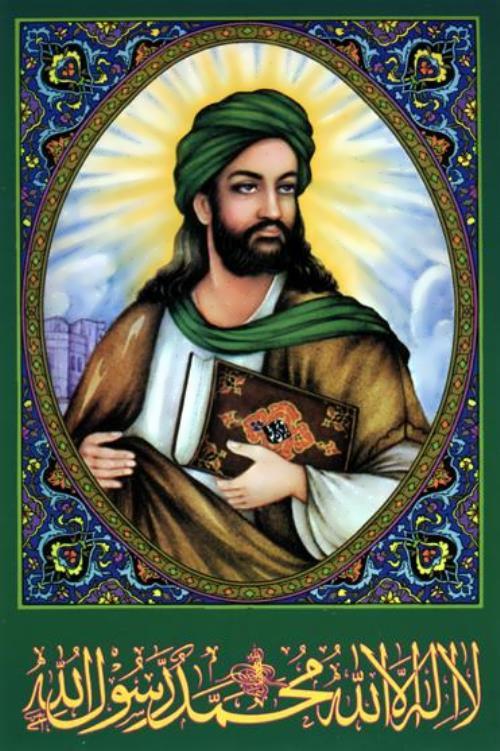
In the name of Allah, the Most Gracious, the Most Merciful.
The Holy Qur’an, Surah Fath, 48:29 states: “Muhammad is the messenger of God, and those who accompany him are powerful against the disbelievers, yet kind to one another. You will see them bowing and prostrating themselves (in prayer), seeking mercy from God and His pleasure. On their faces are signs, which are the marks of their prostration. This is their example in the Torah; and their example in the Gospel is like a seed that produces a sprout, then strengthens it; it then becomes robust and stands upright on its stem, filling the sowers with astonishment and joy. As a result, it causes the disbelievers to feel anger toward them. God has promised those among them who believe and perform good deeds forgiveness, and a magnificent reward.”
However, to continue, it was during the nineteenth century that sincere intellectuals such as Carlyle, Gibbon, and Goethe recognized inherent value in the religion of Muhammad – “already, even now, many among us have embraced his faith, and the Islamization of Europe can be considered to have started”.
Additionally, Reverend R. Bosworth-Smith (1794-1884), an American bishop and academic, mentions in his book ‘Mohammed, and Mohammedanism’, published in London in 1874 on page 92, that “By an extraordinary circumstance unique in history, Muhammad was the triple founder of a nation, an empire, and a religion. He was both head of state and the Church, embodying the roles of Caesar and Pope; however, he lacked the Pope’s pretensions; he had a standing army without a bodyguard, without a police force, and without a fixed revenue. If anyone ever had the right to claim rule by divine right, it was Muhammad, as he possessed all the powers without their supporting structures. He paid no attention to the trappings of power. The simplicity of his personal life matched this public life.”
In addition to the Encyclopaedia Britannica stating that “Muhammad is the most successful of all prophets and religious figures,” Professor Jules Wasserman, following extensive scientific research, states: “Individuals such as Pasteur and Stalk are leaders in the first sense. People like Gandhi and Confucius, on one side, and Alexander, Caesar, and Hitler on the other, are leaders in the second and possibly the third sense. Jesus and Buddha fall into the third category. Perhaps the greatest leader of all time was Muhammad, who embodied all three roles. To a lesser extent, Moses did the same.”
Furthermore, the renowned French writer, Lamartine (1854), ends his remarks on Muhammad with a Socratic question: “Philosopher, Speaker, Apostle, Lawgiver, Soldier, Conqueror of thoughts, Reviver of rational beliefs, of worship without idols; the founder of twenty earthly empires and one spiritual empire, which is Muhammad. When considering all measures by which human excellence can be judged, can we not wonder if there is anyone greater than him?”
Additionally, Mahatma Gandhi, in ‘Young India,’ 1924, stated, “I wanted to learn about the finest aspects of the life of someone who currently holds an undisputed influence over the hearts of millions. I became even more convinced that it was not the sword that helped Islam establish itself in those times within the framework of life. It was the strict simplicity, complete self-neglect of the Prophet, his careful attention to promises, his deep devotion to his companions and followers, his bravery, fearlessness, and complete faith in God and his own mission. These qualities, rather than the sword, achieved everything and overcame every challenge. When I finished the second volume (of the Prophet’s biography), I wished there was more for me to read about that remarkable life.”
According to Dr. Keith L. Moore, Professor Emeritus in the Department of Anatomy and Cell Biology at the University of Toronto, Canada, he states regarding Muhammad (SAW), “It has been a rewarding experience for me to explain the verses in the Qur’an concerning human development. I am convinced that these statements could only have come from God, as much of this information was not uncovered until many years later. This convinces me that Muhammad was indeed a messenger of God.”
The pair of Edward Gibbon and Simon Oakley in ‘History of the Saracen Empire,’ published in London in 1870, comment on Muhammad (SAW), “The greatest achievement of Mohammad’s life was accomplished through moral strength alone. It is not the spread but the lasting nature of his religion that deserves our admiration. The same pure and flawless impression he created in Mecca and Medina remains unchanged after twelve centuries, as witnessed by the Indian, African, and Turkish followers of the Koran. The followers of Mahomed have consistently resisted the temptation to lower the object of their faith and worship to the level of human senses and imagination. ‘I believe in One God and Mahomed the Apostle of God’ is the straightforward and unchanging declaration of Islam. The intellectual concept of the Divine has never been diminished by any physical idol; the honors given to the Prophet have never exceeded the limits of human virtue, and his teachings have kept the gratitude of his followers within the boundaries of reason and faith.”
According to Alphonse de LaMartaine in ‘Historie de la Turquie,’ published in Paris in 1854, “…If the three indicators of a great human genius are a noble purpose, limited resources, and remarkable achievements, who would have the audacity to compare any significant historical figure with Muhammad? The most renowned individuals established weapons, laws, and empires, at best founding only material powers that frequently collapsed before their lifetimes ended. This individual, however, influenced not just armies, legal systems, empires, populations, and dynasties, but also millions of people across one-third of the known world; even more so, he transformed altars, deities, religions, ideas, beliefs, and souls. Based on a single Book, every letter of which became law, he formed a spiritual nation that united people from all languages and races. He left an enduring mark on this Muslim identity: the rejection of false gods and the fervor for the One and Immaterial God.”
This vengeful patriotism against the desecration of Heaven became the virtue of Muhammad’s followers; the conquest of one-third of the earth to this doctrine was his miracle; or rather, it was not the miracle of a person but that of reason. The concept of God’s unity, declared during the decline of extravagant theologies, was in itself such a miracle that when he spoke it, it destroyed all ancient idol temples and ignited one-third of the world. His life, his reflections, his courageous defiance against the superstitions of his homeland, and his bravery in opposing the forces of idolatry, his steadfastness in enduring them for fifteen years in Mecca, his acceptance of public ridicule and almost becoming a victim of his own people. This doctrine had two aspects: the unity of God and the immaterial nature of God: the former explaining what God is, the latter explaining what God is not; one overthrowing false gods with the sword, the other introducing an idea through words. Philosopher, orator, apostle, legislator, conqueror of ideas, restorer of rational beliefs, the founder of twenty earthly empires and one spiritual empire known as Muhammad. Considering all measures by which human greatness can be assessed, we might well ask, is there any individual greater than him?
Additionally, James Michener in ‘Islam: The Misunderstood Religion,’ Reader’s Digest, May 1955, pages 68-70, states: “No other religion in history has spread as quickly as Islam. The West has commonly believed that this religious expansion was achieved through the sword. However, no modern scholar supports this view, and the Quran clearly emphasizes the freedom of conscience. Similar to almost every major prophet before him, Muhammad hesitated to be the messenger of God, feeling his own limitations. But the Angel instructed ‘Read.’ As far as we know, Muhammad could neither read nor write, yet he began to recite those inspired words that would soon transform a significant part of the world: ‘There is one God.’ In all aspects, Muhammad was deeply practical. When his cherished son Ibrahim passed away, an eclipse occurred, and rumors spread that God was personally expressing sorrow. In response, Muhammad reportedly said, ‘An eclipse is a natural occurrence. It is foolish to link such events to the death or birth of a human being.’ ‘At Muhammad’s passing, an effort was made to deify him, but the man who would become his administrative successor silenced the frenzy with one of the most noble speeches in religious history: ‘If any of you worshipped Muhammad, he is dead. But if it is God you worshipped, He lives eternally.’”
May the Almighty Allah keep bestowing His blessings and compassion upon Prophet Muhammad (SAW), Ameen.
- Love Connection: Public vs Private Proposals – Which is More Effective?
- “No” Is a Full Sentence: Why You Should Stop Feeling Ashamed
- Social Gathering: Friendship Discussion 2025 – Tips for Being a Good Friend and Major Issues in Friendship
- Police Subdue Armed Thieves in Ibadan Following Intense Conflict
Provided by SyndiGate Media Inc. (Syndigate.info).



 jasdooit
Leave a comment