
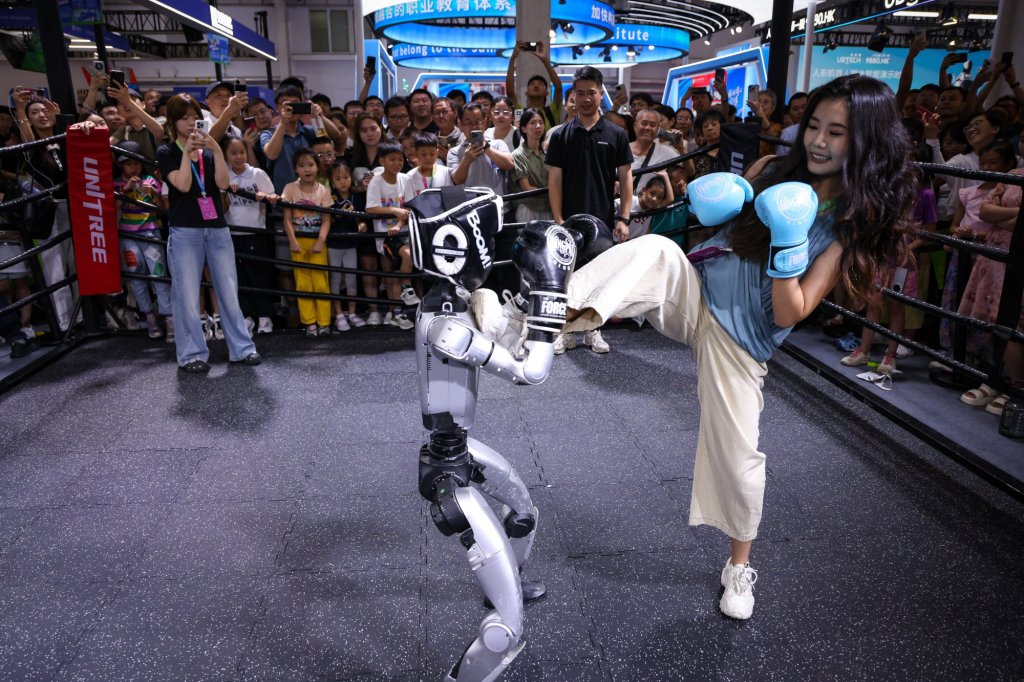
Seven institutions, including Shanghai Jiao Tong University and Zhejiang University, are set to introduce ’embodied intelligence’ as a new academic program.
China is developing a talent pipeline for the rapidly growing robotics sector, as leading universities in the country introduce undergraduate programs focused on embodied intelligence to aid Beijing’s goal of surpassing the US.
In November, China’s education ministry reported that Shanghai Jiao Tong University and Zhejiang University were part of a group of seven renowned institutions that had recently submitted applications to introduce “embodied intelligence” as a new academic program.
The latest initiative was shaped by the requirements of a national strategy aimed at “making special provisions for urgently required fields” following Beijing’s designation of embodied intelligence as a central priority for the future, as stated by the ministry of education.
Are you curious about the most significant issues and developments happening globally? Find the solutions withSCMP Knowledge, our latest platform offering carefully selected content including explainers, FAQs, analyses, and infographics, presented by our acclaimed team.
The current undergraduate and postgraduate programs in areas such as artificial intelligence and engineering do not offer a structured, cross-disciplinary approach to equip students with the skills needed to address real-world challenges within the embodied intelligence sector, according to Shanghai Jiao Tong University’s application document. The department is headed by Lu Cewu, a well-known robotics expert and professor at the university.
Chinese universities are aiming to cultivate the essential specialized skills required by the industry, by partnering with technology companies and firms specializing in humanoid robots as potential employers.
For example, Xian Jiaotong University anticipated that five of its 30 graduating students would secure jobs at telecommunications equipment company Huawei Technologies, electric-vehicle manufacturer BYD, and robotics firm UBTech Robotics.
Seven institutions are anticipated to enroll approximately 330 students for the program in the initial intake. The Beijing Institute of Technology intends to admit 120 students, the highest number compared to other universities.
Intelligent systems that operate within a physical form and gain knowledge through their engagement with the actual environment.
Backed by government backing, interest in embodied intelligence and humanoid robots has been rising sharply, prompting tech giants to enter the sector and allowing new robotics startups like Unitree to capture international attention.
However, a lack of skilled workers has emerged as a significant challenge for the sector. Hangzhou-based Deep Robotics mentioned in Octobera severe dearth ofa talent shortage that was impeding the start-up’s attempt to bring its research and development to market, as stated by chief technology officer Li Chao.
New job opportunities in embodied intelligence increased by 73 per cent in the third quarter, outpacing the AI industry’s 55 per cent growth, as reported by the Chinese recruitment agency Liepin in October.
The report indicated that the average yearly salary for roles in embodied intelligence was 333,400 yuan (US$47,120), which is greater than the 290,900 yuan offered for AI-related positions.
More Articles from SCMP
Why do mammals that group together potentially have a reduced risk of cancer?
EU drops WTO lawsuit against China concerning claims of pressuring Lithuania
This piece was first published in the South China Morning Post (www.scmp.com), a top news outlet covering China and Asia.
Copyright (c) 2025. South China Morning Post Publishers Ltd. All rights reserved.



 jasdooit
Leave a comment