

The System Marginal Price (SMP) of the Korea Electric Power Corporation (KEPCO), used as a standard for buying electricity from power producers, has dropped below 100 won per kilowatt-hour (kWh) for the first time in four years and two months. Analysts expect increased demands to reduce electricity tariffs as South Korean businesses, which have seen a 70% increase in industrial electricity costs over three and a half years, encounter reduced competitiveness.
On the 2nd, the Korea Power Exchange reported that the combined (mainland and Jeju) SMP for the previous month reached 94.81 won per kWh. This is the first instance the rate has fallen under 100 won in 50 months, since September 2021, when it was 98.77 won per kWh.
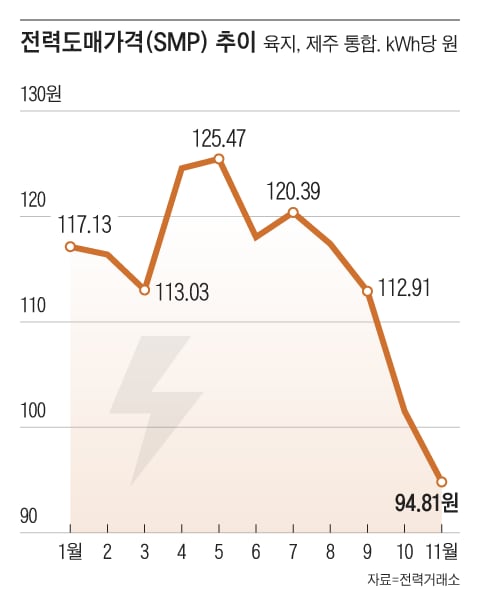
The average SMP was 90.74 won per kWh yearly in 2019, rising to 196.65 won per kWh in 2022 as a result of sharply increasing global energy costs caused by the COVID-19 pandemic, supply chain issues, and the Russia-Ukraine conflict. Monthly rates reached a high of 267 won per kWh in December 2022.
Since that time, the SMP has decreased as fuel costs, such as crude oil and liquefied natural gas (LNG), have become more stable. The U.S. Energy Information Administration predicts that global oil prices (measured by WTI) will drop further into the low 50-dollar range next year, compared to the present 60 dollars per barrel. This indicates that the SMP is expected to maintain its downward trend in the short term.
Amid these circumstances, officials are grappling with difficult choices about whether to revise electricity charges for the first quarter of next year (January–March) by the end of this month. This is because of increasing pressure from industrial sectors, including petrochemical and steel industries, which are facing declines, to lower their electricity rates. Industrial tariffs have increased by 70%, rising from 105.48 won per kWh in 2021 to 179.23 won per kWh in the first half of this year.
Previous governments, aware of public dissatisfaction, refrained from increasing electricity prices even as fuel costs rose (the Moon Jae-in administration) or concentrated on raising industrial rates, which encountered less opposition (the Yoon Suk-yeol administration). Businesses are now urgently trying to lower their electricity expenses by applying for the “direct power purchase system,” enabling them to negotiate directly with power plants instead of going through KEPCO.
Nevertheless, the government encounters challenges in swiftly enacting interest rate reductions due to KEPCO’s debt surpassing 200 trillion won and the essential requirement for significant investments to upgrade the power grid for the artificial intelligence (AI) era. As of the third quarter of this year, KEPCO’s debt amounted to 205.3402 trillion won.
Moon Kyung-won, a researcher from Meritz Securities, stated, “Despite the 20 trillion won in capital expenditure (CAPEX) needed by 2027 for AI data centers and semiconductor cluster developments, reasons supporting increases in electricity rates remain valid.”


 jasdooit
Leave a comment