
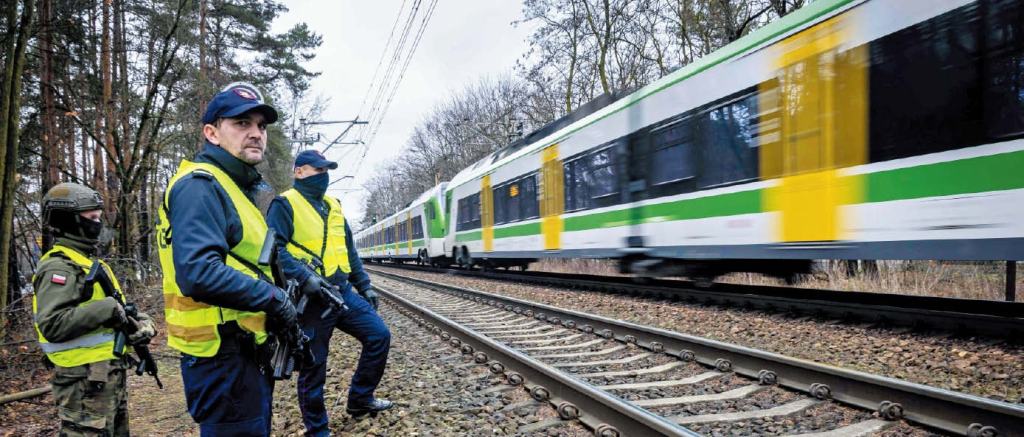

A Ukrainian defamation leaflet posting costs $5 (about 7,300 South Korean won), surveillance camera installation ranges from $300 to $400 (around 440,000 to 590,000 South Korean won), and sabotaging a train derailment is priced at $10,000 (approximately 14,700,000 South Korean won). These are details from the ‘intelligence service pricing list’ that Polish prosecutors examined when they indicted Mikhail Mirkhrodsky, a 28-year-old Russian national, in absentia on charges of organizing destructive actions and espionage activities within the country on the 2nd.
Polish prosecutors claim that Mirkhrodsky directed destructive operations, espionage, and propaganda groups in Poland under the guidance of the Russian Federal Security Service (FSB). He is charged with mobilizing approximately 30 individuals through the Telegram app since 2023 to oversee activities such as ▲placing surveillance equipment at critical infrastructure like airports, train stations, and military installations ▲distributing pro-Russia, anti-Ukraine, and anti-NATO pamphlets ▲committing acts of physical violence and arson across different areas ▲plotting a train derailment in 2023 ▲and obtaining illicit funds via cryptocurrency exchanges. Mirkhrodsky, who has left Poland, is currently subject to an Interpol (International Criminal Police Organization) red notice.
As per the Polish Internal Security Agency (ABW), Russia has been utilizing a strategy of employing locals as ‘contract part-time workers’ for acts such as arson, damage to critical infrastructure, and intelligence gathering, instead of sending trained spies from intelligence agencies as was done previously. These individuals are referred to as ‘disposable’ one-time agents. The main organizer assigns missions via social media chats like Telegram but seldom shows his real identity.
The procedure of checking if tasks were completed as directed and offering payment was also carried out using a ‘non-face-to-face platform.’ The ABW mentioned, “The intelligence group used encrypted communication, submitting completion reports through images and videos, with payments processed in cryptocurrency.” Polish prosecutors have detained 16 individuals for carrying out operations under Mirkhrodsky’s direction in 2023.
Since Russia’s invasion of Ukraine in 2022, there have been numerous cases of arson, destruction of facilities, and spreading of rumors believed to be orchestrated by Russia across Europe. Last year, a fire occurred at an IKEA store in Lithuania, and a warehouse in London also caught fire. Near the Eiffel Tower in Paris, France, five life-sized coffins marked with “French soldiers sent to Ukraine” were found, causing public shock, while a major shopping center in Warsaw, Poland, was entirely destroyed by a fire. According to analysis, the main objective was to create social unrest rather than directly target Europe’s military strength.
The Guardian, a UK-based publication, reported, “Russia is implementing a new form of attack against the West through its intelligence services,” noting, “Individuals recruited online and compensated in cryptocurrency are carrying out these actions.” The main organizers mainly target people who seem to be facing financial issues via social media using the Russian language. When these individuals are offered payment for tasks such as distributing pamphlets or installing surveillance cameras, those having trouble covering basic expenses accept the ‘part-time job.’ For ‘new part-timers,’ PDF documents explaining how to acquire materials for homemade bombs and bomb-making techniques are also provided. Some of them reportedly never realize until the end that they were being used for Russia’s espionage activities.
After completing their operational duties, local leaders such as Mirkhrodsky in Poland quietly vanish, while officials at the central intelligence agency in Moscow eliminate evidence by removing encrypted communication channels. As ‘contract part-timers’ arrested on the spot often remain unaware of who issued the orders, European authorities and intelligence agencies encounter challenges during investigations. A senior European security expert remarked, “This kind of operation presents a widespread threat to everyone,” and noted, “It is far simpler to handle spies with diplomatic immunity or illegal black agents.”




 jasdooit
Leave a comment