
With increasing global competition for artificial intelligence (AI) expertise, a report from the Bank of Korea points out that South Korea’s AI professionals receive relatively modest salaries. According to the joint research paper titled “Current Status of AI Talent and Supply-Demand Imbalance,” released on the 5th by the Bank of Korea’s Employment Research Team and Professor Park Geun-yong from the National University of Singapore’s Business School, South Korean AI specialists earned 6% more than other workers in the previous year. Although this marks an improvement over earlier years, their salaries are still lower compared to those in other major countries, resulting in a continuous migration of talent abroad, as the researchers observed. A primary factor contributing to the lower wages was found to be the seniority-based pay structure. The report was shared at the “AI-Driven Growth and Innovation” event, co-organized by the Bank of Korea and the Korea Chamber of Commerce and Industry, held at the International Conference Hall in Jung-gu, Seoul, on the 4th.
◇Korean AI Workforce Expands but Remains in Short Supply
A research group examined data from the worldwide job site LinkedIn to assess the global standing of AI expertise and compensation. Oh Sam-il, head of the Bank of Korea’s Employment Research Team and involved in the study, stated, “This is the initial research to apply LinkedIn for analyzing AI talent. We analyzed employment history data of around 1.1 million workers in South Korea from 2010 to 2024 along with more than 10 million job records.”
The study revealed that South Korea’s AI workforce has been increasing consistently, along with rising salaries. Nevertheless, due to the worldwide competition in AI fueled by governmental backing, the nation still encounters a lack of skilled professionals and comparatively lower pay rates.
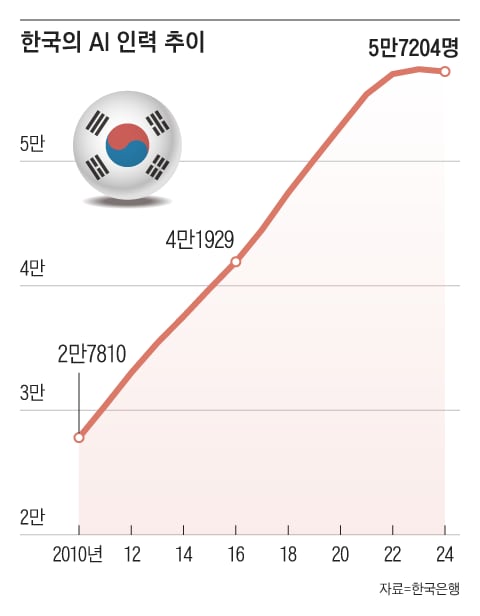
South Korea’s artificial intelligence workforce has grown quickly over the last ten years, with around 57,000 professionals recorded in 2024. These individuals are well-educated, with 58% possessing a master’s or doctorate, and 64% focusing on engineering disciplines. Although this represents a major rise from under 30,000 in 2010, the total number is still relatively modest when compared to the U.S. (780,000), the U.K. (110,000), and France and Canada (70,000 each).
The proportion of AI experts per person is also minimal. The U.S. boasts 7.8 AI specialists for every 100,000 individuals, whereas South Korea has just 0.6.
◇AI Pay Gap: 6% in South Korea, 25% in the United States
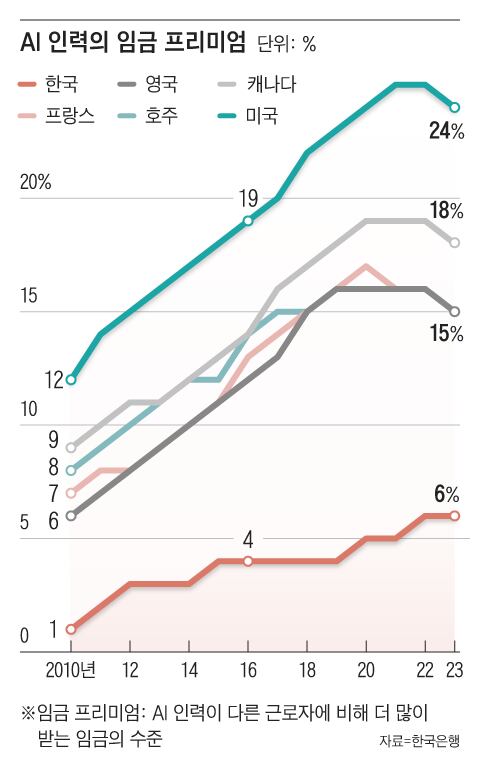
A more urgent concern within South Korea’s artificial intelligence job sector is compensation levels. The “wage premium”—the extra income that AI specialists earn compared to those in non-AI roles—reached 6% last year, an increase from 1.3% in 2010. Nonetheless, this figure is still considerably below that of other nations: 25% in the United States, 18% in Canada, and 15% in the United Kingdom, France, and Australia. This indicates that AI experts who have the opportunity to work internationally might secure significantly higher salaries elsewhere.
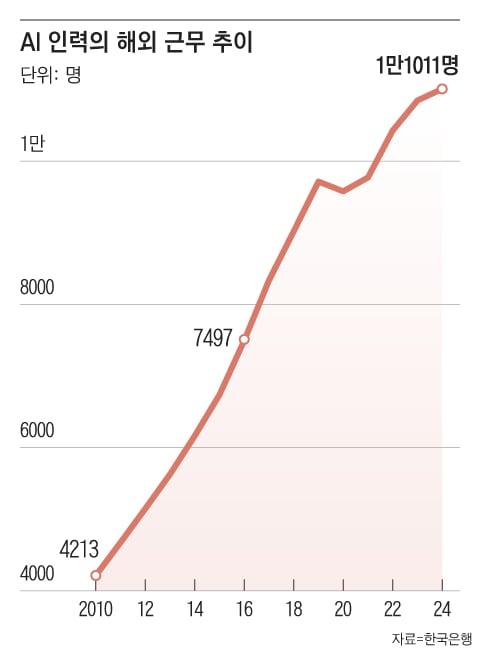
The data verified a continuous migration of South Korean AI experts to other countries. Oh Sam-il said, “In 2024, about 16% of South Korea’s AI workforce was employed abroad, which is 10 percentage points more than other workers. The number of South Korean AI professionals working in the U.S. increased from 2,100 in 2010 to 6,300 last year, showing how the U.S.’s top AI industry and competitive salaries draw local talent.” Last year, approximately 11,000 South Korean AI professionals were working overseas.
◇Pay Structures Based on Experience Encourage AI Professionals to Work Overseas
Researchers linked South Korea’s lower AI salaries to intense global competition for talent, a pay structure that favors experience over youth, and limited local investment and demand in the AI sector. Seo Dong-hyun, a senior researcher at the Bank of Korea’s Employment Research Team and co-author of the study, stated, “Since AI started receiving attention around 2010, the workforce has included many young professionals. Although precise numbers need further examination, it is true that they face disadvantages under South Korea’s seniority-based wage system.”
Leading South Korean conglomerates, such as Samsung Electronics, Naver, and LG CNS, were at the forefront of AI recruitment. Samsung Electronics had the highest number of hires, with 3,253 positions filled last year, significantly more than Naver, which came in second with around 1,098. Among international companies, Amazon, Microsoft, and Oracle also featured prominently. Government-linked research organizations, including the Electronics and Telecommunications Research Institute, along with government AI-related hiring, totaled 1,103 positions, exceeding Naver’s count.



 jasdooit
Leave a comment