
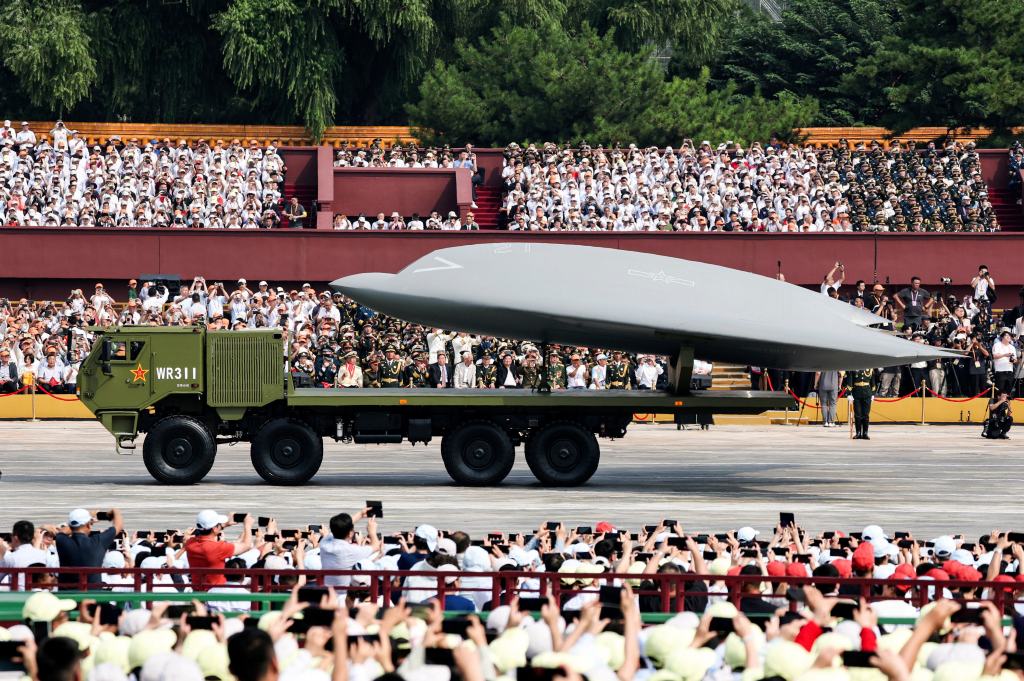
A U.S. Department of Defense analysis has suggested that despite potential American involvement in case of a Chinese military attack on Taiwan, the chances of a U.S. loss are still significant. The New York Times (NYT) acquired and published the main details of the “Overmatch Brief” report, which presents possible situations in the event of a U.S.-China confrontation, on the 8th.
The Overmatch Brief, created by the Office of the Director of Operational Test and Evaluation, is a yearly confidential document that outlines key military concerns presented to high-ranking White House officials throughout the year. As reported by the NYT, this document considers a situation in which the U.S. military intervenes to support Taiwan during a Chinese invasion and assesses that “China possesses the ability to neutralize advanced U.S. weapons before they arrive in Taiwan.”
A report, developed through war games that mimic real combat situations, forecasts that even the U.S. Navy’s most recent aircraft carrier would not endure a Chinese assault. It references the deployment of the latest Gerald R. Ford-class carrier strike group to the Caribbean Sea with the aim of targeting the Venezuelan administration led by Nicolás Maduro. Although the Gerald R. Ford-class is commended for its powerful weaponry, the report claims it could be significantly exposed to emerging types of attacks.
The report cites hypersonic weapons, which China has recently acquired up to 600 units, as a prime example of “new types of attacks” that could potentially sink the Ford-class. These weapons, traveling at speeds up to five times the speed of sound, are challenging to stop even for the most sophisticated military forces. The report also states that “China is capable of destroying U.S. reconnaissance and communication satellites.”
The report further highlights that the U.S. is lagging in the swift advancement of sophisticated weaponry when compared to China and Russia, as it “depends too much on costly and fragile weapons.” It states that U.S. defense spending, which stands at 3.4% of GDP, is the smallest in 80 years, identifying this as a risk to American military power. The report also brings up artificial intelligence, cyber attacks, and biochemical warfare as persistent issues.
The New York Times characterized the report’s conclusions as “consistent and alarming,” highlighting the importance of enhancing military capabilities, and noted, “The reason the U.S. requires a strong military is not to start a war but to prevent potential conflicts.” This is not the first instance where the U.S. Department of Defense has recognized its military disadvantage compared to China. In November, Defense Secretary Pete Hegseth referenced the outcomes of internal simulations, stating, “We always lose.” The NYT also shared a story from 2021 during the Joe Biden administration, in which a senior White House official reportedly became visibly shaken upon reading the Overmatch Brief, which indicated that “China has developed layered countermeasures against any military strategy the U.S. could employ.”
The New York Times highlighted that this marks the first instance where U.S. military disadvantage compared to China has been exposed via official documents instead of confidential sources. Analysts anticipate that the Trump administration will push harder for higher defense expenditures from allied countries in the free world after this report. Indeed, the Overmatch Brief specifically underscores the importance of allies boosting their defense budgets, noting, “Global resource mobilization is essential to address the growth of Chinese capabilities.”



 jasdooit
Leave a comment