
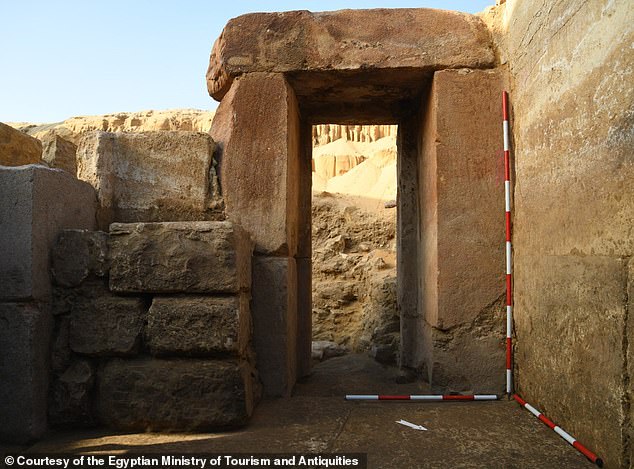
Archaeologists have discovered the ruins of a 4,500-year-old Egyptian temple where visitors would look up at the sky from the rooftop.
The ruins of the structure were discovered at Abu Ghurab, approximately nine miles south of Cairo, the Egyptian capital, and five miles west of the Nile River.
A massive structure surpassing 10,000 sq ft (1,000 square metres), the temple was devoted to the god Ra, the sun deity and originator of all existence.
It was built under the direction of Pharaoh Nyuserre Ini, who ruled between roughly 2420 BC and 2389 BC duringEgypt‘s Fifth Dynasty.
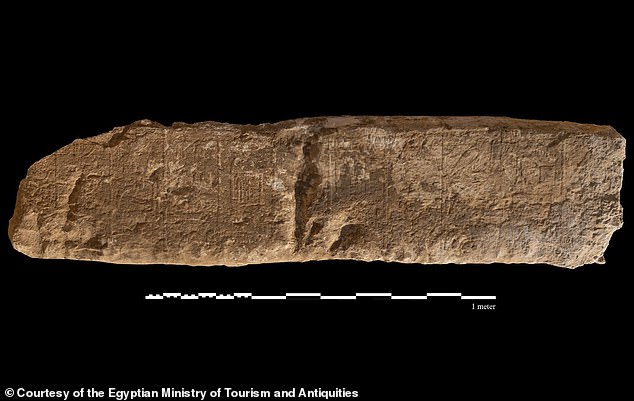
As per Egypt’s Ministry of Tourism and Antiquities, it featured a public schedule of religious festivities etched onto stones and a roof designed for celestial observation.
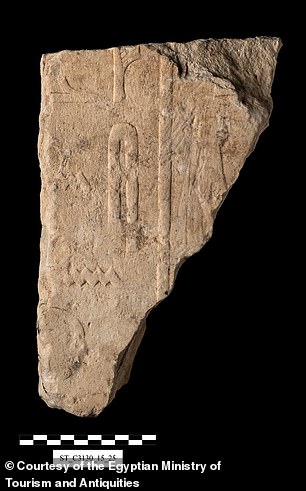
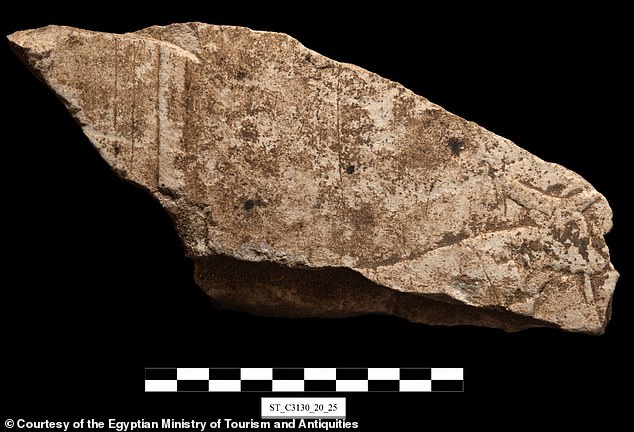
Images reveal various well-preserved components found at the location, such as wall pieces with hieroglyphs and pieces of pottery.
“With an original architectural design, it stands among the biggest and most notable temples in the valley,” the ministry stated in a translation.Facebook post.
Pieces of carved stone made from elegant white limestone have also been discovered, along with significant amounts of pottery.

The location was recognized as early as 1901 by the German archaeologist Ludwig Borchardt, although high groundwater levels prevented any excavations from taking place.
However, the most recent excavations, which began in 2024, have revealed over half of the temple, which had been hidden beneath layers of sediment, according to the ministry.
Operations at the site have uncovered the temple’s entrance, including the original entry floor and remnants of a circular granite column, possibly part of the entrance’s portico.
Some parts of the original stone covering on the corridor walls have also been discovered, along with several architectural components like granite tiles and doorways.
The mission has also found the remnants of an internal staircase that leads to the roof in the northern part of the temple – possibly a secondary entrance – and a slope thought to have connected the temple to the Nile or one of its tributaries.
“The upper part of the valley temple may have been utilized for celestial observations rather than for holding festivals,” said Massimiliano Nuzzolo, an archaeologist and co-director of the excavation.Live Science.
Meanwhile, the lower level served as a docking area for boats arriving from the Nile or, more probably, from one of its tributary channels.
The journey also uncovered a unique set of items, such as two wooden components from the ancient Egyptian game ‘Senet,’ which bear a resemblance to modern chess.
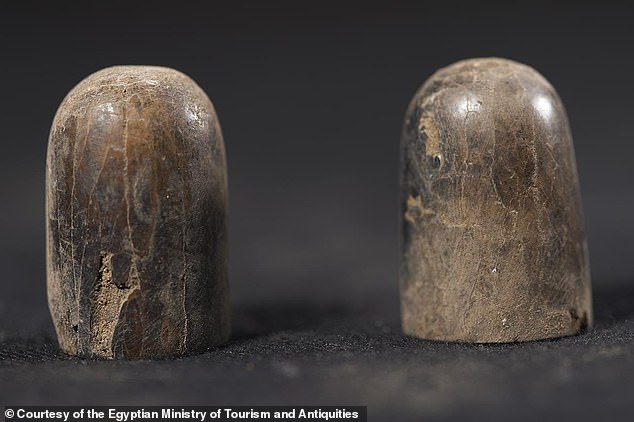

“The sanctuary therefore transformed into a residence, and one of the popular local [games] was likely playing senet,” Nuzzolo added.
Initial research suggests that the temple, following its function as a place of worship, was converted into a modest living space occupied by residents.
Additional digging at the location might uncover more details regarding its past prior to being covered by silt from the Nile.
“The mission is getting ready to carry on its activities in the upcoming seasons to investigate further aspects of this significant archaeological location,” the ministry statement noted.
Peeling back the curtain on new details [will] greatly enhance comprehension of the beginnings and development of the Sun Temples in ancient Egypt.
Famous for his dedication to the sun deity, Pharaoh Nyuserre Ini was the sixth among nine rulers who governed Egypt during the Fifth Dynasty, a period lasting approximately 150 years.
The rulers of the Fifth Dynasty strongly associated themselves with Ra, constructing temples to honor the god.
As per the beliefs of that era, Ra was considered the ruler of the gods and the originator of all existence, along with being the god responsible for the sun’s movements.
The Egyptians formed an agrarian society residing in a desert environment, which is why it’s no surprise that the sun – and consequently Ra – played a fundamental role in their worldview, influencing their beliefs and daily activities.
The people in this area depended on the sun, the Nile, and the fertile land near the river to provide them with food, including bread, beer, and vegetables.
Beer was not only a basic food for the living, but also ‘a representation of status and power,’ playing a significant role in elite banquets and burial ceremonies ‘in this life and the afterlife.’
It could have been “a thick porridge” – probably cloudy and sweet with minimal alcohol content – primarily crafted from wheat, barley, and grass.
- How did beer satisfy the thirst of ancient Egyptian laborers constructing the famous Great Pyramid?
- What ancient secrets can be found after the recent finding at Egypt’s Athribis temple?
- What method did a group of researchers use to determine the historical development of the Karnak Temple?
- Could this finding beneath Egypt’s pyramids significantly alter the history of the New Kingdom and its renowned rulers?
- Did the ancient Egyptians possess advanced hydraulic engineering skills 4,700 years ago to construct the earliest pyramid ever found?



 jasdooit
Leave a comment