
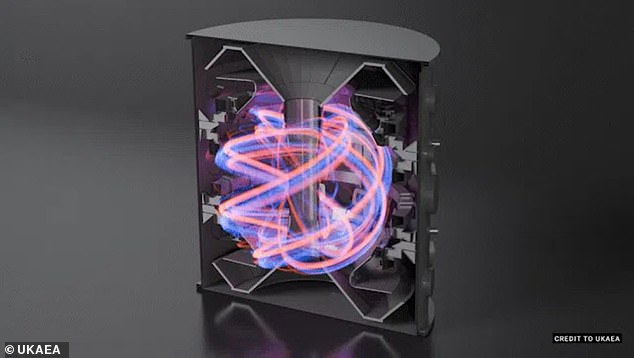
Near-instantaneous clean energy is one step closer to being a reality, after the recent advancement in nuclear fusion.
Researchers from the United Kingdom and Austria have created a novelAIa device capable of mimicking the heated plasma within a nuclear fusion reactor.
The device, called GyroSwin, performs computations in seconds that typically would require days on the world’s fastest supercomputers.
This may assist researchers in learning how to utilize the erratic strength of nuclear fusion and create the first operational reactors.
Fusion reactors mimic the procedures occurring in the core of the sun, where hydrogen atoms are forced together and combined into helium.
However, to generate a small star on Earthrequires heating plasma to approximately 100,000,000°C and maintaining its high temperature and densitysufficient for fusion to occur
As no substance can endure such high temperatures, the plasma is contained using strong magnetic fields within a donut-shaped apparatus called a tokamak.
Thanks to GyroSwin’s simulations, engineers should be capable of adjusting these magnetic fields to achieve a stable fusion reaction.
Nuclear fusion could provide a virtually limitless supply of clean energy, and scientists have previously referred to it as the ‘holy grail’.
There are two forms of hydrogen—deuterium and tritium—that serve as the sole fuel sources, with helium being the only byproduct.
This implies there are no accumulations of enduring radioactive waste or greenhouse gas emissions that could harm the environment.
The challenge lies in our ability to control some of the most erratic forces in the cosmos.
High-temperature plasma does not move in a tidy circle; it moves unpredictably, creating a phenomenon called turbulence.
Co-creator of GyroSwin, Dr. Fabian Paischer from Johannes Kepler University in Linz, stated to Daily Mail: ‘Plasma escapes from its magnetic confinement because of turbulence, which reduces its effectiveness for the fusion process.’
Because of this, nuclear fusion processes usually last for a very brief period.
In reality, the existing record for a continuous reaction holdsat just 43 seconds!
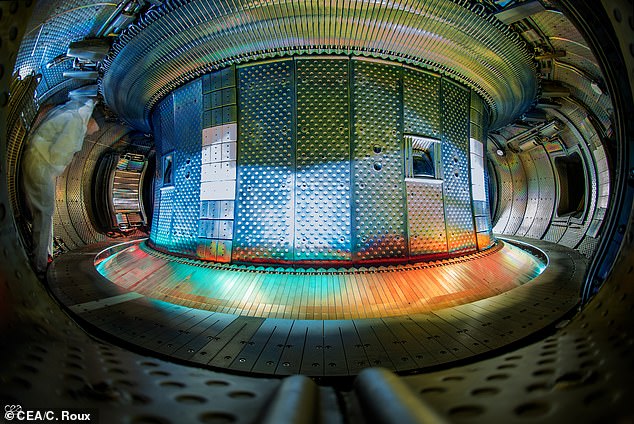
To sustain a fusion reaction continuously, researchers must develop highly precise models of turbulence development across various scenarios.
Due to the intricate nature of processes within a plasma, you cannot apply the same types of simulations used for forecasting weather or analyzing liquid flow.
The most advanced simulations currently monitor plasma particles across five dimensions: three for their position, one for their velocity, and another for their orientation concerning the magnetic field.
Nevertheless, these simulations require several days to finish, even when executed on the most powerful supercomputers available.
GyroSwin, created by the UK Atomic Energy Authority (UKAEA), Johannes Kepler University in Linz, and an Austrian company named Emmi AI, presents an alternative approach.
Researchers initially perform highly precise—though costly and time-consuming—simulations using conventional supercomputers.
The outcomes from these simulations are subsequently utilized to educate an artificial intelligence system, enabling it to develop the ability to forecast the nuanced connections between causes and their effects.
After the training is finished, GyroSwin can bypass the intricate computations and predict the results of simulations in seconds instead of days.
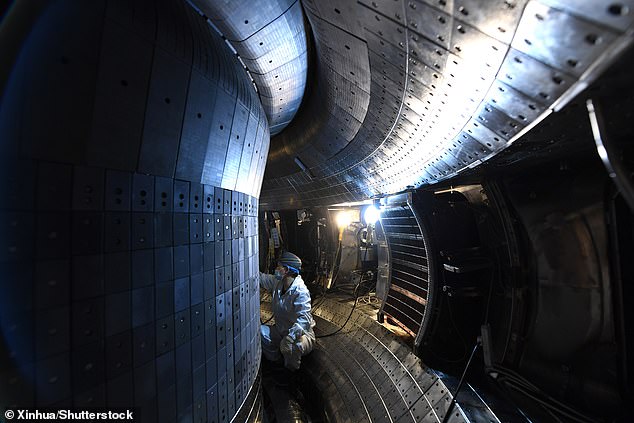
These kinds of ‘AI surrogate models’ are not novel, but what makes GyroSwin particularly intriguing is its impressive level of accuracy.
Dr. Paischer states: “GyroSwin is the initial model that truly captures the entire plasma turbulence in all its complexity and across various scales.”
Earlier methods focused solely on simulating turbulence in a simplified manner, which involved omitting crucial details to enhance prediction efficiency at the expense of precision.
Notably, the model is beginning to demonstrate indications of understanding the fundamental physics behind plasma turbulence.
Although the AI will continue to require conventional simulations to enhance its learning, it has the potential to accelerate the development of functional nuclear reactors.
Rob Akers, head of the Computing Programmes at UKAEA, stated to the Daily Mail: ‘The advancement of fusion is very repetitive, and reliable designs may necessitate a significant amount of simulations.’
Reducing turnaround time from days to seconds can significantly accelerate design cycles and “what if” analysis.
It won’t achieve fusion by itself, but it can significantly accelerate the engineering process – which is precisely what you require on the way to a functional fusion device.
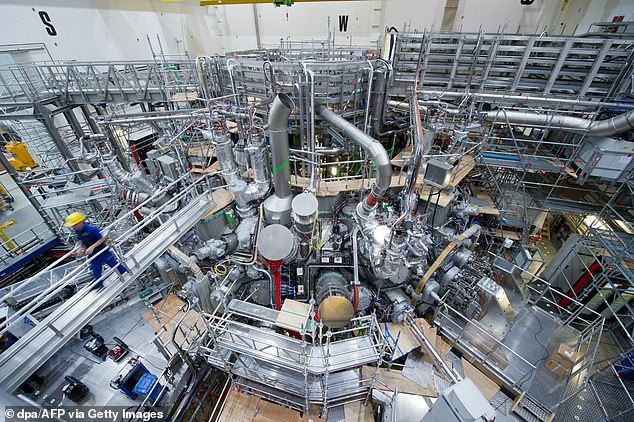
As it stands now, GyroSwin serves as a prototype, but the scientists intend to expand its capabilities for real-world applications.
The objective is to employ AI to assist in the operation of existing fusion reactors or those that will be constructed in the near future.
That might involve the MAST Upgrade experimental tokamak that is under construction near Oxford, or the UK’s leading STEP (Spherical Tokamak for Energy Production) initiative, which seeks to develop a working prototype reactor by the 2040s.
Even though a genuine, operational fusion reactor remains in the domain of science fiction, these essential advancements move it slightly nearer to becoming a reality.
- Is the significant £2.5 billion increase in funding for nuclear fusion research the breakthrough that experts have been hoping for in the UK’s journey toward clean energy?
- Has humanity come nearer than ever to utilizing the sun’s energy, due to groundbreaking developments in nuclear fusion technology?
- Can China’s pioneering nuclear fusion initiative surpass existing energy technologies by offering a source of secure, limitless power?
- Can Germany’s Wendelstein 7-X stellarator take the lead in transforming energy through nuclear fusion?
- Can Helion Energy surpass international competitors in the nuclear fusion competition and challenge established leaders with their bold ambitions?




 jasdooit
Leave a comment