
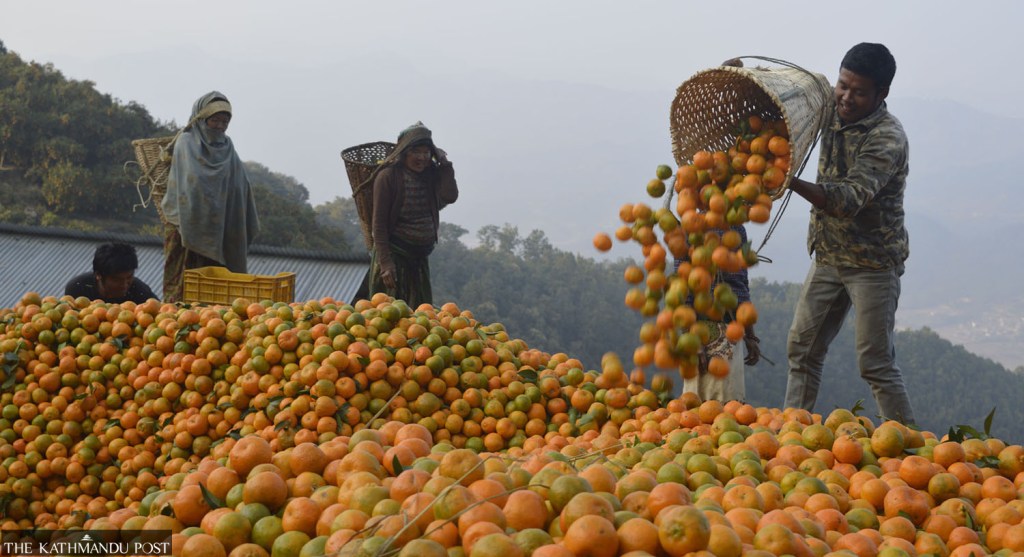
Arghakhanchi, Dec. 17 — In Panini rural municipality-1 of Arghakhanchi, the orchard owned by young farmer Revati Bhattarai has turned into a representation of how cultivating oranges commercially can transform lives.
His 535 orange trees are now producing fruit. Last year, he sold 170 quintals of oranges, resulting in a revenue of Rs900,000. This year, as new trees begin to yield fruit and older ones are heavily loaded, he expects production to potentially reach as high as 200 quintals.
The process of gathering has started, as fully matured yellow oranges are being harvested and transported to the market.
A trader from Butwal, Jivalal Pandey, had reserved Bhattarai’s orchard prior to the fruits reaching full maturity.
Our task is to generate output. Traders arrive at our door as soon as the green fruits become visible and reserve the trees,” Bhattarai stated. “After the orchard is reserved, our duty is to look after the trees and safeguard the fruits. We intend to harvest them in crates from mid-January, although some fruits have already been delivered to the market.
Following the harvest, the oranges are placed into crates and taken by truck to Butwal by the same merchants. The cost is discussed when the fruit is picked. Last year, oranges were sold for Rs60 per kilogram in retail shops; this year, the price has increased to Rs70.
After finishing Grade 12, Bhattarai worked for a few years abroad. He came back home ten years ago and started growing oranges on land that previously used to cultivate grain.
Motivated by a stable market, he progressively transformed all his farmland into orange groves. Earnings from oranges have allowed him to construct a two-and-a-half-story concrete house in Simle.
More than working abroad, growing oranges transformed my life,” he said. “There’s no worry about unsold crops. Traders reserve the trees while the fruits are still green, so I don’t have to chase after markets.
Dadhi Ram Gautam, a former agricultural technician, has been focused on growing oranges at his home for the last five years.
His yearly earnings from oranges are three times his pension amount. Nearly all of his 250 fruit-producing trees have already been reserved, leaving just four or five trees for home use and visitors.
Traders from Butwal, Palpa, and Pokhara visit my home directly to examine and purchase the oranges,” he stated. “They use their own vehicles to transport the oranges. There is no requirement to sell on credit.
After being collected, oranges are categorized and placed into boxes according to their size—large, medium, and small—each group having a distinct value.
Merchants frequently buy full trees or entire orchards under agreement.
Chandrakant Paudel, the ward chair of Panini-2, oversees his orange farm while handling his official responsibilities.
The traders have already reserved his orchard.
Production has gone up in comparison to the previous year,” he stated. “There was no hailstorm, and pests and diseases did not affect the trees. Revenue is expected to be greater this year.
Of the 600 trees, approximately 350 are producing fruit and are heavily loaded. Paudel is currently waiting for the optimal time to harvest while monitoring possible prices.
In Panini-1’s Sallery Tole, nearly every home maintains an orange grove. With rising demand and higher incomes, farmers shifted away from grain crops and began cultivating oranges in their fields.
To manage agricultural activities and gather assistance, they established the Pakhapani Farmers’ Group. Among the 45 households that grow oranges, 30 are part of this group. Tuk Bahadur Darlami, the biggest orange producer in the village, made Rs350,000 last year from 150 fruit-bearing trees.
Darlami, who is also a ward member, stated, ‘Orange cultivation is a dependable agricultural venture that offers steady income. Our entire Salleri village has become an orange center. Oranges have ensured our farmlands remain productive, and there is little migration from the village.’
Certain agriculturalists are tending to young trees in preparation for upcoming harvests.
When the entire village turns golden from the ripening oranges, it appears stunning and vibrant,” Darlami said. “This year, without any hailstorms or pest infestations, the trees are heavily loaded.
Merchants from Butwal have already concluded an agreement to purchase from the orchards, he mentioned.
Through the agricultural collective, farmers consistently gather to exchange ideas on planting methods, orchard maintenance, fertilization, and strategies for growing bigger fruits.
Last year, the Agriculture Knowledge Centre assisted in building two water tanks, each capable of holding 1,500 liters, which are currently utilized for irrigation.
Additional tanks are planned. According to farmers, oranges provide significant profits when given appropriate care and nourishment. Revenue generated from orange cultivation has simplified the management of family expenses, enabled children’s education, and facilitated improvements in homes and livestock shelters.
Another young farmer, Bishnu Bhattarai, mentioned that oranges have started to mature this season, with production looking favorable, boosting expectations that revenue will exceed last year’s figures.
Panini-1, Simle is the biggest region for orange cultivation in the area.
Observing the significant earnings of Simle farmers, cultivators from nearby villages have also increased their orange farming activities. Every year, Simle alone produces over Rs30 million from orange sales. This season, the orchards throughout the region are once again covered in bright yellow ripe fruits.
Sharda Acharya, a technician at the Agriculture Knowledge Centre, mentioned that large-scale orange cultivation is growing in Simle, as well as in Pokharathok, Khidim, Panena, Maidan, Mareng, Bhagwati, Arghatosh, Khandaha, and Hanspur Sakindhara villages.
She mentioned that this year’s robust output has the potential to greatly boost economic activity in these regions.



 jasdooit
Leave a comment