
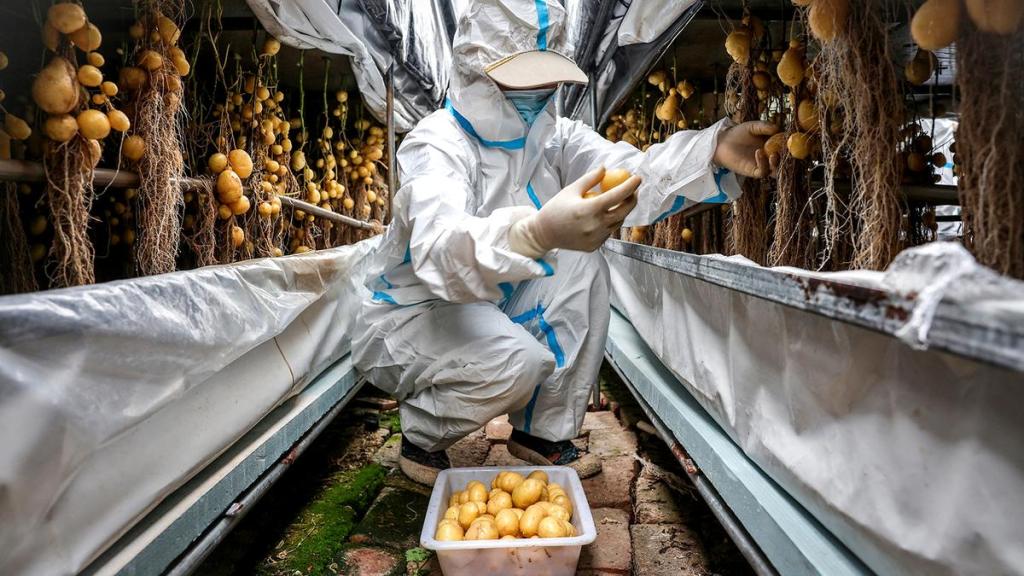
Researchers at the Potato Research Institute (PRI) in Sahiwal are striving to create potato varieties that can endure smoggy and foggy environments. As per the Punjab Agriculture Department, potatoes are grown on almost one million acres within the province, yielding approximately nine million tons annually. Nevertheless, evolving climate conditions and increasing smog levels have started to impact crop yields significantly. ‘Smog and frost are very harmful to potato growth. We are currently developing several smog-resistant potato lines to tackle the drop in productivity,’ Dr. Syed Ijazul Hassan, Director of the Potato Research Institute Sahiwal, mentioned to Wealth Pakistan. He pointed out that various factors, such as rising temperatures, changing rainfall patterns, and limited water supply, have led to decreased potato production. Smog, he added, hinders photosynthesis, facilitates the spread of diseases like blight, and reduces the overall quality of tubers. Additional diseases affecting potato crops in Punjab include Potato Leafroll Virus (PLRV), Potato Virus Y (PVY), mosaic virus, early blight, brown leaf spot, Rhizoctonia, common scab, and black leg.
Dr. Ijazul Hassan mentioned that PRI has already created 12 potato varieties that are resistant to fog and produce high yields, and is currently working on developing lines that can withstand smog.
Locally created types include PRI-Red, Ruby, Sadaf, Sahiwal Red, Sahiwal White, Ravi, Punjab, Sutlej, Kashmir, Sialkot Red, Ijaz-22, and Cosmo.
Among the seed varieties currently utilized by farmers are Constance, Kuroda, Esmee, Rudolph, Alouette, Emanuelle, Fabula, Felsina (for frying), Franceline, Frisia, Sababa, Alverstone Russet, Hermosa, Allison, Desiree, Cardinal, and Diamant.
“Among locally grown types, Ijaz-22 is a potato variety designed to handle smog, and it has effectively survived the smoggy environment in Punjab,” said the PRI director.
He mentioned that PRI generated 60,000 kilograms (60 tonnes) of potato seed this year, with 4,550 kilograms (4.55 tonnes) given out to farmers. Nevertheless, the lack of quality-certified local seed in large quantities continues to be a significant issue, leading farmers to depend mostly on expensive imported seed and increasing their production costs.
Dr. Ijazul Hassan also emphasized that the use of integrated pest management and the encouragement of sustainable farming methods could assist in minimizing the negative impacts of smog on potato crops.
Vice Chairman of the Potato Growers Cooperative Society, Chaudhary Maqsood Ahmad Jatt, informed Wealth Pakistan that the majority of potato seeds are brought in from the Netherlands, leading to higher costs for farming. He further mentioned that the halt in trade between Pakistan and Afghanistan has significantly affected potato exports. “Cold storage units are overflowing with potatoes, and the new harvest is already available in the market,” he stated.
Jatt mentioned that Pakistan has the potential to export potatoes to a minimum of 37 countries, noting that China might serve as a significant market for Pakistani potatoes from January to April.
He highlighted the importance of increasing value, suggesting that potatoes should be exported in processed forms like powder, starch, and chips, to avoid excess supply, maintain stable prices, and minimize losses for farmers.
Provided by SyndiGate Media Inc.Syndigate.info).



 jasdooit
Leave a comment