
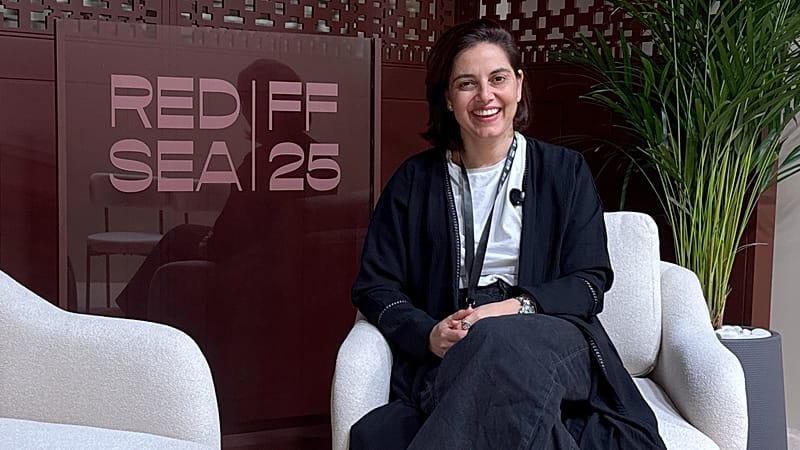
Female filmmakers from the Arab world have played a significant role in reshaping the Arab film industry in recent years, bringing forth narratives that were previously untold and establishing their presence in an industry where women often face limited opportunities for development.
Four prominent female filmmakers participated in this year’s Red Sea Film Festival in Jeddah, contributing to a broader range of stories in Arab cinema.
The event, which unites 38 directors, highlights Saudi Arabia’s significant financial commitment to film, gaming, and sports as part of its larger reform initiatives. Certain advocacy organizations have questioned these moves, arguing that they aim to divert focus from the country’s human rights issues, such as its elevated execution rate and limitations on free speech.
Cherien Dabis
Palestinian-American director Cherien Dabis introduced her latest movie, “All That’s Left of You,” which presents a multi-generational narrative following one family’s journey from the 1948 Nakba, meaning “catastrophe” in Arabic, the large-scale expulsion of Palestinians before and during the Arab-Israeli conflict that emerged after Israel’s creation, up to the year 2022. The film explores themes of Palestinian displacement and individual sorrow.
It recounts the tale of a single family across three generations and their struggle during the Nakba in 1948 and the continuing occupation,” she stated. “It provides people with background on how we arrived at our current situation and illustrates the hardships Palestinians have faced over the years.
Dabis, who was born and raised in the United States by Palestinian-Jordanian parents, mentioned that her drive and inspiration to become a filmmaker came from the absence of genuine Arab and Palestinian representation in Western media. “I realized I wanted to enter the world of storytelling to share our true stories, because we weren’t visible anywhere,” she stated.
She mentioned that growing up in the United States provided more career opportunities in film compared to the Arab world, yet the racism her family encountered strengthened her determination to combat negative stereotypes. “My time in the diaspora is truly what inspired me to become a storyteller,” she stated.
Yet she continued to face challenges in being regarded with seriousness, experiencing pressure to use a more dominant, perhaps more masculine style to challenge stereotypes about female directors. “There is this perception of women filmmakers as excessively emotional or incapable of leading a set,” she mentioned. “Many of us felt we needed to fight against these unjust notions.”
The movie “All That’s Left of You” received the Silver Yusr Feature Film award, accompanied by a $30,000 prize, at the Red Sea Film Festival.
Shahad Ameen
Saudi filmmaker Shahad Ameen stood out as a prominent voice at this year’s festival. Her new film, “Hijra,” received the Yusr Jury Prize, representing another significant achievement in her professional journey.
“The Hijra” recounts the tale of three women — a grandmother and her two granddaughters — as they travel from Taif to Mecca to carry out the Hajj, the Islamic pilgrimage. When one of the granddaughters vanishes unexpectedly in the desert, the movie traces the quest for her throughout southern Saudi Arabia.
Ameen’s love for filmmaking began in her early years, influenced by the historical TV series that once filled Arab television. “I believed that as Arabs, we should express our own stories, rather than letting others tell them for us,” she mentioned.
Ameen stated that the transformations occurring in Saudi Arabia and the expansion of the Red Sea Film Festival have significantly influenced her path in filmmaking. “Ten years ago, we couldn’t have imagined this,” she mentioned, referring to the festival as a pivotal moment for cinema in the country.
She mentioned that filmmaking continues to be an unpredictable journey for Arab women, requiring ongoing determination without any assurance of achievement. “Each film is a fresh start,” she stated, highlighting that directors must continually persuade investors, film festivals, and viewers about their creative perspective.
Amira Diab
Amira Diab’s path to filmmaking was unconventional. Previously working as a financial investment professional in Manhattan, she discovered her passion after viewing “Omar,” the Oscar-nominated film directed by Palestinian filmmaker Hany Abu-Assad — who eventually became her husband. The movie, along with their relationship, drew her into the film industry.
Diab continued her education in film production in Los Angeles, serving as a producer alongside Abu-Assad. She directed two short films and worked with her husband on a television series. A significant milestone in her career was the short film “As a Husband,” which was included in the Netflix collection “Love, Life, and What’s Between.”
The movie deeply touched viewers by portraying the emotional complexity of life in the Palestinian territories. “People told me they saw a lot of themselves in it. That’s how life is in Palestine — joy transforms into sorrow, and then back into joy. Yet there’s always a spark of hope,” she mentioned.
Diab’s film “Wedding Rehearsal” initially started as a narrative set in the Palestinian territories but later shifted to Egypt — a choice she believed broadened the story’s cultural impact. “Egypt has a very rich and varied social structure,” she mentioned. “I collaborated with wonderful individuals like Nelly Karim and Sherif Salama. Egypt truly welcomed me.”
Despite her background in Hollywood, Diab continues to focus on sharing Arab stories that highlight the perspectives of women. “Of course, women perceive the world in their own way. That’s why our voices are important,” she stated. “However, it doesn’t imply that men can’t write about women — it simply means that some emotional elements can only be fully captured by women on screen.”
Zain Duraie
Zain Duraie mentioned that her interest in filmmaking started when she was 10 years old, watching “Titanic” with her father in Amman, Jordan. She was more drawn to the depiction of the ship’s sinking — the way the movie was created — rather than the romantic storyline. This initial fascination grew into a passion that was developed through school theater and eventually honed at the Toronto Film School.
At the Red Sea International Film Festival, Zain unveiled her debut feature film, “Sink,” which explores the challenges of a mother dealing with her son’s mental illness, a theme rarely addressed in Arab cinema.
Duraie began her professional journey at the ground level, accepting any position she could get, including production assistant, assistant director, and producer, before eventually directing her own movies. “I used to carry heavy gear up mountains,” she remembered. “People would say, ‘This isn’t a woman’s job,’” but that only motivated her more. “I worked in every aspect of filmmaking. I wanted to master it all.”
Duraie is recognized for addressing profoundly personal and societal issues, particularly concerning mental health and the female perspective. “I enjoy working within the psychology of drama, and I aim to share stories about women — while also challenging stereotypes,” she mentioned. She noted that Arab cinema has not yet reached a stage regarding gender inclusivity.




 jasdooit
Leave a comment