
MUJI (無印良品, hereinafter referred to as MUJI), born as a private brand (PB) in 1980, opened its first store measuring 103 m² (approximately 31 pyeong) in Aoyama, Tokyo, in 1983. By the fiscal year ending August 31 of last year (September 1, 2024–August 31, 2025), it grew into a company with sales of 784.6 billion yen (approximately 7.4 trillion Korean won) and ordinary profit of 72.3 billion yen.
For a business to expand, simply boosting sales of current products has its boundaries. New product creation and entering new markets are the two main drivers of growth. MUJI’s track record in developing new products is fascinating. In 2001, it partnered with Nissan to launch a special edition ‘MUJI car.’ Starting from 2004, it started offering homes that embody its values, like the ‘Tree House’ and ‘Sunlight House.’ In 2019, it introduced the MUJI Hotel in Ginza. It spans floors 6–10 of a structure that includes a basement and 10 levels above ground. The basement contains a MUJI restaurant, while floors 1–5 are MUJI shops. Although the building has an official name, it is commonly referred to as the ‘Ginza MUJI Building.’
Entering new markets also involves different phases. Selling products, setting up manufacturing facilities, and opening retail locations can be likened to climbing a local hill, Bukhansan Mountain, and Mount Everest, respectively. MUJI’s international sales make up 40% of its overall revenue. It operates 729 stores abroad, surpassing the 683 stores it has in Japan. Although manufacturing sites can be set up by taking into account labor costs and political factors, running stores is a different challenge. Without generating local interest and establishing brand loyalty, it is impossible to survive.
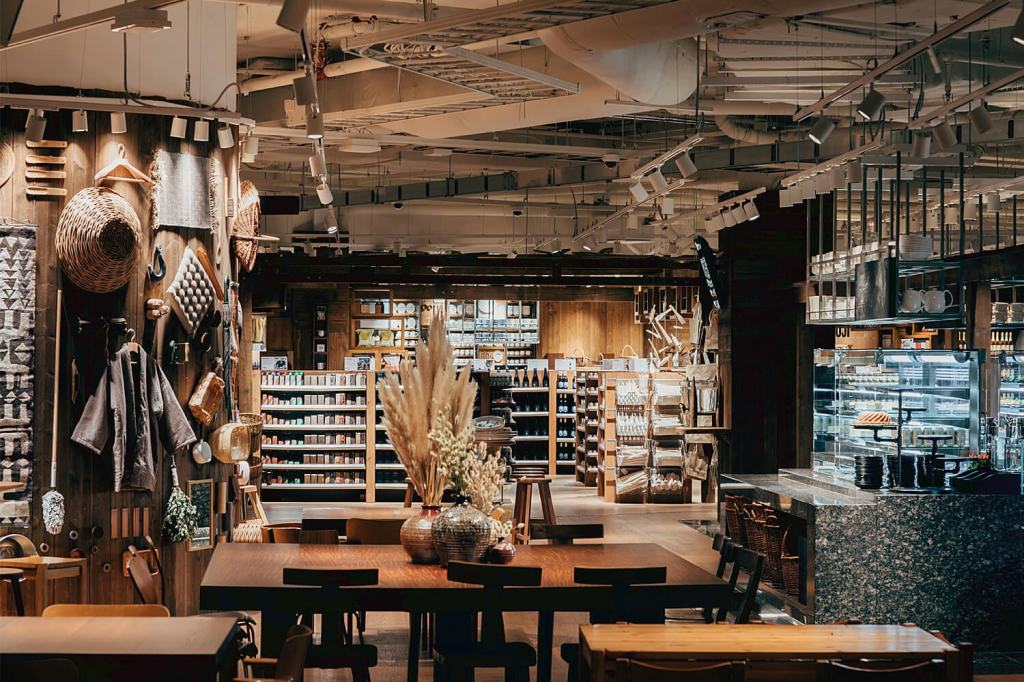
MUJI has broadened its reach across Europe, North America, and other areas. Let’s look at its biggest store in Europe, MUJI Kamppi Helsinki. MUJI opened ‘MUJI Kamppi Helsinki’ in November 2019 in Helsinki, the capital of Finland. Covering an area of 3,600 square meters, it is the largest one in Europe. The entire fourth floor of the Kamppi Shopping Center was converted into a MUJI store. Why did MUJI select Finland for its largest European location? In 2017, MUJI was invited to the biggest Nordic interior and design exhibition and ran a temporary pop-up shop, which made them realize the strong connection between the MUJI brand and Finland.
What are the store’s characteristics? Firstly, it strongly integrated Finland’s features into its design. As roughly 70% of Finland’s territory is forested, people living in cities still have a strong connection to nature. MUJI utilized plenty of wood in the interior and added columns and beams inspired by the architecture of cabins frequently found in the suburbs of Helsinki, forming a space that feels welcoming to locals.
Second, it made use of locally sourced Finnish products and ingredients. The food section and dining area highlight ingredients that follow the theme of “local production for local consumption,” carefully chosen from approximately 100 Finnish companies and farms. Third, it merged Finnish and Japanese culinary traditions. At the restaurant ‘MUJI Ravintola’ (Ravintola translates to restaurant in Finnish), Japanese-style home-cooked meals are available for about 16 euros. Considering the high costs in Northern Europe, this is considered affordable, drawing in many Finns. A Finnish chef and a Japanese consultant worked together to develop “Japanese home-style meals using Finnish ingredients.”
The main attraction is an area dedicated to Japanese culture. A video is shown on one side of the escalator connecting the third and fourth floors, featuring Kiyomizu-dera Temple in Kyoto surrounded by stunning autumn foliage, followed by the MUJI Kyoto store. It then presents the vibrant night view of Tokyo Tower and introduces the MUJI Tokyo store. By highlighting Japan’s popular tourist attractions and their local stores, it encourages a favorable interest in Japan.
MUJI created the Helsinki store as a venue for ‘localizing space, localizing supply, and sharing cultural stories.’ When talking about international growth, we usually focus on exports and manufacturing first. However, the true difficulty is the ‘Mount Everest’—retail stores. If businesses don’t become part of the local community, they depend on sales and special offers to stay afloat. It’s time to think: which mountain are we currently tackling, and do we have the plan and endurance to reach the summit?


 jasdooit
Leave a comment