

A beloved star, she once admitted that her fame was accompanied by a deep sense of isolation. A natural performer who accomplished much on stage but constantly sought new challenges. Yoon Seok-hwa (69), known for her roles in “Agnes of God” and “The Last Empress,” passed away on the 19th at 9:54 a.m. at Seoul Sinchon Severance Hospital, where she had been receiving treatment for a brain tumor following surgery, with her family by her side.
She fainted during a business trip to the UK in October 2022 following a performance in the play “Hamlet.” She was diagnosed with a brain tumor and had three significant surgeries in Seoul. The chemotherapy was extremely painful, even for her resilient spirit. Eventually, she turned to alternative treatments, stating, “It’s crucial to live as myself for at least one day,” but she never regained her health after battling for three years.
In August 2023, she had a short appearance in the play “Toccata,” which celebrated the 60th anniversary of actress Son Suk. She portrayed an elderly woman sitting on a park bench for roughly five minutes. She was wearing a cap on her short hair and was seen flipping through a book. With assistance, she went to the curtain call stage and smiled warmly, stating, “I’m healthy once the cancer is removed.” “Let me say it loudly: Sister, I love you!” She then exited the stage in Son Suk’s embrace. This marked her last performance.
◇A Stage Performance as a “Prodigy Girl”
Born in Seoul in 1956, she initially became well-known for her distinct voice in commercial jingles such as “Oran C” and “Bravo Cone.” In the early spring of 1975, she met members of the People’s Theater Group at the studio of music critic Lee Baek-cheon, a place where she frequently went for recording sessions. Lee Hyo-young, the group’s leader and a radio host, asked, “Would you like to become a performer?” “I don’t want to be a performer, but a theater actress,” she responded. This statement marked the beginning of her journey. That same year, she made her stage debut as the lead in the play “The Taste of Honey” at the Namsan Drama Center. Playwright Lee Geun-sam described her as “the emergence of a gifted young woman.”
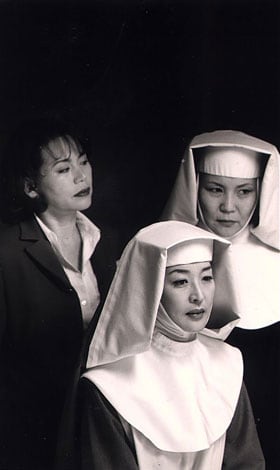
She spent many long days as the youngest member of the theater group, handing out flyers at sunrise, putting up posters, and even getting taken to the police station. In 1983, the play “Agnes of God,” in which she played a leading role, created a big stir. By the time it reached 170 performances, 30,000 people had come to watch it. It was a miracle of small theater that turned her into a star and made her beloved by everyone.
During the 1980s and 1990s, when theater was seen as a symbol of intellectual achievement, she remained at the forefront. Works such as “Duet for One” (1988), “Voice” (1989), “Letter to My Daughter” (1992), “Master Class” (1998), and the musicals “Guys and Dolls” (1994) and “The Last Empress” (1995) solidified her widespread fame. The name Yoon Seok-hwa came to represent a “surefire success.”
She once remarked, “After ‘Agnes,’ the term ‘star’ was associated with me, and that made me sad. The more luxurious it became, the more isolated I felt. There were days when I felt as if I were in paradise for performing well, and the next day, I was in torment for not achieving enough.”
At the age of 60, she portrayed Ophelia, Hamlet’s young lover, in the 2016 performance. On stage, she remained ever youthful, untouched by the passage of time. For her, theater was “a stronghold of truth constructed on imaginary ground.” She described the stage as “a truthful space where you can’t redo errors or only show the appealing sections,” and “my own territory and world where I can breathe freely and conceal my deepest secrets.”
◇”The Honest Theater Stage, My Universe”
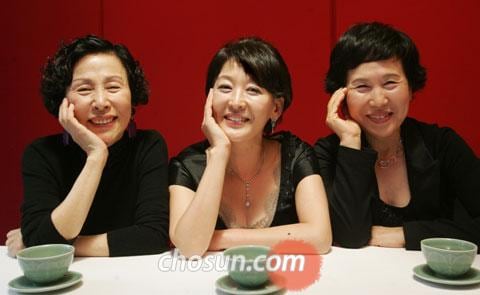
In her 50s, she encountered a major crisis. In 2007, she was involved in a controversy regarding the fabrication of her academic credentials as an “Ewha Womans University graduate” from her younger years. She repeatedly apologized, stating, “I am truly sorry.” “At one point, I attempted to jump off the Han River Bridge and even went up to the top of a 20-story building.” A foreign actress’s words, “I won’t die before my time,” became her guiding principle. “Who can live without wounds? I don’t wish for my life to be a torment while I’m still alive. The way to deal with wounds is not through confrontation or resentment, but by letting go.”
Every time she felt herself slipping, the theater stage and the audience she encountered there would lift her once more. “What kept me going was always the gaze and breathing of the audience. I came to realize that the audience’s ‘vitality’ is truth and love. That truth and love were the most valuable life lessons I gained as an actor, the lifeline that kept me on this journey.”
When questioned about her involvement in theater, she frequently cited a quote from “Master Class,” a drama depicting the intense life of Maria Callas: “The world will continue without us. However, we have transformed this world into a more enriched and knowledgeable place than it would be without art.”
◇Director, Producer, Publisher of “Auditorium”…
Although she had a lengthy acting career, she only appeared in a limited number of films and dramas, including the movie “Spring, Snow” (2012) and the drama “The Miracle We Met” (2018), reflecting her strong passion for theater. In order to develop effective theater criticism, she worked as the publisher of the performing arts magazine “Auditorium” for seven years, starting in 1999. Throughout her time in this role, the magazine once sold more than 30,000 copies.
She also contributed to establishing small theaters, directing, and producing plays for emerging theater artists. The small theater “Jeongmiso,” which opened in Daehakro, Seoul, in 2002, became a center for experimental theater. Directors Yang Jung-woong and actors Park Hae-soo and Jeon Mi-do, along with other notable figures, developed new plays without financial concerns on the stage she established. It operated for 17 years and was celebrated by theater enthusiasts as “a place more beautiful than Paris’s Pompidou Center.”
In 2003, she directed the musical “Saturday Night Fever.” She moved to the UK and became the first Korean individual to produce a West End musical, “Top Hat,” and in May 2013, she walked the red carpet as a co-producer when it received the esteemed Laurence Olivier Award. In 1995, she established the entertainment firm Dolkkot Company and was involved in producing the animated film “Hong Gil-dong 95.”
◇ Took in a Son and Daughter… Initiated Welfare Programs for Theater Professionals
The late actress, who took in a son and a daughter, strongly advocated for adoption by organizing charity events to collect money. As the leader of the Theater Artists Welfare Foundation, she worked tirelessly to assist struggling theater performers with medical and housing expenses, as well as provide educational opportunities for their children.
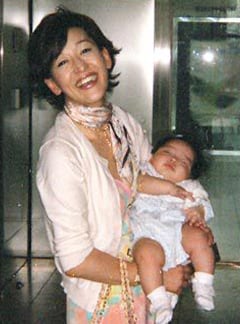
In late autumn 2020, during the COVID-19 pandemic, she remarked, “Theater is an art that exists in the present, leaving nothing behind and offering no particular benefits, yet the emotions and warmth shared are the most valuable rewards for artists.” “I returned to the stage 20 days after a car accident. I had six broken ribs, and the doctor warned me, ‘You could die on stage like that.’ But I still went on. I thought, ‘If I can die on stage, that would also be a form of happiness.’” Very few actors could express such heartfelt and solitary words with the same level of genuine emotion as Yoon Seok-hwa.
In 2021, while directing the play “Harold and Maude” featuring Park Jung-ja, she remarked, “Each time I performed, I felt like fleeing, but when I connected with the audience, I thought, ‘I’m glad I crossed this river.’” Now, she has successfully navigated that river before others, creating a divine stage by collaborating with both senior and junior theater artists who came before her.
She was honored with the Lee Hae-rang Theater Award in 1998. She has received numerous top acting accolades, such as the Baeksang Arts Award on four occasions, the Dong-A Theater Award, and the Seoul Theater Festival Award. In 2005, she was presented with the Presidential Citation, and in 2009, she received the Korea Culture and Arts Award.
The funeral ceremony is scheduled to take place in Room 1, the Special Funeral Hall, at Seoul Sinchon Severance Hospital. Attendees include the husband, Kim Seok-ki, who previously served as the head of Jungang Comprehensive Finance; their son, Kim Soo-min; and their daughter, Kim Soo-hwa. The funeral procession will begin at 9 a.m. on the 21st.
◇Confusion Regarding “Death on the 18th”
Earlier, on the night of the 18th, friends of the actress went to the hospital to offer their final condolences, and it was reported that the family was getting ready for the funeral. Some theater-related groups sent messages and issued press statements saying, “Actress Yoon Seok-hwa died at 9 p.m. on the 18th,” which were then covered by media. The Korea Theater Actors Association later released a statement apologizing to the family and withdrawing the earlier announcement, leading to confusion.


 jasdooit
Leave a comment