
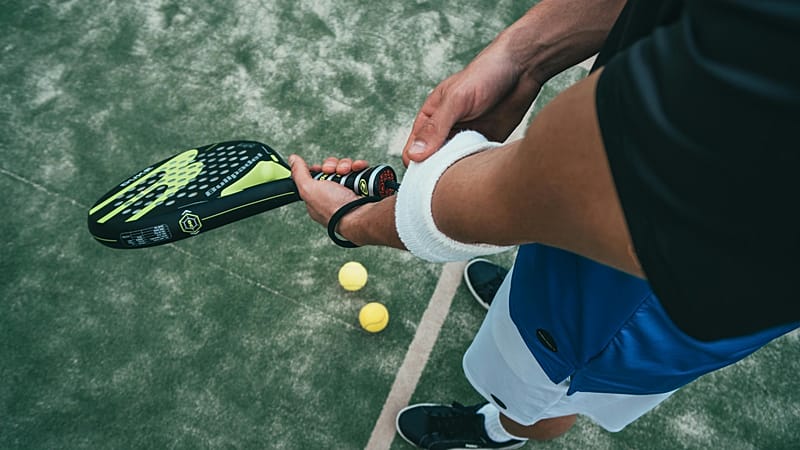
Initially a niche activity conducted behind glass enclosures, padel is now experiencing rapid growth. New clubs are emerging quickly, and the sport has become well-established in approximately 90 countries.
The popularity of the rapidly expanding racquet sport stems from its ease of play, availability, and the communal aspect of the game. Typically played in doubles on a small, glass-walled court, padel maintains continuous rallies and keeps participants actively involved—regardless of their experience level, from experienced players to total newcomers.
That’s evident inside an indoor padel club in southern Spain. By 10 AM on a weekday, the place is already lively. Francis Calvache, a padel instructor and the top-ranked player in Almería province, states that the sport’s worldwide growth comes as no surprise.
It’s quite simple to move the ball from one side of the court to the other. Additionally, since there are walls, the ball can bounce back, giving you a chance to retain it, which isn’t always the case in tennis.
Where did padel originate?
Padel originated in the sunny city of Acapulco, Mexico, during the late 1960s. A wealthy man named Enrique Corcuera came up with the idea out of frustration. He loved tennis but didn’t have enough space to construct a proper court on his land.
Resolute in his desire to partake in the game, he devised the concept of building a reduced-sized court enclosed by walls to ensure the ball remained in play.
Alfonso de Hohenlohe-Langenburg, a Spanish acquaintance of Corcuera, had the chance to test the latest padel creation at Enrique’s house and became immediately addicted to the game.
Drawing from his personal experiences, Alfonso took the lead in creating the first two padel courts at a tennis club inMarbella, Spain, in 1974. It soon became popular in Spain and other Spanish-speaking nations such as Argentina and Uruguay.
From that point, the sport gradually became a part of Spanish culture – and particularly in Andalusia, where padel transitioned from exclusive clubs to public parks, apartment complexes, and daily activities.
The nation currently leads the professional scene: seven of the top ten male players globally are from Spain, as reported by the International Padel Federation (FIP).
A sport for everyone
Beyond the energy of indoor clubs, there is another aspect to padel’s growing appeal. In the coastal town of San José, a group of local women have recently started playing the sport, gathering on Friday mornings for relaxed matches on an outdoor public court.
None of them has received structured training, yet rallies come naturally and laughter frequently breaks in during the game.
For María Jesus, the game stirs up memories from her childhood: “It’s very similar to when I played bat and ball on the beach. It reminds me of that, and it’s a wonderful memory for me,” she mentions. “It really takes me back to those beach moments with my family during the summer.”
Padel has emerged as one of the fastest-rising sports globally, with tens of millions of participants spread across over 130 countries, as reported by national associations and industry sources.
In addition to being simple to implement, local governments in numerous nations have become more encouraging, as a padel court is less expensive to maintain than a tennis court. Private venues have also adopted the sport since they generate higher revenue by having more individuals rent the same area for an hour or more.
FIP states that the sport has grown quickly outside its usual centers in Spain and Argentina, showing significant development throughout Europe, the Middle East, and the Americas.
Only in the UK, over 400,000 individuals participated in padel at least once during 2025, according to the Lawn Tennis Association – showing a significant increase compared to the previous year.
A game that originated due to space constraints is now gaining popularity effortlessly.




 jasdooit
Leave a comment