
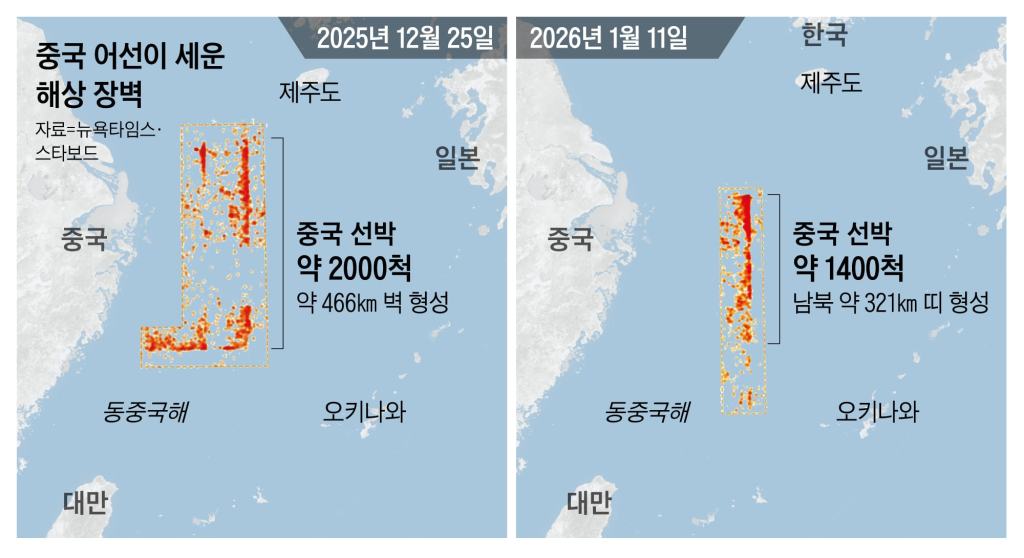
The New York Times (NYT) stated on the 16th that in the last month, China has assembled thousands of fishing boats twice in the same region of the East China Sea, forming a “maritime barrier” that extends as far as 466 kilometers. It is understood that China has planned this large-scale maritime barrier as a strategy to isolate Taiwan in case of an armed confrontation with the island.
The New York Times examined vessel location data provided by the marine information firm Starboard and noted that on the 11th, roughly 1,400 Chinese ships created a rectangular-shaped line stretching approximately 321 kilometers from north to south in the East China Sea. The arrangement was so thick that some cargo ships were seen taking alternative routes around the “strip” or moving in a zigzag pattern through it. The NYT also mentioned that during last Christmas, more than 2,000 vessels assembled in the same region to create an “L”-shaped “barrier,” with the structure extending 466 kilometers in length at that time.
The New York Times stated, “A fishing fleet of this size and organization is unheard of,” and proposed, “It might be a training exercise for a maritime militia that appears as civilians during peace but can be used in military actions during emergencies.” Western specialists think that China is setting up a maritime militia that can be quickly used in military operations and is evaluating its abilities.
Gregory Poling, head of the Center for Strategic and International Studies (CSIS) in Washington, D.C., stated to the New York Times, “The Chinese ships seen in satellite images did not seem to be involved in fishing, and their actions are hard to explain without government involvement.” He further mentioned, “This might be a training scenario simulating a situation that could lead to isolation, blockading, and different pressure methods aimed at Taiwan in the future.”
In reality, the two occurrences of Chinese ships gathering aligned with the time when the Chinese military carried out military drills near Taiwan at the end of last month. Specialists are especially highlighting that the sea blockades were consistently established in the East China Sea, near significant shipping routes that extend from Shanghai. According to analysis, China has developed specific situations, including establishing maritime routes to manage during emergencies.
Although specialists believe it would be challenging for China to enforce a “total blockade” of Taiwan using solely fishing boats, they recognize that extensive mobilization could act as a supporting method to improve the success of blockade efforts. When numerous small vessels gather simultaneously, sea lanes become crowded, limiting the movement of Taiwanese naval ships and supply routes. A sudden increase in targets might cause radar and drone sensors to nearly overload, diminishing the precision of monitoring and communication systems.
In some scenarios, there are talks about fishing boats serving as “bait” to attract missiles and torpedoes, thus diverting defensive efforts. According to certain analyses, as China enhances this “gray zone” strategy—employing civilian ships to reduce expenses and create strategic uncertainty—the reaction from nearby nations may grow more complex.


 jasdooit
Leave a comment